
Last Updated: October 27, 2026
Quick Summary
To vet a plumbing contractor, check the state license database, confirm insurance directly with the insurer, and compare itemized written estimates. Ask job-specific questions, call references, and watch for red flags like cash-only demands or pressure to decide immediately.
- Search the state licensing database by license number or business name and save a record of what you find.
- Call the insurer using independently verified contact information to confirm the policy is active.
- Ask for itemized estimates that list labor, materials, and service fees separately.
- Call two past customers and ask if the crew showed up on time and the final bill matched the estimate.
- Treat cash-only demands and pressure to decide immediately as red flags.
Table of Contents
- How to Verify a Plumber’s License Before You Hire
- Plumber Insurance and Bonding: What to Confirm in Writing
- Questions to Ask a Plumber Before Hiring for Your Specific Job
- Your Plumbing Contractor Estimate Checklist for Apples-to-Apples Quotes
- Red Flags and Scam Prevention When Choosing a Plumbing Contractor
- Permits, Inspections, and Code Compliance for Residential Plumbing Work
- Comparing Plumbing Contractors and Checking References
- Requesting Your Written Estimate from Alpha Rooter & Plumbing
- Frequently Asked Questions
How to Verify a Plumber’s License Before You Hire
Hiring a residential plumber without checking credentials can leave you without important information about the contractor. At Alpha Rooter & Plumbing, we hold License #874454. Below is a practical walkthrough for checking a license, confirming insurance, and comparing estimates so you can hire with confidence.
Check the State License Database Step by Step
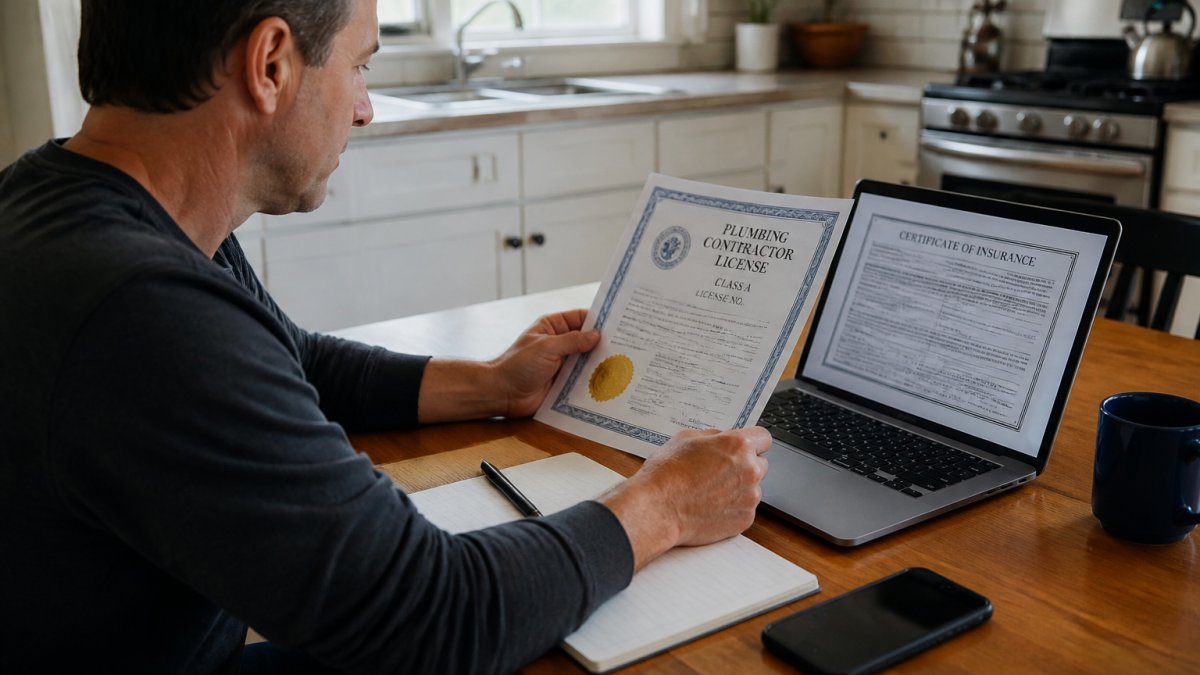
The steps for checking a license are simple, but the details matter:
- Find the relevant licensing authority’s website and look for its license verification instructions.
- Search by the contractor’s license number or business name. If you only have a business name, try variations (with and without “Inc.,” “LLC,” or a DBA).
- Review the license status and any notes shown in the official record.
- Review any additional information provided in the official record.
- Check whether the license information is relevant to the work you need.
A number printed on a truck or business card is not, by itself, confirmation of a license.
Save a record of the license information and the date you checked it.
Match the License to the Person, the Company, and the Job
Compare the name on the license with the company you’re hiring. If a subcontractor shows up, ask for their credentials too. Also check whether the license information is relevant to the type of work you need.
Ask who will be on site and check the relevant licensing authority’s information about the license and the person doing the work.
Confirm Insurance Directly, Not Just on Paper
A certificate of insurance is not a guarantee of current coverage. Contact the insurer using independently verified contact information to ask whether the policy is active and what it covers.
Ask what insurance or other coverage the contractor carries and request documentation.
Request these documents in writing and keep copies. If a contractor hesitates to share them, that is a serious red flag. For a deeper walkthrough, see our guide on how to verify a plumber’s license and insurance.
A certificate that lists only a trade name, a P.O. box, or an out-of-state address is worth a second look. Match the named insured to the legal entity on your contract before work begins.
Plumber Insurance and Bonding: What to Confirm in Writing
Ask the contractor what insurance coverage they carry and request documentation.
Liability Insurance, Workers’ Compensation, and Surety Bonds
Three types of coverage matter for residential plumbing:
- Liability insurance pays for damage to your property if the crew causes it.
- Workers’ compensation covers injuries to workers on your property.
- Surety bonds protect you if the contractor fails to finish the job or violates permit rules.
Request these documents in writing and keep copies. If a contractor hesitates to share them, that is a serious red flag. For a deeper walkthrough, see our guide on how to verify a plumber’s license and insurance.
Questions to Ask a Plumber Before Hiring for Your Specific Job
Generic answers to generic questions tell you little. Ask about your exact problem, and match the questions to the job. Ask the contractor to explain the diagnosis, repair options, and likely timeline in plain terms.
Start with these baseline questions before you sign anything:
- Have you worked on this type of plumbing system before?
- What is your diagnosis, and how did you reach it?
- Will you use a camera inspection to confirm the problem?
- What repair options do I have, and what does each involve?
- How long will the job take, and what could change that timeline?
- Who handles permits and inspections?
- What does your warranty cover?
Then go deeper by job type. The questions below can help you discuss the work with a contractor.
Leak Repairs (Slab, Wall, or Fixture)
- How will you locate the leak, visual inspection, moisture meter, acoustic listening, or thermal imaging?
- If the leak is under a slab or behind a wall, what is your plan to access it, and who repairs the drywall, concrete, or flooring afterward?
- Will you repair the section or reroute the line, and what are the trade-offs in cost and longevity?
- What is your policy if the leak turns out to be larger than the initial diagnosis?
Water-Heater Replacement
- Will you replace with the same type (tank or tankless) and size, and how did you size it for my household?
- What brand and model are you quoting, and what is the warranty on parts versus labor?
- Does the quote include removal and disposal of the old unit, a new expansion tank, a drain pan, and code-required fittings?
- Who pulls the permit, and will the installation be inspected?
- If I choose tankless, what upgrades (gas line, venting, electrical) does my home need, and are they in the quote?
Sewer and Drain Work
- Will you run a camera inspection before quoting, and will I get the video or a report?
- If you recommend a repair, is it a spot repair, a liner, or a full replacement, and why?
- How do you handle roots, bellied pipe, or offset joints, and what is the expected lifespan of each fix?
- Does the quote include excavation, restoration, and disposal, or are those separate?
- Who confirms the work meets code, and will the line be inspected before backfill?
Remodels and Repipes
- Will you provide a fixture schedule and a rough-in plan before work starts?
- How do you coordinate with my general contractor, electrician, and tile setter, and who is responsible for sequencing?
- What is the plan for shutting off water and keeping the rest of the house usable during the project?
- Are permits and inspections included, and who schedules them?
- What is the change-order process if I add a fixture or move a drain after work begins?
For older homes with cast iron pipes or recurring backups, ask directly about the contractor’s experience with that type of work. If you are hiring during an emergency, ask about the diagnosis, access plan, permit responsibility, and warranty before authorizing work.
Your Plumbing Contractor Estimate Checklist for Apples-to-Apples Quotes
When comparing estimates, review the scope of work as well as the total. Ask contractors to itemize labor, materials, and service fees so you can compare the estimates.
Use this checklist when reviewing each written estimate:
- Labor costs listed separately from materials
- Parts named by brand or specification
- Service fees and after-hours charges stated up front
- Deposit amount and payment terms in writing
- Scope of work describes exactly what gets fixed
- Permit costs included or clearly excluded
- Warranty terms spelled out
- Cleanup and disposal included
A written estimate can help clarify the proposed work. If a quote only lists a lump sum, ask for a breakdown before you compare it to others. Our guide on avoiding hidden fees in plumbing quotes covers estimate line items.
Red Flags and Scam Prevention When Choosing a Plumbing Contractor
Be cautious if a contractor shows up unsolicited, claims a serious problem, pressures you to pay immediately, or adds charges after work begins.
Watch for these red flags:
- No physical business address or verifiable license number
- Cash-only payment demands
- Pressure to decide immediately
- Refusal to put the scope of work in writing
- A price that seems far below every other quote
- No references and no reviews anywhere
Ask questions and request written information about the proposed work. For a step-by-step vetting process, read how to find honest plumbers.
Permits, Inspections, and Code Compliance for Residential Plumbing Work
Permit and inspection requirements depend on the work and applicable local rules. Ask the relevant authority or your contractor who is responsible for permits and inspections.
Ask who is responsible for permits and inspections. Our guide on sewer line repair permit requirements discusses permit questions to consider.
Comparing Plumbing Contractors and Checking References
References and reviews can provide information about a contractor’s past work. If you contact references, ask specific questions: Did the crew show up on time? Was the final bill close to the estimate? Would you hire them again?
Then review online feedback and consider whether it addresses work like yours. Our broader guide to choosing a residential plumbing pro walks through the comparison process.
| What to Check | How to Confirm It | Why It Matters |
|---|---|---|
| License | State licensing database | Proves legal right to work |
| Insurance | Certificate plus insurer call | Protects you from damage costs |
| Experience | Job-specific questions | Confirms fit for your system |
| References | Call two past customers | Shows real-world reliability |
| Estimate | Itemized written quote | Enables fair comparison |
| Warranty | Written terms | Covers future failures |
Requesting Your Written Estimate from Alpha Rooter & Plumbing
Alpha Rooter & Plumbing offers upfront pricing with no hidden fees and no hourly or overtime charges. Our licensed plumbers use state-of-the-art diagnostic tools, and we guarantee a response time of under 90 minutes for emergencies. When you’re ready to discuss pricing, contact our team.
Frequently Asked Questions
What should I check before hiring a residential plumbing contractor?
Check the license number with the relevant licensing authority, ask what insurance coverage the contractor carries, request references from jobs similar to yours, and ask for a written estimate. Also ask who will handle any required permits and what warranty covers the work.
How can I verify a plumber’s license and insurance?
Ask for the license number and the name it is issued to, then check the information with the relevant licensing authority. Ask the contractor what insurance coverage they carry and request documentation.
What should a plumbing estimate include?
Ask for an estimate that describes the proposed work and its pricing. You can use a plumbing contractor estimate checklist to review the information provided.
How can I spot red flags when hiring a plumber?
Consider asking questions about payment terms, the written scope of work, warranty information, and credentials before hiring.
Plumbing problems rarely wait for a convenient moment. When water is rising or a drain keeps backing up, you need a licensed crew that shows up fast and quotes honestly. Alpha Rooter & Plumbing offers 24/7 emergency service, upfront pricing with no hidden fees, and a response time under 90 minutes. Get started with Alpha Rooter & Plumbing and get your plumbing fixed right the first time.
