
Table of Contents
- Why Finding Honest Plumbers Matters More Than Ever
- Step 1: How to Verify a Plumbing License and Insurance
- Step 2: Questions to Ask a Plumber Before Hiring
- Step 3: Recognizing the Signs of a Plumbing Scam
- Step 4: What to Look for in a Plumbing Contract
- Emergency vs. Non-Emergency Vetting: A Different Approach
- The Final Check: Digital Footprint and Post-Service Verification
- Conclusion: Building a Long-Term Relationship with Honest Plumbers
- Frequently Asked Questions
Last Updated: September 11, 2026
Why Finding Honest Plumbers Matters More Than Ever
Finding honest plumbers starts with understanding what you’re up against: a home service category where trust is hard to verify and the cost of getting it wrong is measured in water damage, mold, and repeat repairs. This guide walks through the exact vetting steps every homeowner should know before making that first call.
The stakes are simple. A burst pipe or backed-up sewer line forces a fast decision, and fast decisions favor whoever answers the phone first, not whoever deserves the job. That’s exactly the window dishonest operators count on.
So how do you separate a straight-shooting plumbing contractor from a smooth talker with a clipboard? Below, we break down seven vetting steps, from checking a license database to verifying the work after the truck pulls away. Most homeowners skip at least three of them.
Step 1: How to Verify a Plumbing License and Insurance
Verification is the fastest way to eliminate risk before you ever invite someone into your home. A legitimate plumbing contractor should be able to produce a license number and proof of insurance on request, and you should confirm both independently rather than taking a business card at face value.
Checking State and Local Licensing Databases
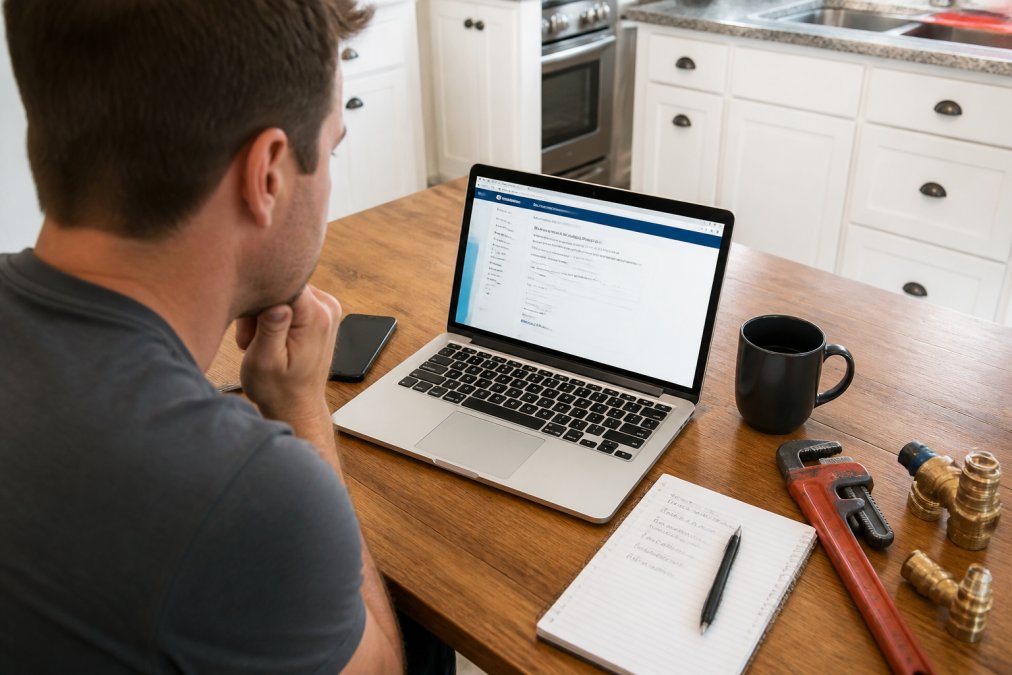
Most states maintain a public database where you can search a plumber’s license number and confirm it’s active, not expired or suspended. Cross-check the name on the license against the name on the estimate. If a company sends out subcontractors, ask whether those workers are covered under the same license or carry their own.
Confirming Insurance and Bonding Coverage
Ask for a certificate of insurance showing general liability and workers’ compensation coverage, then call the insurer to confirm the policy is current. Being insured and bonded protects you if a worker is injured on your property or damages your home. A plumber who dodges this question is telling you something important.
If a plumber can’t produce a license number or insurance certificate on request, stop the conversation there. Unlicensed work often voids homeowner insurance claims and can leave you liable for injuries on your property.
Step 2: Questions to Ask a Plumber Before Hiring
The right questions to ask a plumber before hiring reveal how a company operates before money changes hands. Ask about licensing, insurance, pricing structure, and who will actually show up at your door.
Start with these:
- Are you licensed and insured, and can I see the numbers?
- Is your pricing flat-rate or hourly, and what’s the service call fee?
- Will you provide a written estimate before starting work?
- Do you use subcontractors, or are all technicians employees?
- What’s your warranty on labor, parts, and materials?
A transparent company answers these without hesitation. A vague one deflects, rushes, or promises to “work it out later.” That’s your signal to keep calling.
Ask for the license number over the phone before you book. A company that has to “look it up and call you back” is often a company that doesn’t have one to give.
Step 3: Recognizing the Signs of a Plumbing Scam
The clearest signs of a plumbing scam show up in how a quote is structured, not in how smooth the sales pitch sounds. Most articles tell you to “watch for price gouging” without explaining how to actually spot it in a written estimate. Here’s the checklist.
Price Gouging Detection: Reading the Quote Line by Line
Price gouging rarely announces itself. It hides in the line items. Before you approve anything, ask for the estimate in writing and check these five things:
- Flat-rate vs. hourly structure. A flat-rate quote bundles labor and parts into one number, which is fine, but it also makes it easy to inflate. An hourly quote should state the hourly rate, the estimated hours, and whether the clock starts on arrival or on the first wrench turn. If a company won’t tell you which model it uses, that’s a red flag.
- Trip or diagnostic fees. Many legitimate shops charge a service call fee that’s credited toward the repair if you approve the work. A scam pattern is a low advertised rate that becomes a non-creditable “diagnostic” charge plus a separate “trip” charge plus a “disposal” charge, none of which were mentioned on the phone.
- After-hours and weekend multipliers. Emergency rates of 1.5x to 2x the standard rate are common and legitimate (angi.com). What’s not legitimate is a multiplier applied to a job that isn’t actually an emergency, or a multiplier that appears only after the technician is already in your home.
- Parts markup. Ask whether parts are billed at cost plus a stated percentage or at a flat markup. A markup in the 20-50% range is typical; a part that retails for a known price suddenly costing several times that is a signal to get a second opinion (angi.com).
- Scope creep language. Watch for phrases like “while we’re in there” or “we should probably also.” Legitimate upsells come with a written change order and a new price. Pressure upsells come verbally, on the spot, with a deadline.
Bait-and-Switch and Pressure Tactics
Bait-and-switch works the same way in plumbing as anywhere else: a low advertised rate that balloons once the diagnostic fee, parts markup, or a “discovered” larger scope is added. The pressure version adds a clock, “sign now or the rate doubles,” “this price is only good today.” Neither is how a reputable shop operates. A straight-shooting plumber will put the scope in writing, tell you what’s included in the flat rate, and let you sleep on a non-emergency decision.
| Red Flag | What It Looks Like | How to Respond |
|---|---|---|
| Pressure pricing | “Sign now or the rate doubles” | Walk away, get a second estimate |
| Vague scope | No written estimate before work starts | Request itemized pricing in writing |
| Unlisted fees | Trip, diagnostic, or disposal charges not quoted upfront | Ask for the all-in number before work begins |
| Cash-only demand | Refuses card or check payment | Pay by traceable method or decline |
| No license number | Deflects or changes subject | Verify independently before hiring |
A quote that’s dramatically lower than two others isn’t automatically the best deal, it’s often the entry point for a bait-and-switch. Get three written estimates on any non-emergency job and compare the line items, not just the totals.
The Second-Opinion Rule
For any repair above a few hundred dollars, a second opinion is cheap insurance. A common pattern is a first technician recommending a full replacement while a second confirms a repairable part. You don’t owe the first company an explanation, and a legitimate shop won’t pressure you for one.
Step 4: What to Look for in a Plumbing Contract
A written contract is your only real protection if the work goes wrong. What to look for in a plumbing contract comes down to four things: a clear scope of work, an itemized price, a timeline, and a workmanship guarantee.
The contract should spell out which parts and materials are included, whether permit requirements are being handled, and who’s responsible for cleanup. For larger jobs, it should reference local building codes and confirm the contractor will pull any required permits. Never sign a blank or vaguely worded service agreement, and never pay the full amount upfront.
A written contract with itemized pricing and a stated warranty on labor protects you more than any verbal promise. If a plumber resists putting terms in writing, that’s your answer.
Emergency vs. Non-Emergency Vetting: A Different Approach
Emergency plumbing calls require faster vetting than planned work, but the core checks don’t disappear. When water is actively damaging your home, you have minutes, not days, to decide who to call.
For emergencies, prioritize three things: a company that answers the phone live, one that confirms licensing upfront, and one that gives you a clear price before work begins. Non-emergency jobs let you slow down, gather multiple estimates, check online reputation, and ask for professional references.
A 24/7 operation like Alpha Rooter & Plumbing is built for the emergency side of that split, with upfront pricing and no hourly or overtime charges.
The Final Check: Digital Footprint and Post-Service Verification
Your last vetting step happens before and after the job: audit the digital footprint first, then verify the work once the truck pulls away. Most homeowners skip the second half entirely, and that’s the half that catches problems while the workmanship guarantee is still active.
Spotting Fake Reviews on Google and Yelp
A wall of five-star reviews is not proof of anything. Review platforms are gameable, and plumbing is a category where fake-review farms are active. Read for these tells:
- Timing clusters. A dozen five-star reviews posted within the same week, especially from accounts with no other activity, is a pattern worth distrusting.
- Generic language. “Great service, highly recommend!” with no detail about the specific job, the technician, or the problem solved reads like a template.
- No middle ground. Real businesses have a mix of four- and five-star reviews with occasional threes. A profile that’s almost all fives with a handful of angry ones, and nothing in between, is often curated.
- Reviewer history. Click the reviewer’s name. If their only review is for this plumber, weight it less.
- Response style. How a company replies to a negative review tells you more than the review itself. A professional, specific reply (“We’re sorry about the scheduling issue on the 14th, here’s what we did”) is a good sign. A defensive or dismissive reply is not.
Cross-check across at least two platforms, Google and Yelp, plus the Better Business Bureau for complaint history. A company with strong Google reviews and a stack of unresolved BBB complaints is telling you two different stories.
Post-Service Verification: What to Check Before the Plumber Leaves
Do this inspection while the technician is still on site. Once they’re gone, you’re relying on a callback.
- Run the fixture. Turn the water on and off, run the disposal, flush the toilet, run the dishwasher or washing machine if that was the repair. Watch for slow drains, new leaks at the connections, or water where it shouldn’t be.
- Check the surrounding area. Look under the sink, around the water heater, and at the base of the toilet for moisture. A small drip left behind becomes a mold problem in weeks.
- Match the invoice to the estimate. Confirm the final bill matches the written scope. If the price changed, ask for the change order in writing before you pay.
- Confirm permits and inspection. If the job required a permit, ask for the permit number and confirm it was filed with your local building department. For permitted work, an inspection is typically required, don’t let the contractor skip it (hud.gov).
- Get the warranty in writing. Ask for the labor and parts warranty terms on paper, including how long each is good for and what voids it.
Post-service verification is the step most homeowners skip, and it’s the one that catches problems while the workmanship guarantee is still active. Ten minutes of checking beats a callback two weeks later.
Conclusion: Building a Long-Term Relationship with Honest Plumbers
The homeowners who avoid plumbing scams aren’t luckier than everyone else. They vet once, carefully, and then keep the same trusted plumber on speed dial for years.
When you find a licensed, insured plumbing contractor who quotes upfront pricing, puts terms in writing, and stands behind the work, hold onto them. Alpha Rooter & Plumbing offers 24/7 emergency service, a response time under 90 minutes, no hourly or overtime charges, and upfront pricing with no hidden fees, all backed by licensed, experienced plumbers. Call now.
Frequently Asked Questions
What is the best way to find a good plumber?
Start by asking for referrals from neighbors, then verify the plumber’s license and insurance through your state’s licensing board. Check online reviews on multiple platforms and look for consistent feedback about reliability and pricing. Ask for a written estimate and a copy of the contract before work begins. A good plumber will have no problem providing proof of licensing, insurance, and references. Trust your instincts: if something feels off, keep looking.
How can I tell if a plumber is ripping me off?
Watch for these signs of a plumbing scam: pressure to approve work immediately, prices that seem far higher than other quotes, refusal to provide a written estimate, and demands for cash payment only. A plumber who diagnoses a problem without inspecting the pipes or who claims a simple fix requires a full system replacement is a red flag. Always get at least two written estimates and compare line items, not just the total.
What questions should I ask a plumber before hiring them?
Ask these questions to ask a plumber before hiring: Are you licensed and insured in this state? Can you provide your license number? Do you offer a written estimate and a contract? What is your warranty on labor and parts? Will you use subcontractors? How do you handle unexpected issues? What is your service call fee? A professional plumber will answer each clearly and without hesitation. If they dodge any question, move on to another candidate.
How do I verify a plumber’s license and insurance?
To verify a plumbing license, visit your state’s licensing board website and search by name or license number. The listing should show the license status, expiration date, and any complaints. For insurance, ask for a certificate of insurance and call the provider to confirm the policy is active. A legitimate plumber will gladly provide this information. If they refuse or give excuses, that is a major red flag and you should not hire them.
Comments are closed