
Last Updated: November 7, 2026
Quick Summary
A slow draining kitchen sink usually clears with a few simple steps: clean the stopper and strainer, flush with hot water, baking soda and vinegar, then use a plunger, zip tool or drain snake. Check whether one basin or both are slow to find where the clog sits. If the sink still drains slowly, the clog may be deeper in the line and needs a professional.
- Run the water and watch whether one basin or both are slow to locate the clog.
- Clean the stopper and strainer first, since hair and soap scum cause many slow drains.
- Pour 1/2 cup baking soda and 1 cup white vinegar, cover the drain for 15 minutes, then flush.
- Use a plunger for clogs near the opening, and a plastic drain snake for deeper clogs.
- Call a plumber if more than one fixture backs up or water pools near the floor.
Table of Contents
- Diagnose Where the Slow Drain Starts
- Clean the Stopper, Strainer and Visible Debris
- Flush the Drain with Hot Water, Baking Soda and Vinegar
- Clear the Clog with a Plunger, Zip Tool or Drain Snake
- Clean the P-Trap Step by Step
- Slow Draining Kitchen Sink with Garbage Disposal: What to Check
- Kitchen Sink Drains Slowly and Bubbles: Venting and Chemical Safety
- Book a Plumber When Your Sink Still Drains Slowly
- Frequently Asked Questions
Most slow kitchen sinks clear up with a few simple steps. A kitchen sink that drains slowly usually points to grease, food scraps or soap buildup somewhere between the sink and the main drain line.
Start with the basics before you grab any tools. Run the water and watch where it stalls. If the water backs up in both basins, the clog sits further down the line.
Diagnose Where the Slow Drain Starts
A slow draining kitchen sink often has a simple cause close to the surface. Find that cause first so you do not waste time on the wrong fix.
Run the water and watch how it behaves before you touch anything. Then compare what you see against these patterns:
- Both basins slow, water rises evenly: The clog is likely in the shared drain line below the trap or in the branch line that joins the two bowls. A single-basin clog would not slow both bowls at the same rate.
- One basin slow, the other drains freely: The clog is probably in that basin’s strainer, stopper assembly, or the short tailpiece above the trap. On a double bowl, each side has its own stopper and strainer, so debris on one side can restrict only that bowl.
- Water gurgles or bubbles as it drains: Air is being pulled through the trap because the vent is restricted or the clog is far enough down the line to create suction. Gurgling is a vent or branch-line clue, not a stopper clue.
- Bad smell from the drain: Food debris or grease is probably trapped in the P-trap or on the walls of the tailpiece. A smell that appears only when the dishwasher runs points toward the dishwasher hose connection.
- Water backs up in a nearby fixture when the sink runs: The clog sits in a shared branch line or the main line, not in the sink’s own trap. Stop working on the sink and treat this as a line problem.
Note what you see before you start. This helps you decide whether a plunger, a snake or a call to a plumber makes sense. A stopper or trap clog usually responds to hand tools in under an hour.
Kitchen sink draining slowly with no blockage
Sometimes a sink drains slowly even when nothing looks blocked. The cause is often a partial clog of soap scum and grease that narrows the pipe over time.
A quick way to separate a partial clog from a vent problem is to watch the water level in the trap. If the sink drains slowly but steadily and never gurgles, the pipe is partly narrowed.
Clean the Stopper, Strainer and Visible Debris
Start with the parts you can reach easily. These steps take about 15 minutes and fix a surprising number of slow drains.
- Remove the drain stopper. Pull it up or twist it out, depending on the type.
- Clear the strainer. Lift out any hair, food bits and grime.
- Scrub the stopper. Use dish soap and an old toothbrush to remove the film.
- Check the drain opening. Look for debris you can pull out by hand.
- Run hot water. Check whether the water drains faster.
Hair and soap scum build up on stoppers faster than most people expect. Clean them once a month to prevent a repeat problem.
Flush the Drain with Hot Water, Baking Soda and Vinegar
This method is gentle and works best on early clogs made of grease and soap. For more gentle, non-chemical ways to keep kitchen drains clear, see natural ways to keep kitchen drains clear.
Follow these steps:
- Pour a full kettle of very hot water down the drain, but skip this step if your pipes are PVC and the water is at a rolling boil. Let hot tap water run for a minute instead.
- Pour 1/2 cup of baking soda down the drain.
- Follow with 1 cup of white vinegar.
- Cover the drain with a stopper or cloth for 15 minutes so the fizzing works down the pipe.
- Flush with hot tap water for two minutes.
Many people use this home remedy first because it costs only a few dollars in supplies. Results vary, so check the drain flow after one round before you move on.
Clear the Clog with a Plunger, Zip Tool or Drain Snake
When the water still drains slowly, mechanical tools usually do more than chemicals. Pick the tool that fits the clog.
Plunger: Fill the sink with a few inches of water so the cup seals.
Zip tool: This flat plastic strip with barbs pulls out hair and gunk from the drain opening.
Plastic drain snake: A flexible auger reaches deeper than a zip tool.
| Tool | Best for | Key difference |
|---|---|---|
| Plunger | Clogs close to the sink opening | Uses pressure; fill the sink so the cup seals |
| Zip tool | Hair and gunk in the first few inches | Flat barbed strip pulled in and out |
| Plastic drain snake | Clogs deeper in the drain | Flexible auger that reaches further |
Clean the P-Trap Step by Step
The P-trap is the curved pipe under the sink. It catches grease and debris, so it is often the real cause of a slow kitchen drain. Cleaning it takes about 30 minutes and requires a bucket, rubber gloves and an adjustable wrench.
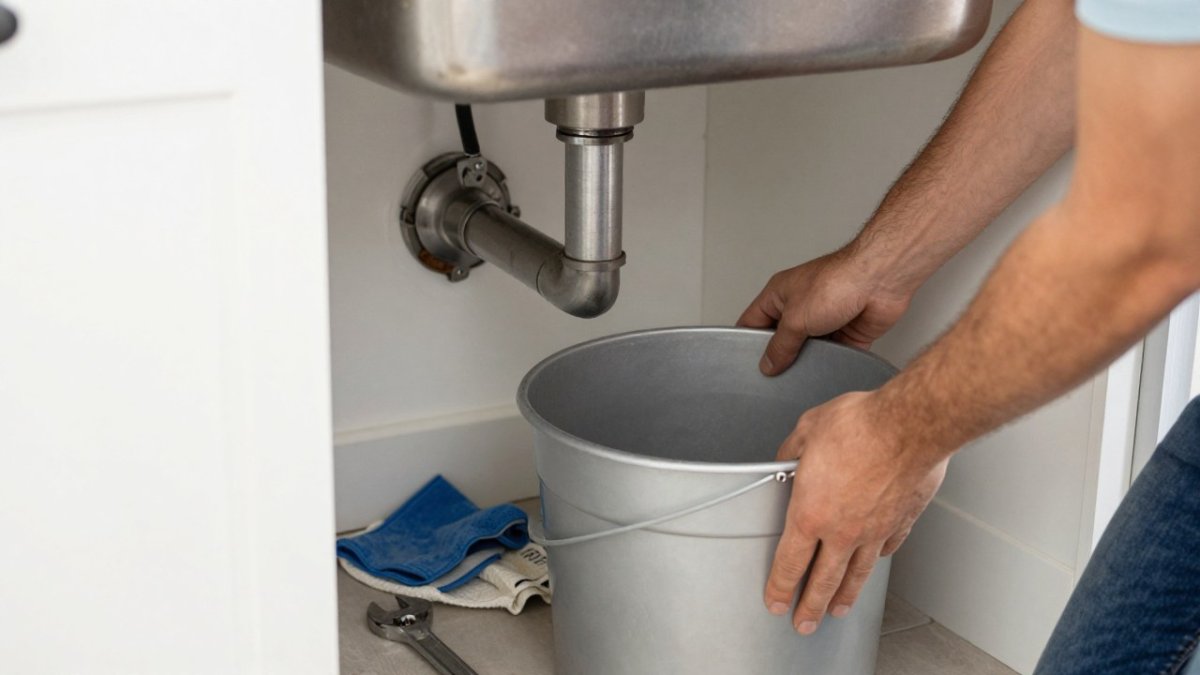
- Place a bucket under the trap. Old water and debris will spill out.
- Loosen the slip nuts. Turn them counterclockwise by hand first. Use the wrench only if they resist.
- Remove the trap. Pull the U-shaped section free and empty it into the bucket.
- Clean the trap. Scrape out grease and food with an old brush or rag. Rinse it with hot water.
- Check the pipe ends. Clear any debris you can reach in the wall pipe with a small brush.
- Reassemble. Hand-tighten the slip nuts, then give them a quarter turn with the wrench.
- Run water. Look for leaks at each joint and check that the sink drains quickly.
Watch out: If you see water seeping after reassembly, tighten the slip nuts a little more. Overtightening can crack the plastic.
Slow Draining Kitchen Sink with Garbage Disposal: What to Check
A slow draining kitchen sink with a garbage disposal often has a disposal-specific cause. Check the disposal before you work on the trap.
- Turn off the disposal and power. Never reach into the disposal while it may be on.
- Look for debris in the chamber. Use tongs to remove food scraps and bones.
- Press the reset button. It sits on the bottom of most units and can trip after a jam.
- Run cold water while the disposal runs. This helps flush small pieces into the drain.
- Check the dishwasher hose. On many setups, it connects to the disposal and can slow both drains.
Avoid pouring grease down the sink, even with the disposal running. Grease hardens in the pipes and causes the slow drain you are trying to fix.
Kitchen Sink Drains Slowly and Bubbles: Venting and Chemical Safety
Bubbling and gurgling often mean air cannot move freely through the drain system.
Chemical drain cleaners are a common choice, but they carry real risks that are easy to underestimate.
Before you open any product:
- Read the entire label, including the first-aid and storage sections, and confirm the product is labeled for kitchen sinks with food debris and grease.
- Put on chemical-resistant gloves and eye protection. Keep the room ventilated and keep children and pets out of the area.
- Never combine two cleaners, and never add vinegar, bleach, or another product on top of one that has already been poured. Mixing can release dangerous fumes or cause splashes, and the reaction can heat the pipe.
- Do not use a plunger or snake after pouring a chemical cleaner. The force can splash the chemical back out of the drain or push it into a trap you are about to open.
If a chemical cleaner has already been used and the drain is still slow:
- Do not open the P-trap until the product has been flushed according to its label and the drain has been run with plenty of water. Residual cleaner can burn skin and damage the trap parts.
- Wear gloves and eye protection even after flushing, and place a bucket under the trap before you loosen anything.
- If the drain did not clear and you cannot flush it safely, stop and call a plumber. Tell them what product was used and when.
If the sink bubbles, gurgles, and drains slowly at the same time, address the vent and the clog together.
Book a Plumber When Your Sink Still Drains Slowly
Call a professional if the sink still drains slowly after these steps, if more than one fixture backs up, or if you see water near the floor.
Alpha Rooter & Plumbing offers 24/7 emergency service across the Los Angeles area. Our licensed plumbers use upfront pricing, so you know the cost before the work starts. Pricing depends on the job, so ask for a quote when you call. You can book a plumber for a slow sink that will not clear and get a clear answer on what is wrong. If you want to understand the costs first, our guide on professional drain cleaning costs explains what affects the bill.
For a deep clog that DIY tools have not cleared, hydro jetting is one option for deeper clogs. Comparing the options helps you pick the right fix, and snaking vs. jetting lays out when each method works best.
To keep the drain clear over time, run hot water after each use, keep grease out of the sink and clean the strainer every few weeks. Your sink will drain faster for it.
Frequently Asked Questions
Why would my kitchen sink be draining slowly?
The most common cause is a buildup of grease, food particles, and soap residue that narrows the drainpipe over time. Hair and coffee grounds also collect in the P-trap and the stopper. A slow sink can also come from a partial blockage further down the drain line, a garbage disposal that is clogged, or a vent problem that prevents air from flowing freely. Checking the stopper and P-trap first usually identifies the cause quickly.
Do baking soda and vinegar actually work to unclog drains?
Baking soda and vinegar can break up light buildup and help loosen soap scum, but they rarely clear a full clog. Pour half a cup of baking soda down the drain, follow with half a cup of white vinegar, cover the drain for about 15 minutes, then flush with hot water. This works best as a maintenance step. If the sink still drains slowly afterward, move on to a plunger or a drain snake.
Can a garbage disposal cause a kitchen sink to drain slowly?
Yes. A clogged or worn garbage disposal can slow the entire sink drain, especially when fibrous food waste or grease has built up inside the unit. Run cold water, turn the disposal on, and check whether the flow improves. Always switch off power at the wall or breaker before reaching into the disposal, and use the hex key on the bottom to manually rotate the flywheel if it jams.
When should you call a plumber for a slow-draining kitchen sink?
Call a plumber if the sink still drains slowly after you have cleaned the stopper, flushed the drain, cleared the trap, and tried a drain snake. Other warning signs include water backing up into a second sink or shower, gurgling from other drains, foul sewer odors, or water appearing in a basement. Alpha Rooter & Plumbing offers 24/7 service, and you can request current pricing or a quote directly from the company’s website.
