
Table of Contents
- DIY Sewer Drain Cleaning vs Professional Service: A Side-by-Side Comparison
- Quick Comparison: DIY vs Professional
- Pros and Cons of Each Approach
- Sewer Line Clog Symptoms: When DIY Might Work and When It Won’t
- DIY Methods and Tools: Drain Snake for Sewer Line and Chemical Risks
- Hydro Jetting vs. Snaking: Professional Equipment Explained
- Sewer Camera Inspection: Diagnosing Blockages Before You Dig
- Cost Comparison: DIY Tools, Repairs, and Professional Service
- How to Evaluate a Professional Drain-Cleaning Provider
- Prevention and Maintenance for a Healthy Sewer Drain
- Frequently Asked Questions
Last Updated: October 12, 2026
DIY Sewer Drain Cleaning vs Professional Service: A Side-by-Side Comparison
When a main drain backs up, the choice between DIY sewer drain cleaning vs professional service comes down to one question: where is the clog, and how bad is it?
Here’s the honest version most guides skip: DIY works on soft, recent clogs near an accessible cleanout. It fails on grease buildup, roots, and anything past the first bend.
Quick Comparison: DIY vs Professional
The short answer: DIY sewer drain cleaning suits slow drains and fresh clogs you can reach. Professional drain cleaning suits recurring clogs, multiple slow fixtures, and anything involving the main sewer line.
| Factor | DIY Approach | Professional Service |
|---|---|---|
| Best for | Slow drains, hair buildup, one fixture | Main drain, sewer line, recurring clogs |
| Tools | Plunger, hand snake, enzyme cleaner | Hydro jetting, drain camera, power auger |
| Time required | 1-3 hours, often repeated | Usually one visit |
| Safety risks | Chemical burns, pipe damage | Low, handled by trained plumbers |
| Cost | Tool purchase only | Depends on scope; ask for upfront pricing |
| Success on roots | Almost never | Standard fix |
If more than one fixture in the home drains slowly at the same time, the clog is in the main drain or sewer line. DIY tools rarely reach it. That is your signal to call a professional.
Pros and Cons of Each Approach
DIY sewer drain cleaning pros: it is cheap, immediate, and fine for a single slow drain caused by hair or soap scum.
Professional drain cleaning pros: correct equipment, a camera inspection to diagnose blockage, and a fix that holds.
A common mistake is treating these as competing options. They are sequential. Try the safe DIY steps first. Stop the moment they fail twice.
Sewer Line Clog Symptoms: When DIY Might Work and When It Won’t
Sewer line clog symptoms tell you which path to take. One slow drain points to a local clog. Several slow drains, gurgling toilets, or sewage odor point to the main drain.
DIY is reasonable when:
- A single sink or tub drains slowly
- The clog started recently, after hair or food went down
- Water backs up only in one fixture
Call a professional when:
- Two or more fixtures drain slowly at once
- Water backs up into a tub or shower when you flush
- You smell sewage in the basement or yard
If sewage is backing up into multiple fixtures, stop running water immediately. Every flush adds volume to an already blocked sewer line and can push waste into your home.
DIY Methods and Tools: Drain Snake for Sewer Line and Chemical Risks
A drain snake for sewer line work is the most useful DIY tool, but only for clogs within reach. A hand snake feeds 15 to 25 feet of cable, enough for a trap or short branch line, not a main line clog 50 feet out.
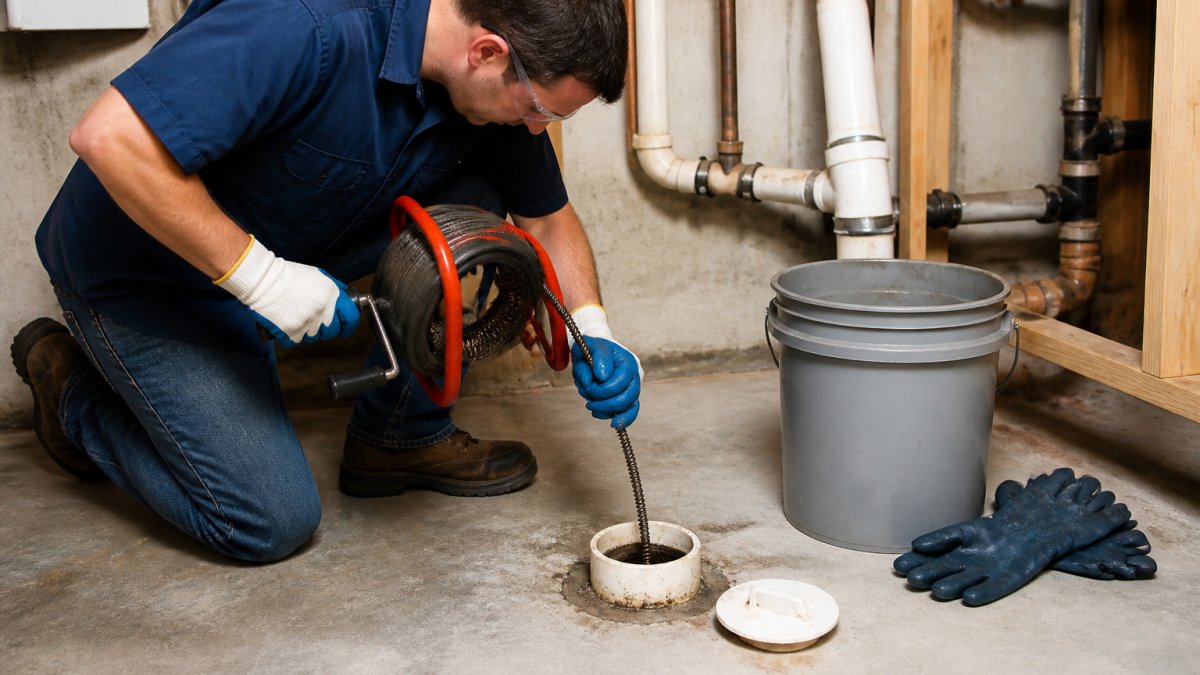
Safe DIY steps, in order:
- Remove the strainer and clear visible debris by hand, wearing gloves.
- Try a plunger first. Seal the overflow hole with a wet rag for a better seal.
- Feed the drain snake slowly. Crank clockwise. Do not force it past resistance.
- Flush with hot water, not boiling, to move loosened debris.
- Stop after two failed attempts. Repeating the same method rarely works.
Chemical Drain Cleaners: Safety Risks and Pipe Damage
Chemical drain cleaners are the riskiest DIY option. Most contain caustic soda or sulfuric acid, which can cause skin burns and eye damage. They also generate heat inside the pipe that can soften or crack older pipes, turning a clog into a repair in homes with cast iron or aging PVC.
They also rarely work on the actual cause: grease buildup and roots shrug them off. Worse, standing chemical water in the line is a hazard for any plumber who arrives later.
Never use a chemical drain cleaner after a mechanical snake has failed. The chemical sits on top of the clog and can splash back when a plumber opens the line. Tell your plumber what you poured and when.
Hydro Jetting vs. Snaking: Professional Equipment Explained
Hydro jetting vs. snaking is the core difference between scouring a pipe and punching a hole in a clog.
Hydro jetting uses a high-pressure water jet, often 3,000 to 4,000 PSI, to scour the full pipe diameter, removing grease buildup, scale, and debris from the walls. For restaurant grease lines and older sewer lines, it is the more effective method.
Neither works blind. That is where diagnostics come in.
Sewer Camera Inspection: Diagnosing Blockages Before You Dig
A sewer camera inspection shows what is actually in the pipe before anyone cuts or digs.
This matters for two reasons. First, it prevents guesswork: a plumber can confirm the clog type and location instead of snaking repeatedly. Second, it distinguishes a clog from a pipe defect.
Ask any provider whether a camera inspection is included. If the answer is no, keep calling.
Cost Comparison: DIY Tools, Repairs, and Professional Service
DIY sewer drain cleaning costs whatever the tool costs, and nothing more if it works. The catch is the hidden second cost: a failed attempt that damages a pipe or pushes a clog deeper can turn a clearing job into a system repair.
Here is how the money actually breaks down. These are typical ranges, not quotes, line length, pipe material, access point, and clog type all move the number.
| Line item | Typical DIY cost | Typical professional cost |
|---|---|---|
| Plunger | $10-$30 | Included in service call |
| Hand snake (15-25 ft) | $25-$60 | Not used on main lines |
| Enzyme or bacterial drain treatment | $15-$40 per bottle | Not a clearing method |
| Drill-powered drum auger (25-50 ft) | $80-$250 | Not used on main lines |
| Chemical drain cleaner | $8-$25 | Never recommended |
| Service call / diagnostic fee | , | $75-$200 (often waived if work is performed) |
| Drain snaking (branch line) | , | $100-$300 |
| Drain snaking (main line) | , | $200-$500 |
| Hydro jetting | , | $300-$800 |
| Camera inspection | , | $150-$400 (sometimes bundled) |
| Emergency / after-hours surcharge | , | $50-$200 on top of base rate |
| Repair after DIY pipe damage | , | $500-$5,000+ depending on access and pipe material |
Three things drive the professional number more than anything else:
- Access. A cleanout in the basement is cheap to work from. A line that has to be accessed through a toilet pull, a roof vent, or a dug-up yard is not.
- Clog type. Hair and soap scum clear fast. Grease, scale, and roots take longer and usually require jetting.
- Line length and material. A 30-foot branch line is a different job than a 100-foot main under a mature tree. Cast iron and clay tile are more fragile than PVC and change which tools are safe.
A quote that sounds low can grow once the technician is on site. Ask what is included in writing: diagnosis, clearing, camera inspection, and cleanup. No hidden fees should mean exactly that.
Budget the DIY path at the cost of the tool plus the cost of the likely fallback. If the fallback is a main-line jetting job, the DIY savings shrink to almost nothing.
How to Evaluate a Professional Drain-Cleaning Provider
Evaluating a drain-cleaning provider takes five quick checks.
- Ask for the license number and confirm it is current with your state or local licensing board
- Confirm the plumbers are licensed and insured in writing, ask for the certificate, not just a verbal yes
- Ask whether a camera inspection is part of the diagnosis, or an add-on
Response time matters too. Alpha Rooter & Plumbing guarantees a response time of under 90 minutes, with 24/7 emergency service and no hourly or overtime charges. Our team is licensed (License #874454).
Questions that separate a real diagnosis from a sales pitch
A provider who plans to clear the line and leave will answer differently than one who plans to fix the cause. Ask these before you approve work:
- “Will you camera the line before and after?” Before shows the clog type and location. After proves the line is actually clear. A provider who skips the after-camera has no way to show you the result.
- “What method will you use, and why?” Snaking punches a hole. Jetting scours the wall. If the answer is “whatever we have on the truck,” that is not a diagnosis.
- “What is the warranty on the clearing?” A 30-day warranty on a recurring root intrusion is a red flag. Ask what happens if the same line backs up next month.
- “Will I get a written estimate before work starts?” Verbal estimates are hard to enforce. Get it in writing, with the scope spelled out.
- “What documentation do I get when you leave?” Ask for the camera footage or stills, the invoice with line-item scope, and any notes on pipe condition. That record matters if you sell the home or file an insurance claim.
The stop-DIY decision tree
Before you call anyone, run this sequence to see whether you are still in DIY territory or already past it.
Step 1, Count the affected fixtures. One slow fixture: local clog, DIY is reasonable.
Step 3, Try the safe DIY sequence once. Plunger, then hand snake, then hot (not boiling) water.
Step 5, Call, and tell them everything. What you tried, what you poured, when the clog started, and which fixtures are affected.
If you have already poured a chemical cleaner, say so before the technician starts. It changes their safety gear and their approach, and hiding it is how people get hurt.
The right provider cameras the line, explains the method, gives a written scope, and hands you documentation when they leave. If any of those four are missing, keep calling.
Prevention and Maintenance for a Healthy Sewer Drain
Preventive maintenance is cheaper than any emergency call. Most main drain clogs build over months, not minutes.
- Never pour cooking grease down a drain. Wipe pans into the trash first.
- Use drain strainers in every sink and tub, and empty them weekly.
- Run hot water for 30 seconds after each kitchen use to move residue.
One slow drain is a warning. Treat it before it becomes a sewer backup, and you skip the emergency entirely.
Frequently Asked Questions
Can I clean a sewer drain myself?
You can handle minor clogs in a sink or tub with a plunger or hand snake, but a main sewer line clog is different. If multiple drains are slow or sewage backs up, DIY tools rarely reach the blockage. A drain snake for a sewer line may clear soft debris, but grease, roots, or collapsed pipes require professional equipment like hydro jetting or a camera inspection. Stop DIY attempts if water backs up further or you smell sewage.
Is it safe to use a drain snake on a sewer line?
A manual drain snake is safe for small, soft clogs near the access point, but using it incorrectly can scratch pipe walls or push debris deeper. For older cast iron or clay pipes, aggressive snaking can crack the pipe. If you meet strong resistance, stop. A professional can assess pipe condition with a sewer camera inspection before snaking, reducing the risk of damage.
Can chemical drain cleaners damage sewer pipes?
Yes. Chemical drain cleaners contain caustic ingredients that generate heat and can corrode pipes, especially older metal or PVC. They also pose skin burns and eye damage risks if splashed. Repeated use can weaken joints and lead to leaks. For a main sewer line clog, chemicals rarely reach the blockage and may create a hazardous pool of liquid for anyone who later opens the pipe.
When should I call a plumber for a sewer drain clog?
Call a plumber if you see sewage backing up in multiple fixtures, hear gurgling from drains, or notice a slow drain that returns within days. These are common sewer line clog symptoms that DIY tools cannot fix. Also call if you have recurring clogs, older pipes, or a blockage that a hand snake cannot clear. A professional can perform a camera inspection and use hydro jetting to clear the line safely.
A backed-up main drain is one of the few home problems that gets worse the longer you wait. If DIY has failed twice, or more than one fixture is slow, the smart move is a licensed plumber with the right equipment. Alpha Rooter & Plumbing offers 24/7 emergency service, a response time under 90 minutes, upfront pricing with no hidden fees, and state-of-the-art diagnostic tools to find the real cause. Call now and get your drain flowing again.