

Last Updated: November 4, 2026
Quick Summary
Upfront pricing is a price you quote before the work starts, based on what the job actually needs. Quote the full job before work begins to build customer trust, and state the total plainly, define what is included, and disclose exclusions before the customer asks.
- Diagnose the job first, because a quote without a diagnosis is a guess customers can detect.
- State the full number in one clean sentence, then pause to let the customer absorb it.
- Break the total into line items like service call, parts, labor, disposal, and permits.
- Handle objections by explaining costs and offering smaller scope, not discounts.
- Track quote-to-close rate and sales cycle length for 60 days before and after switching.
Table of Contents
- Why Share Upfront Pricing Before the Sales Conversation
- A Step-by-Step Framework for Presenting Price Early
- Customer Communication Scripts for Pricing in Real Situations
- Handling Price Objections in Service Industries Without Discounting
- Explaining Flat Rate vs Hourly Plumbing Pricing to Homeowners
- What to Disclose: A Total-Cost and Fee Checklist
- Testing and Measuring the Impact of Price Transparency
- Request Your Upfront Quote Before the Emergency Hits
- Frequently Asked Questions
Why Share Upfront Pricing Before the Sales Conversation
Upfront pricing is a price you quote before the work starts, based on what the job actually needs. Quoting the full job before work begins builds customer trust.
Here is the core problem. Most service businesses hide the price until after a sales visit. Customers read that delay as a warning sign.
When you share the number early, three things happen:
- The customer stops bracing for a surprise
- The sales conversation becomes a planning talk, not a pitch
- You find out fast whether the budget and the scope match
That last point saves you hours. A price discussion that happens early filters out mismatched jobs before anyone drives anywhere.
Upfront Pricing vs. Hourly Billing: What Customers Actually Hear
“Hourly billing” sounds like an open tab. Customers hear “we charge for every minute, and you cannot see the meter.”
“Upfront pricing” sounds like a fixed number they can plan around. The FTC guidance on pricing and advertising claims backs this up: advertised prices must be truthful and not misleading. A vague hourly estimate that grows later can cross that line.
The difference is not just money. It is control. A fixed quote hands the customer a decision. An hourly rate hands them anxiety.
A Step-by-Step Framework for Presenting Price Early
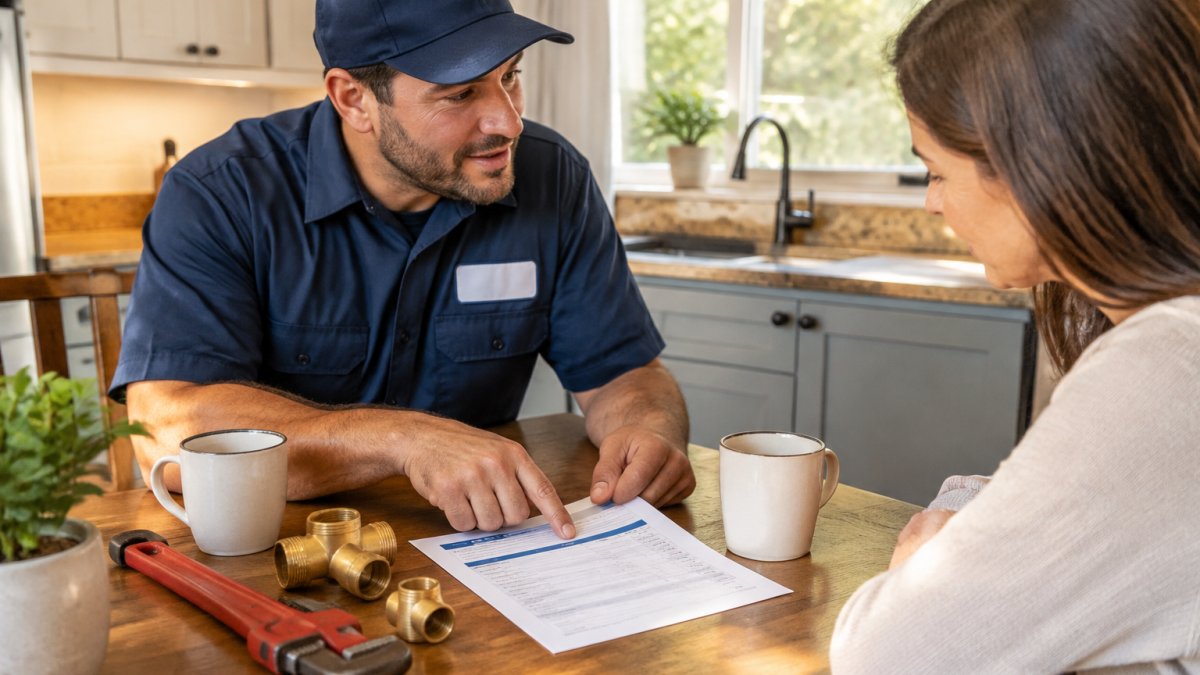
Most guides tell you to be transparent and then stop. That leaves you without a repeatable sequence. Use this five-step framework when presenting price to customers.
Step 1: Diagnose Before You Quote
Ask questions first. What is backing up? When did it start? Has anyone snaked it already? A quote without a diagnosis is a guess, and customers can smell a guess. Take ten minutes to understand the scope, then quote. If you quote before you diagnose, you will either underprice the job or scare the customer with a number that later shrinks, both erode trust.
Step 2: State the Price Plainly, Then Pause
Give the full number in one clean sentence. Do not bury it in caveats or trail off. Say: “The total for this job is $[amount].” Then stop talking for a moment. The pause feels uncomfortable, but it lets the customer absorb the number and signals that you are not negotiating against yourself. A clear, unhedged price tends to reduce haggling because it projects confidence.
Step 3: Define What Is Included
Break the total into line items: service call, parts, labor, disposal, permits, and any after-hours fee. If you need a model for how service call fees work, our guide on plumbing service call fees explains what those fees cover and when they get waived. Customers appreciate seeing the math instead of one lump sum. Watch out: quoting only the base price and adding “extras” later is the fastest way to lose a customer’s trust.
Step 4: Connect the Price to Outcomes
A number alone means nothing. Tie it to what the customer gets. Say: “That covers the work quoted on site, and our callback terms, which we will confirm in writing.” Now the price has a shape. If the job prevents a bigger problem, like a sewer backup that could cost thousands in water damage, name that outcome explicitly. The goal is to move the conversation from “what does it cost” to “what does it protect.”
Step 5: Disclose Exclusions and Check Understanding
Tell the customer what the quote does not cover before they ask. Common exclusions in the industry include hidden damage found after opening a wall and code upgrades required by local authorities. Then ask a closing question: “Does that breakdown make sense, or is there a line you want me to walk through again?” This check catches confusion early and gives the customer permission to raise concerns without feeling adversarial.
Why the Sequence Matters
Skipping steps is where quotes go wrong. If you state the price before diagnosing, you look careless. If you define inclusions before stating the number, you sound evasive. If you skip the exclusions, you set up a billing dispute. The sequence builds a case: here is the problem, here is the number, here is what it buys, here is what it does not, and here is your chance to ask. That is the difference between a quote that closes and one that gets shopped around.
Customer Communication Scripts for Pricing in Real Situations
Steal these customer communication scripts for pricing. Adjust the wording to your voice, but keep the structure.
Opening the number after diagnosis:
“The good news is we can fix this today.
When the job is bigger than expected:
“We found a second issue behind the first one. Here is the revised total, and here is exactly what changed.
When they ask why it costs that much:
“Fair question. Most of that is labor and the equipment to clear the line without damaging your pipes.
When they go quiet:
“Take a minute. If the number does not work, tell me and I will show you what a smaller scope would look like.”
When they are comparing competitors:
“That is smart to shop around.
When they ask for a discount:
When they want to think about it:
“No pressure. I will send you the written quote so you have the inclusions and exclusions in front of you.
When they ask about payment terms:
When they push back on a competitor’s lower price:
“Ask what their quote includes.
When you need to follow up on a sent proposal:
“I wanted to make sure the quote landed and see if any line item needs a closer look.
Watch out: scripts are scaffolding, not a cage. If you recite them word for word, you sound like a call center.
Handling Price Objections in Service Industries Without Discounting
Handling price objections in service industries comes down to one move: explain, do not cut. Discounting teaches customers that your first number was fake.
Try these responses instead:
- “That is more than I expected.” → “I hear you. Let me show you what is driving the cost so you can decide what matters most.”
- “The other guy quoted less.” → “Ask what their quote includes. Ours covers the permit, the haul-away, and the callback.”
- “Can you do better on price?” → “I can do better on scope. We can fix the immediate blockage now and schedule the full repair later.”
Stand your ground on the number. Offer options, not markdowns.
Explaining Flat Rate vs Hourly Plumbing Pricing to Homeowners
Explaining flat rate vs hourly plumbing pricing is easier when you use a simple picture.
Hourly pricing is a taxi meter. The fare climbs while you sit in traffic. Flat-rate pricing is a fixed fare quoted before you get in the car.
| Pricing Model | What the Customer Sees | Main Risk for Them |
|---|---|---|
| Hourly | A rate per hour, total unknown | Bill grows with job time |
| Flat rate | One total for the whole job | Fewer surprises, easier to budget |
| Time and materials | Parts plus labor, itemized | Needs trust in the itemization |
For a concrete example of how flat-rate pricing looks on a common job, see our breakdown of professional drain cleaning services cost. It shows the pricing models side by side.
We use flat rate because it puts the risk on us, not the homeowner. If the job runs long, that is our problem.
What to Disclose: A Total-Cost and Fee Checklist
Run this checklist before you send any quote. Missing one line item is how “no hidden fees” becomes a broken promise.
- Service call or dispatch fee, stated plainly
- Parts and materials, itemized
- Labor, with the flat rate named
- Permits, if the job requires one
- Disposal or haul-away charges
- After-hours, weekend, or holiday rates
- Taxes
- Payment terms and accepted methods
- What voids the quote, such as a scope change found on site
- Warranty or callback terms
If you want a deeper walkthrough of what belongs in a transparent quote, our guide on what is included in upfront pricing covers the full breakdown.
Testing and Measuring the Impact of Price Transparency
Transparency is testable. You do not have to guess whether early pricing helps.
Track these numbers for 60 days before and after you switch:
- Quote-to-close rate. Compare how many quotes turn into booked jobs.
- Sales cycle length. Count the days from first call to signed approval.
- Callback and complaint rate. Fewer billing disputes usually follow clear quotes.
- Average job value. Watch for upsells that come from trust, not pressure.
A simple A/B test works too. Give half your callers a full price breakdown and half a base price only. Compare close rates.
One caveat: small sample sizes lie. Give the test at least a month before you draw conclusions.
Request Your Upfront Quote Before the Emergency Hits
The best time to learn how a plumber prices is before your basement floods. Ask for a quote in writing, check what it includes, and confirm the response window.
Alpha Rooter & Plumbing quotes the full job before work starts, with no hourly or overtime charges and no hidden fees. We answer calls 24/7, aim for a response under 90 minutes, and send licensed plumbers. License #874454.
If you want to see how our pricing compares to another local option, our plumbing services comparison lays it out side by side. When a pipe bursts or a drain backs up, do not wait on hold. Request an upfront-priced emergency visit and get a clear number before anyone arrives.
Frequently Asked Questions
What does upfront pricing mean for plumbing services?
Upfront pricing means you get a flat rate for the whole job before any work starts, based on the diagnosis the plumber makes on site. The quote covers labor, parts, and any disposal or permit costs that apply, so the number you agree to is the number you pay. It removes the hourly clock and the surprise invoice that comes with it. Ask the plumber to confirm in writing what is included and what would count as an additional charge.
How do you handle customer pushback on upfront pricing?
Acknowledge the concern, then reframe the number as the full scope of work rather than a starting point. Walk through the cost breakdown line by line: labor, parts, and any fees. If the customer compares you to a cheaper hourly quote, point out that hourly billing can grow if the job takes longer than expected, while a flat rate stays fixed.
Why is upfront pricing better than hourly billing for customers?
Hourly billing ties the final bill to time, so a slow diagnosis or an unexpected pipe layout raises the cost even when nothing changes on the customer’s end. Upfront pricing locks the total price before work begins, which makes budgeting easier and removes the incentive to rush or pad hours.
How do you explain the value behind a fixed-price quote?
Break the quote into the work and parts it covers. Then name the risk a flat rate removes, such as extra fees if the repair takes longer than expected.
Price transparency is a habit, not a slogan. Quote early, break down the total, and stand behind the number. If you want a plumber who puts the price in writing before the work begins, call Alpha Rooter & Plumbing. Get started with Alpha Rooter & Plumbing and know your total before we ring the doorbell.

Comments are closed