
Table of Contents
- Tankless vs. Tank Water Heaters for Small Apartments
- Tankless Water Heater Installation Cost and Retrofitting Challenges
- Tankless Water Heater Maintenance Requirements
- HOA and Rental Lease Compliance Issues
- Real-World Performance: What Apartment Dwellers Actually Experience
- Is a Tankless Water Heater Worth It for Your Apartment?
- Frequently Asked Questions
Last Updated: September 17, 2026
Tankless vs. Tank Water Heaters for Small Apartments
Is a tankless water heater worth it for small apartments? The answer depends on your space constraints, electrical capacity, and hot water demand. The answer depends on your space constraints, electrical capacity, and hot water demand. Unlike traditional tank systems that store 40-80 gallons of heated water continuously, tankless water heaters heat water on demand using a heat exchanger, delivering hot water instantly without the standby heat loss. For apartment dwellers facing tight utility closets and rising energy costs, this distinction matters significantly.
The core question isn’t whether tankless systems work, they do, but whether the benefits justify the installation complexity and upfront investment in your specific situation. Many apartment residents discover that the space savings alone make the upgrade attractive, but the technical requirements often create unexpected obstacles that tank systems simply don’t present.
Space-Saving Benefits
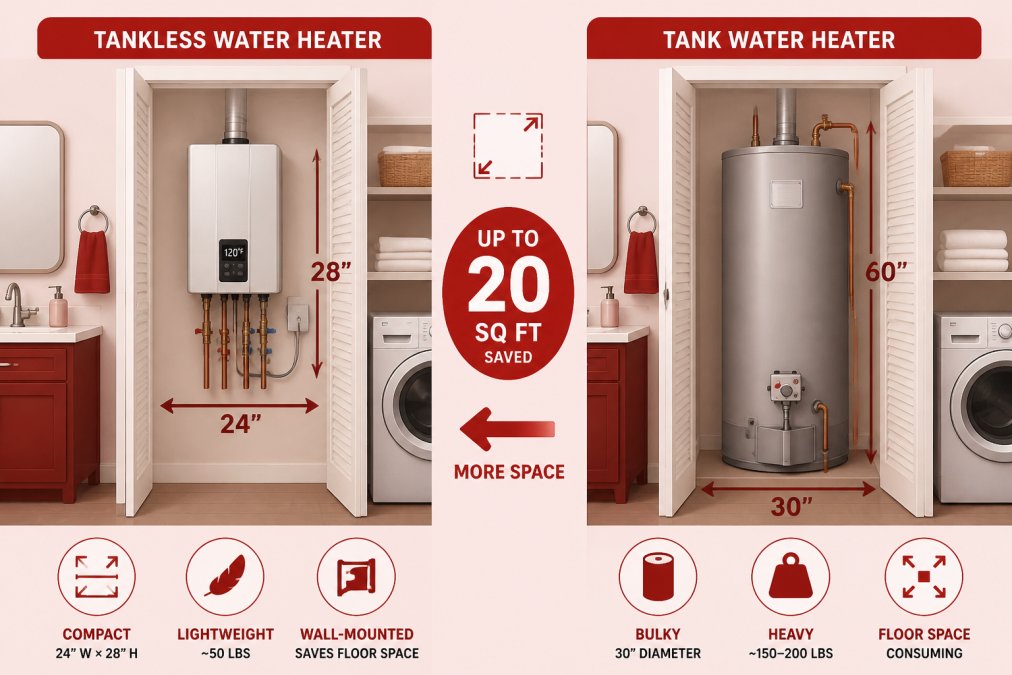
A tankless water heater occupies roughly one-fifth the footprint of a traditional tank. While a standard 50-gallon tank requires floor space roughly 2 feet wide by 4 feet tall, a wall-mounted tankless unit measures around 24 inches wide by 18 inches tall. For apartment dwellers, this difference transforms unusable utility closet space into storage or mechanical room for other systems.
This compact design makes tankless systems particularly attractive for studio apartments, one-bedroom units, and older buildings where mechanical closets were designed for minimal equipment. The wall-mounted installation also frees up floor space that would otherwise be permanently occupied by a large tank, a meaningful advantage in tight quarters.
However, the space benefit comes with a critical caveat: you still need adequate venting space for gas models or sufficient electrical access for electric units. A tankless system that saves floor space but requires expensive wall modifications or venting upgrades may not deliver the practical advantage it promises.
Energy Efficiency Comparison
Tankless water heaters eliminate standby heat loss, the continuous energy waste from keeping 40-80 gallons of water hot even when nobody’s using it. This efficiency gain appeals to apartment residents watching utility bills climb. A tankless system only consumes energy when hot water is actively flowing, which can reduce water heating costs compared to maintaining a full tank at temperature.
The real-world efficiency advantage depends on your hot water usage patterns. Households with consistent, moderate demand throughout the day see measurable savings. Apartments where occupants shower at different times, wash dishes sporadically, and use minimal hot water for laundry realize the greatest efficiency gains because the system never heats unused water.
The catch: electric tankless models require significant amperage, and gas models need proper venting. Both can demand upgrades that consume the energy savings in installation costs alone. A system that’s theoretically efficient becomes practically inefficient if you’re paying to upgrade your electrical panel or install new gas lines.
Flow Rate and Simultaneous Usage Limitations
Flow rate, measured in gallons per minute (GPM), defines how much hot water a tankless system can deliver simultaneously. This is where apartment living reveals a fundamental limitation of tankless technology.
Most residential tankless units deliver 4-8 GPM. A typical shower uses 2.5 GPM, a kitchen sink uses 1.5 GPM, and a washing machine uses 2 GPM. The math seems straightforward until someone showers while another resident runs the dishwasher. Many apartment residents expect a tankless system to handle simultaneous hot water demands the way a 50-gallon tank would. They’re often disappointed.
This limitation particularly affects multi-occupant apartments or units with high simultaneous demand.
A common mistake is assuming a tankless unit sized for peak demand will solve simultaneous usage issues. The unit may technically deliver enough GPM, but temperature rise drops significantly when flow increases, sometimes producing lukewarm water instead of the hot water you expected.
Tankless Water Heater Installation Cost and Retrofitting Challenges
Installation complexity separates tankless systems from their tank-based predecessors. While a tank water heater replacement is often a straightforward swap, tankless retrofits in existing apartments frequently demand modifications that drive costs beyond the equipment price itself.
Gas vs. Electric Installation Requirements
Gas tankless units require dedicated natural gas supply lines, proper venting to the exterior, and adequate combustion air. Apartments built with existing gas water heater connections may accommodate this relatively easily. Older buildings or units that previously used electric systems present challenges, extending gas lines to a new location or installing new venting through walls and roofing becomes expensive and invasive.
Before committing to a tankless system, have a licensed electrician or plumber evaluate your building’s infrastructure. A free consultation often reveals whether your apartment can accommodate the system without major modifications. This step prevents costly surprises after purchase.
Electrical Panel Upgrades and Venting Considerations
Electrical panel upgrades represent the largest hidden cost for electric tankless installations in apartments with aging electrical systems. If your building’s main panel lacks available capacity, upgrading requires a licensed electrician and building permits. Some apartments in older structures simply cannot accommodate the amperage demand without replacing the entire service entrance, a prohibitively expensive modification.
Tankless Water Heater Maintenance Requirements
Tankless systems require ongoing maintenance that tank-based systems don’t demand. Understanding these requirements helps you assess the true cost of ownership.
Descaling and Water Quality Impact
Hard water, water with high mineral content, degrades tankless system performance over time. Mineral deposits accumulate inside the heat exchanger, reducing efficiency and eventually causing system failure. This process, called scaling, requires periodic descaling with specialized chemical solutions.
HOA and Rental Lease Compliance Issues
Apartment residents often overlook a critical barrier: lease restrictions and HOA regulations. Many rental agreements prohibit permanent modifications to building systems, including water heater replacements. Landlords may refuse to authorize a tankless installation because they assume responsibility for the system’s performance and maintenance.
Real-World Performance: What Apartment Dwellers Actually Experience
Theory and practice diverge sharply when tankless systems enter apartment living. Real-world performance reveals limitations that marketing materials downplay.
Temperature Rise and First-Hour Rating Reality
A tankless system’s temperature rise, how many degrees it can heat incoming water, determines whether it meets your hot water needs. Cold water entering a tankless unit in winter might be 50°F. If the system delivers a 70°F temperature rise, you get 120°F water. In summer, when incoming water is already 70°F, the same system produces 140°F water, which is scalding.
Standby Heat Loss and Utility Bills
While tankless systems eliminate standby heat loss, real-world utility savings often disappoint apartment residents. The efficiency advantage assumes you’re replacing an old, poorly insulated tank system. If your building already has a modern tank with good insulation, the savings shrink dramatically.
Is a Tankless Water Heater Worth It for Your Apartment?
Whether is tankless water heater worth it for small apartments hinges on five specific factors: your available space, electrical or gas infrastructure, simultaneous hot water demand, water hardness, and lease restrictions.
| Consideration | Tankless Advantage | Tank System Advantage |
|---|---|---|
| Space requirement | Minimal footprint | Larger but simpler installation |
| Simultaneous usage | Limited flow rate | Handles multiple demands easily |
| Hard water impact | Requires frequent descaling | Less critical to performance |
| Electrical needs | High amperage demand | Standard 120V connection |
| Maintenance | Regular descaling required | Minimal ongoing maintenance |
| Lease modifications | Permanent changes needed | Often easier to approve |
Frequently Asked Questions
What is the downside of a tankless water heater in a small apartment?
Tankless water heaters have several practical drawbacks for small apartments. They require significant upfront installation costs, especially if your electrical panel needs upgrades or gas venting must be added. Flow rate limitations mean you may struggle with simultaneous hot water demand (shower and sink at the same time). They also require regular descaling maintenance to prevent mineral buildup, which can be costly. Additionally, many apartments have HOA restrictions or lease prohibitions against installing them, and retrofitting older buildings poses plumbing challenges.
How much does tankless water heater installation cost?
Installation costs vary significantly based on your apartment’s setup. Electric tankless units typically cost less to install than gas models, but gas installations require venting and may need gas line work. If your electrical panel lacks capacity, you’ll need expensive upgrades. Gas models need proper venting. Labor and materials combined can vary. Consult with a licensed plumber for an accurate quote based on your specific apartment layout and existing infrastructure.
What are the tankless water heater maintenance requirements?
Tankless units require more frequent maintenance than traditional tanks. Annual descaling is essential to remove mineral buildup in the heat exchanger, particularly in areas with hard water. This typically incurs a cost per service. You should also flush the system regularly and inspect connections. Unlike tank systems with minimal upkeep, tankless models demand professional attention yearly. If you have hard water, maintenance becomes even more critical to prevent efficiency loss and system failure. Budget for ongoing maintenance costs when calculating long-term value.
Do tankless water heaters actually lower your electric bill?
Tankless systems eliminate standby heat loss, the energy wasted keeping water hot in a tank 24/7. This can reduce energy consumption by 24-34% for some users. However, the actual savings depend on your usage patterns. If you use hot water frequently and simultaneously (common in multi-person households), efficiency gains shrink. In small one-person apartments with light usage, savings may be modest. High-efficiency models like condensing gas units perform better than electric resistance types. Compare your current utility costs against projected savings; in many cases, payback takes 10+ years, making the upfront cost hard to justify in a rental or short-term situation.
What size tankless water heater do I need for a one-bedroom apartment?
Size depends on your simultaneous hot water demand and desired temperature rise. A one-bedroom typically needs 3-5 gallons per minute (GPM) flow rate for basic use (one shower or sink at a time). If you want simultaneous usage, aim for 5-8 GPM. Gas models generally deliver higher flow rates and temperature rise than electric units. Electric tankless heaters require 240V service and have strict amperage limits, restricting their capacity. Point-of-use electric models work for single fixtures but not whole-apartment supply. Consult a licensed plumber to assess your water pressure, incoming temperature, and usage patterns for accurate sizing.
Comments are closed