
Table of Contents
- Why Older Homes Need a Different Kind of Plumber
- Common Plumbing Problems in Older Homes and Their Causes
- Material-Specific Challenges: Galvanized Steel, Lead, and Cast Iron
- Hiring a Licensed Plumbing Contractor: Credentials That Matter
- Questions to Ask Before Any Plumber Touches Your Pipes
- Cost to Repipe an Old House vs. Spot Repairs
- Emergency Plumbing and Historic District Permits
- Your Next Step: Call a Plumber Who Knows Old Systems
- Frequently Asked Questions
Last Updated: September 9, 2026
Why Older Homes Need a Different Kind of Plumber
A house from the 1950s or earlier wasn’t built with modern water pressure, fixtures, or usage patterns in mind. That’s why finding licensed plumbers for older homes isn’t just about verifying a credential; it’s about finding someone who understands legacy systems. The contractor who handles new construction efficiently may be lost when faced with a corroded galvanized supply line or an Orangeburg sewer line.
The core difference comes down to diagnostics: modern plumbing is standardized, while older systems are a patchwork of materials, code changes, and previous repairs. A plumber who doesn’t read those signs will treat the symptom while the underlying failure continues to degrade your infrastructure.
The stakes are higher here, too: a wrong move on an old pipe can turn a minor repair into a wall-out or slab leak. Below, we’ll show you how to vet a contractor, what questions to ask, and when spot repairs stop making financial sense.
Common Plumbing Problems in Older Homes and Their Causes
Most issues in older homes trace back to aging infrastructure that has exceeded its intended lifespan. While symptoms look like random failures, they usually follow predictable patterns tied to the original installation. Understanding the mechanism of failure helps you ask the right questions and avoid unnecessary repairs.
Common plumbing problems in older homes, low water pressure, recurring drain clogs, and rust-colored water, aren’t separate issues; they are downstream effects of pipes narrowing from internal corrosion. As mineral deposits build up, the diameter available for water flow shrinks, reducing pressure and trapping debris that leads to clogs.
But the type of corrosion matters. In galvanized steel supply lines, zinc oxidation and hard water minerals create a rough, tubercular surface that restricts flow, traps sediment, and accelerates wear at elbows and joints (nist.gov). Cast iron waste lines fail differently: sulfuric acid in sewage reacts with the iron, creating a soft, graphitic layer that erodes over time, so a 100-year-old stack can look intact outside yet be paper-thin inside.
Another frequent issue is the incompatibility of old venting systems with new fixtures. Modern high-efficiency toilets require specific venting configurations; when a homeowner modernizes a bathroom without updating the venting stack, they often introduce sewer gas odors or slow drainage. A 1.6-gallon toilet needs a certain volume of air behind the water for proper siphonic action, if the vent is undersized or shared with too many fixtures, the system cannot equalize pressure, causing gurgling drains or weak flushes.
A common mistake is assuming a “drain cleaning” fixes a recurring backup. If you’re calling for the same clog twice a year, the problem likely isn’t the drain; it’s the deteriorated pipe itself. Repeated hydro-jetting on a collapsing line can actually accelerate the failure by eroding the remaining structural wall.
Old supply lines are also incompatible with modern water pressure. Municipal systems have increased pressure over the decades to serve taller buildings and longer mains; a house built in 1950 was designed for 40-50 psi, yet many homes today receive 80-100 psi (the EPA). That extra pressure can overwhelm aging joints and cause pinhole leaks in galvanized pipe. A pressure-reducing valve (PRV) is often the first line of defense, but many older homes lack one.
Finally, consider previous repairs. Older homes are rarely on their original plumbing; each prior owner may have added a bathroom, moved a kitchen, or patched a leak with materials that were code-compliant then but are now incompatible. A plumber who doesn’t trace this history will likely misdiagnose a recurring issue, for example, blaming a slow drain on a clog when the real problem is a pipe installed with the wrong slope during a 1970s renovation.
Ask your plumber to perform a camera inspection of both the sewer line and the main supply line before any work begins. This provides a visual record of the pipe’s internal condition, distinguishes between a localized blockage and systemic deterioration, and gives you documentation to compare quotes.
Material-Specific Challenges: Galvanized Steel, Lead, and Cast Iron
The specific metal in your walls dictates the type of failure you will experience. You cannot treat a galvanized supply line the same way you treat a lead gooseneck, and neither behaves like a cast iron waste stack.
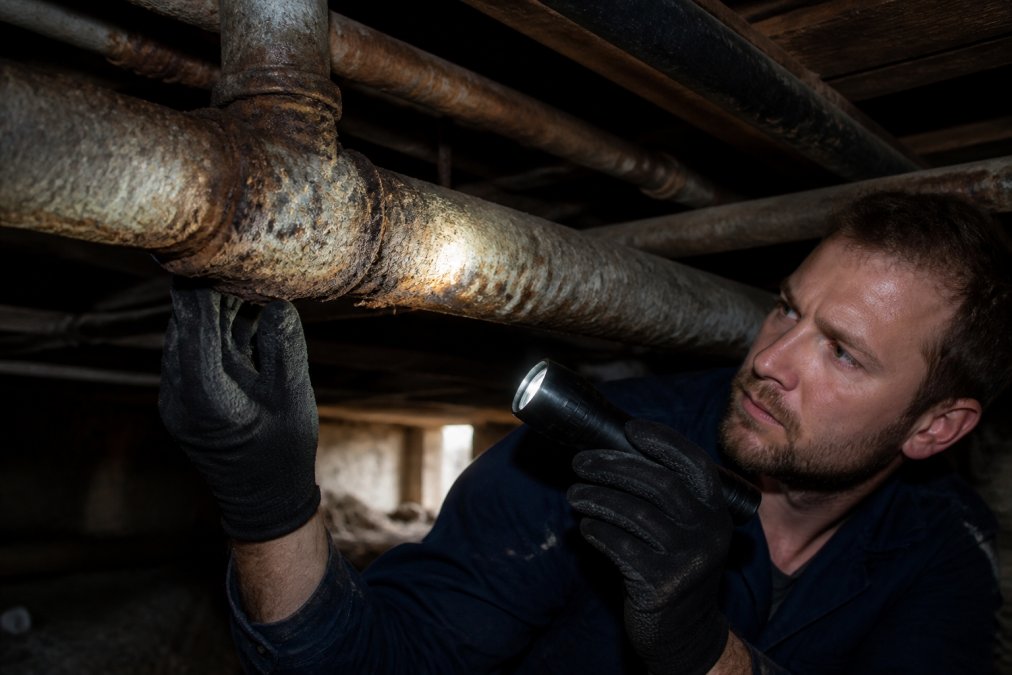
Galvanized steel pipes were standard until the 1960s. They fail from the inside out, with rust and scale restricting flow until the pipe eventually pinholes and leaks. When cut into, these lines are often completely occluded with sediment despite looking solid outside.
Lead pipes, commonly used for service lines into the 1930s, pose a health risk rather than a structural one. While the EPA regulates public water systems, the service line on your property is your responsibility. If you have lead pipes, replacement isn’t a convenience; it’s a safety priority.
Cast iron sewer lines are durable but eventually succumb to internal corrosion, creating a rough surface that catches debris and leads to a “bellied” pipe or collapse under shifting soil. A camera inspection is essential before buying or renovating an older property, as these failures are invisible until the backup occurs.
Hiring a Licensed Plumbing Contractor: Credentials That Matter
Hiring a licensed plumbing contractor is the only way to protect yourself from liability and shoddy workmanship. A license proves the individual passed a state exam and maintains continuing education, but verify a few specific details before they start.
First, confirm the license number is active and in good standing with your state’s licensing board. Second, ask for proof of general liability and workers’ compensation insurance, which protects you if the plumber damages your property or a worker is injured on your job site.
Ask if the plumber is bonded. A bond is a separate guarantee that the contractor will complete the job according to the contract or pay for damages. It adds a layer of financial protection that a license alone doesn’t provide.
According to the EPA’s guidelines on lead service line replacement, identifying the material of your service line is the first step in protecting your water quality, and many municipalities now require licensed contractors to handle this specific work.
Questions to Ask Before Any Plumber Touches Your Pipes
Before you authorize any work, you need answers that separate a specialist from a handyman with a wrench. A reputable contractor will welcome the scrutiny.
Ask about their experience with your specific pipe material: “Do you have experience repiping galvanized steel in a house from the 1920s?” is better than “Are you a good plumber?” You want someone who has dealt with your system’s quirks, not someone who will learn on your dime.
Inquire about their diagnostic process. Will they perform a camera inspection of the sewer line or a pressure test on the water supply? A contractor who relies on guesswork is a red flag. Finally, ask who will do the work, many companies send a licensed estimator but dispatch unlicensed day laborers for the installation. Confirm the crew on site is licensed and insured.
Cost to Repipe an Old House vs. Spot Repairs
The decision to repipe versus patch is usually financial, but it often comes down to frequency of failure. If you repair the same section every year, service call costs quickly exceed the value of a permanent fix.
The cost to repipe an old house depends on the number of bathrooms, pipe accessibility, and whether you are doing a full repipe or just the visible lines. While we cannot provide a specific quote without an on-site assessment, a full repipe is a significant investment that solves the problem permanently; spot repairs are cheaper upfront but leave the rest of the corroded system intact.
| Decision Factor | Spot Repair | Full Repipe |
|---|---|---|
| Upfront Cost | Lower | Higher |
| Recurring Failures | Likely | Unlikely |
| Water Pressure | Diminishing | Restored |
| Access Requirements | Minimal | May require wall opening |
| Best For | Recent, isolated leaks | Pinhole leaks, low pressure, rust |
A useful heuristic is the “50% rule”: if the cost of repairs over the next five years is projected to exceed half the cost of a repipe, the repipe is the better financial decision.
If you have galvanized pipes and are experiencing low pressure alongside rust-colored water, the system is failing internally. The most cost-effective solution in the long run is a full replacement, not a series of spot fixes.
Emergency Plumbing and Historic District Permits
When a pipe bursts at midnight, you need a response that prevents structural damage, a contractor’s logistics matter as much as their technical skill. Look for a team offering 24/7 emergency services with a guaranteed response time; a 90-minute window is a reasonable benchmark, as water damage accrues by the minute.
Emergency work in a historic home adds a second layer of complexity: the permitting process. If your property is listed on the National Register of Historic Places or sits within a locally designated historic district, rules governing even urgent repairs can be strict. The National Park Service requires that work on a certified historic structure be reviewed for consistency with the Secretary of the Interior’s Standards for Rehabilitation. While emergency repairs to stop active water damage are generally allowed, the method and materials may still require approval if they affect character-defining features.
Here is where many homeowners get into trouble. A burst pipe behind a plaster wall in a 1920s home often requires opening the wall to access the leak; in a historic district, the repair must typically preserve the original lath-and-plaster finish rather than replacing it with drywall. A plumber unfamiliar with preservation rules might cut a large access hole and patch it with modern materials, triggering a violation notice, making the fix more expensive because you must redo the work to match the original construction.
Another common scenario involves sewer line replacements. Many older homes have clay tile or Orangeburg lines that have collapsed, requiring excavation through a yard that may be part of the historic landscape. Local ordinances frequently protect not just the building but also mature trees and original walkways; a standard trenching approach could damage protected root systems, leading to fines or restoration requirements. A contractor experienced with historic properties will use trenchless technology, such as pipe bursting or cured-in-place pipe (CIPP) lining, to minimize ground disturbance.
The permitting process varies by jurisdiction, but a few patterns hold true. You will likely need a plumbing permit from the local building department, separate from any certificate of appropriateness from the historic preservation commission. The plumbing permit ensures code compliance; the certificate ensures the work does not alter historic character. Both are typically required before work begins, even for emergencies, though many jurisdictions allow retroactive application if work was necessary to stop active water damage.
Before hiring a plumber for any work on a historic home, ask specifically: “Have you pulled permits in this historic district before?” and “Will you coordinate with the preservation board on my behalf?” A contractor who hesitates or suggests skipping the permit to save time is a red flag. Unpermitted work can void your insurance coverage, trigger fines, and create major obstacles when you sell the home.
A final consideration is insurance. Many homeowners policies exclude coverage for damage caused by unpermitted work; if a plumber performs an emergency repair without the required permit and the work later fails, your insurer may deny the claim. The cost of pulling a permit is usually modest, often under $200, but the financial protection it provides is substantial.
In practice, establish a relationship with a plumbing contractor who has experience in historic districts before an emergency occurs. Ask them to walk your property and identify potential failure points; a proactive inspection can catch a corroded supply line or failing sewer before it becomes a midnight emergency, especially in homes with original galvanized or cast iron pipes.
Your Next Step: Call a Plumber Who Knows Old Systems
Finding the right specialist for your older home requires diligence, but the effort pays off in avoided damage and lower long-term costs. You need a team that combines diagnostic tools with hands-on knowledge of legacy materials and stands behind its work with transparent pricing.
Alpha Rooter & Plumbing brings licensed, experienced plumbers to every job, backed by state-of-the-art diagnostic equipment and upfront pricing with no hidden fees. Whether you face a sudden burst pipe or plan a full repipe, our team offers 24/7 emergency services with a response time of under 90 minutes.
Get started with Alpha Rooter & Plumbing and get a specialist who treats your home’s age as an asset, not a problem.
Frequently Asked Questions
How much does it cost to redo plumbing in an old house?
The cost to repipe an old house varies significantly based on square footage, number of bathrooms, pipe material chosen, and local permit fees. A full repipe is a major project, so the final price depends on your home’s specific layout and accessibility. For an accurate estimate, a licensed plumber must inspect the property to identify the scope of work. Contact Alpha Rooter & Plumbing for a detailed quote based on your home’s needs.
What is the difference between a certified plumber and a licensed plumber?
A licensed plumber has met state-specific requirements for training, apprenticeship hours, and passed a licensing exam. Certification typically refers to specialized training in a specific area, like backflow prevention or green plumbing. For older homes, hiring a licensed plumbing contractor ensures they have the foundational knowledge of codes and system design to handle complex issues like repiping or sewer line replacement safely.
Do I need a specialized plumber for galvanized steel pipes?
Yes, working with galvanized steel pipes requires specific experience. These pipes corrode from the inside out, often causing low water pressure and rusty water. Cutting them can disturb decades of buildup, leading to clogs. A plumber experienced with older homes will know how to diagnose the extent of the corrosion, whether to replace sections or plan a full repipe, and how to handle the transition to modern materials.
Comments are closed