
Table of Contents
- Tools and Safety Prep Before You Clear Stubborn Drain Clogs
- How to Use a Plumbing Snake to Break Up Deep Blockages
- Natural and DIY Methods That Work on Stubborn Drain Clogs
- Signs of a Main Sewer Line Clog vs. a Simple Sink Clog
- When to Call an Emergency Plumber for Stubborn Drain Clogs
- Preventing Future Stubborn Drain Clogs
- Frequently Asked Questions
Last Updated: September 10, 2026
Tools and Safety Prep Before You Clear Stubborn Drain Clogs
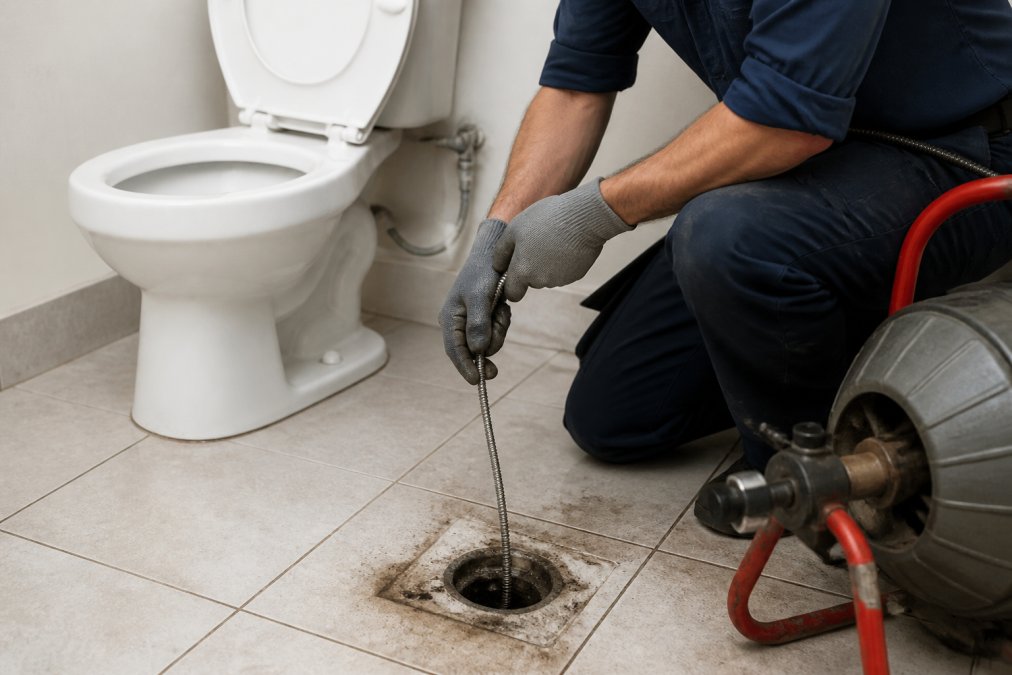
Best ways to clear stubborn drain clogs start with knowing what your pipes can survive. At Alpha Rooter & Plumbing, we know the most common mistake is skipping prep. A drain snake forced through brittle cast iron can crack the pipe wall (peer-reviewed research). Before you touch a tool, confirm your pipe material, protect your eyes and hands, and lay down towels.
Pipe Material Compatibility: What Your Drain Can Handle
Pipe material decides which methods are safe. Plastic PVC and ABS flex slightly and tolerate most DIY tools, including a manual auger. Older galvanized steel corrodes from the inside, so aggressive snaking can punch through weakened walls. Cast iron from the 1950s cracks under too much torque. If you don’t know your material, start with the gentlest method and stop the moment you feel resistance.
Never pour chemical drain cleaner into a fully blocked drain (the CDC). If the liquid can’t flow through, it sits in the basin and can splash back when you plunge, causing burns. It also corrodes older pipes.
The basic kit for stubborn drain clogs includes:
- Cup plunger with an extended flange
- Manual drain snake or auger
- Bucket and old towels
- Rubber gloves and safety glasses
- Adjustable wrench and plumber’s tape
How to Use a Plumbing Snake to Break Up Deep Blockages
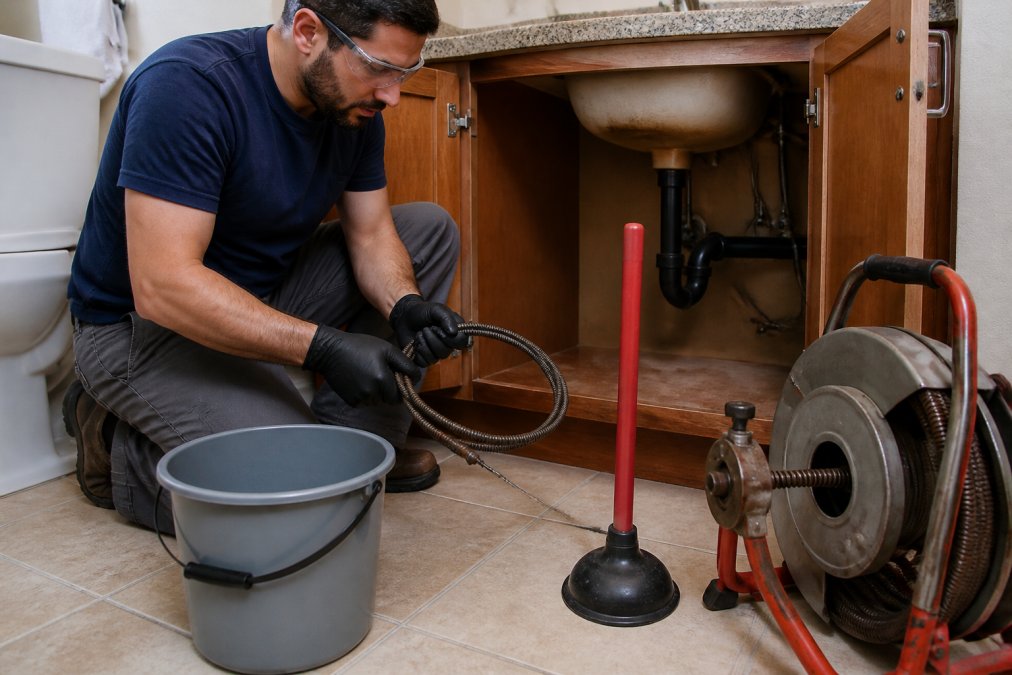
Learning how to use a plumbing snake is the single most valuable DIY skill for deep blockages. A plumbing snake, also called an auger, is a flexible metal cable that navigates pipe bends to reach debris a plunger can’t touch. Feed the cable into the drain until you feel resistance, then crank clockwise while applying gentle forward pressure.
Manual Auger vs. Drill-Powered Snake
A manual auger costs less and gives you more control in tight bends. A drill-powered snake spins faster and clears long horizontal runs, but it can kink thin cables or scratch pipe walls if you rush. For most household sinks and tubs, the manual version wins.
- Remove the strainer and any visible debris.
- Feed the cable in until it contacts the blockage.
- Crank clockwise to hook the clog.
- Pull back slowly, wiping the cable as it exits.
- Flush with hot water to confirm flow.
If the cable keeps slipping past the blockage, the clog may sit in the P-trap or beyond the vent stack, which points to a bigger problem.
Natural and DIY Methods That Work on Stubborn Drain Clogs
Natural methods are maintenance tools, not emergency tools. They work best on light organic buildup, soap scum, grease film, and food residue, and they fail against hair mats, solid obstructions, and anything past the P-trap. The key is knowing which reaction you’re triggering and which pipe material can survive it.
How Each Method Actually Works
Baking soda and vinegar work through a mechanical, not chemical, action. The fizzing carbon dioxide agitates loose debris and lifts it off the pipe wall, but the reaction is weak and short-lived. It will not dissolve a hair clog, because hair is protein-based and resistant to mild acids. The standard ratio is half a cup of baking soda followed by one cup of vinegar; let it sit fifteen minutes, then flush with hot, not boiling, water.
Boiling water melts grease and softens soap scum, which is why it performs well in kitchen lines. But it is risky in PVC and ABS. Most plastic drain pipe is rated for continuous temperatures well below boiling, and repeated boiling-water flushes can soften solvent-welded joints and cause leaks at the trap (peer-reviewed research). Use hot tap water in plastic pipes and reserve boiling water for metal.
A flexible zip stick or drain stick is the most underrated tool in this category. It’s a thin plastic strip with barbed edges that grabs hair directly. It costs a few dollars, requires no chemicals, and works on the most common bathroom clog there is. For a tub or bathroom sink with a hair clog, reach for the zip stick before anything else.
Pipe Material Compatibility for DIY Methods
| Pipe Material | Baking Soda + Vinegar | Boiling Water | Zip Stick |
|---|---|---|---|
| PVC / ABS | Safe | Avoid, can soften joints | Safe |
| Galvanized steel | Safe | Safe | Safe, but avoid force |
| Cast iron | Safe | Safe | Safe, but avoid force |
| Copper | Safe | Safe | Safe |
This is the part most guides skip. A method that’s harmless in a 1960s cast iron stack can damage a newer plastic trap, and vice versa. If you don’t know your pipe material, look under the sink, plastic is usually white, black, or gray and joined with slip nuts; metal is silver-gray and may show rust at the threads.
Eco-Friendly Disposal of What You Pull Out
When a zip stick or snake comes back loaded with hair, grease, and biofilm, don’t rinse it in the sink, you’ll just push the debris back into the drain. Wipe the tool with a paper towel, bag the towel, and put it in the trash. If you’ve used a bucket to catch standing water, pour it into a utility sink or toilet, not back into the clogged fixture. This step is boring, but it’s the difference between clearing a drain and re-clogging it in a week.
Never mix chemical drain cleaner with a natural treatment. If you’ve already poured a caustic product down the drain, do not follow it with vinegar or boiling water. The reaction can produce heat, fumes, and splashback. Flush with cool water and wait before trying anything else.
What to Do When Natural Methods Fail
If two rounds of baking soda and vinegar plus a zip stick don’t restore flow, stop. You’re now past the point where DIY chemistry helps, and you’re into mechanical territory, a plunger, a snake, or a call to a professional. Repeatedly pouring treatments into a standing-water drain wastes money and can damage older pipes. The decision tree below covers what to try next.
Signs of a Main Sewer Line Clog vs. a Simple Sink Clog
A main sewer line clog affects multiple fixtures at once, while a simple sink clog stays in one basin. That single distinction drives every decision that follows. If you snake one sink and the problem returns the next day, you’re not dealing with a sink clog, you’re dealing with a line clog, and no hand tool will fix it.
Diagnostic Decision Tree: What If Your First Attempt Failed?
Most guides stop at “call a plumber.” Here’s the actual sequence to run before you spend money.
- Did the clog clear and stay clear for 24 hours? If yes, it was a local clog. Move on.
- Did it clear, then return within a day or two? The blockage is deeper than your tool reached, likely past the P-trap or in the branch line. Try a longer manual auger before calling anyone.
- Do other fixtures in the home drain slowly at the same time? This is the strongest signal of a main line clog. Stop snaking the sink.
- Does water back up in a tub or shower when you run the washing machine or flush a toilet? That’s a shared-line backup. The clog sits downstream of where those fixtures connect.
- Do you hear gurgling from a drain you’re not using? Air is being pulled through a partially blocked line. Same conclusion.
- Is there sewage odor, or does water rise in a floor drain? Stop using water in the home and call a professional. This is a main line or vent stack issue.
Pipe Material Changes the Diagnosis
What’s blocking the line often correlates with what the line is made of. Older galvanized steel corrodes from the inside, narrowing the pipe until even normal use backs up, that’s not a clog you can snake out, it’s a pipe that needs replacement. Cast iron from the mid-20th century develops scale and root intrusion at joints. PVC and ABS rarely fail from corrosion, so a recurring clog in plastic pipe usually means a foreign object, a belly in the line, or root intrusion at a joint. Knowing your material tells you whether you’re fighting debris or fighting the pipe itself.
Visual Identification of Clog Types
What comes back on the tool tells you what you’re dealing with:
- Hair and soap scum: Gray-black, fibrous, often wrapped around the auger tip. Common in bathroom drains. A zip stick or snake handles it.
- Grease buildup: Yellowish-white, waxy, sometimes with food particles. Common in kitchen lines. Hot water and a snake, not chemicals.
- Foreign objects: Sudden total blockage with no slow-drain warning. A toy, a utensil, or a wad of paper. Snaking may push it deeper, a professional with a camera is the safer call.
- Root intrusion: Repeated clogs in the same spot, often in older homes with mature trees. Roots enter at joints. Only a professional with a cutter head can clear it.
| Symptom | Simple Sink Clog | Main Sewer Line Clog |
|---|---|---|
| Affected fixtures | One sink or basin | Multiple drains |
| Gurgling sound | Rare | Common |
| Overflow drain backup | No | Yes |
| Sewage smell | Mild | Strong |
| Recurrence | Occasional | Constant |
| Water backs up elsewhere | No | Yes, tub, shower, floor drain |
| Clears with hand snake | Usually | Rarely |
If several fixtures drain slowly at once, stop. A sewer line blockage needs professional equipment like hydro-jetting or a camera inspection, not a hand snake. Continuing to snake a main line can damage the pipe and push the clog further downstream, turning a service call into a repair.
Run the decision tree before you call. If you can answer “yes” to any of steps 3 through 6, you’re past DIY territory. If you’re stuck at step 2, a longer auger is worth one more try, but only one.
When to Call an Emergency Plumber for Stubborn Drain Clogs
Call an emergency plumber when raw sewage backs up, when you smell gas, or when water floods a finished space. Stubborn drain clogs that survive a plunger, a snake, and a natural treatment usually sit in the main line or a vent stack. Repeated backups after every fix mean the pipe itself is failing, not just blocked.
Property managers should log every backup by unit and date. A pattern across multiple units points to a shared line issue, which is a maintenance problem, not a tenant problem.
Alpha Rooter & Plumbing handles 24/7 emergency calls with a response time under 90 minutes, licensed plumbers, and upfront pricing with no hidden fees. When a clog defeats every DIY method, our guaranteed response time matters.
Preventing Future Stubborn Drain Clogs
Prevention beats any repair. Install drain screens in every kitchen and bathroom basin to catch hair and food before they enter the pipes. Once a month, flush kitchen lines with hot water to keep grease from building up. Never pour cooking oil, coffee grounds, or fibrous food scraps down the sink.
For older homes with recurring drainage issues, schedule a camera inspection to check pipe integrity. A slow-draining sink today is a full blockage next month. Catch it early and you avoid the emergency call entirely.
A stubborn drain clog can turn a normal day into a flooded kitchen, and the DIY methods above only go so far. When a plunger, snake, or natural treatment fails, Alpha Rooter & Plumbing is ready with 24/7 emergency service, a response time under 90 minutes, and licensed plumbers. Our upfront pricing means no hidden fees and no overtime charges, so you know the cost before we start. Call Alpha Rooter & Plumbing today and get your drains flowing again.
Frequently Asked Questions
What do plumbers use instead of chemical drain cleaner?
Professional plumbers rely on mechanical removal tools like drain snakes, augers, and hydro-jetting equipment rather than chemical drain cleaners. These methods physically break up or flush out blockages without exposing pipes to corrosive substances. For stubborn drain clogs caused by grease, hair, or scale, hydro-jetting uses high-pressure water to scour the pipe walls clean. This approach is safer for older plumbing and delivers longer-lasting results than pouring chemicals down the drain.
Are chemical drain cleaners safe for older plumbing systems?
Chemical drain cleaners pose real risks for older pipes, especially cast iron or galvanized steel common in pre-1970s homes. The corrosive ingredients generate heat and can weaken pipe walls, accelerate corrosion, and even cause leaks. If your home has older plumbing, skip the chemical aisle and try a plunger or plumbing snake first. For recurring stubborn drain clogs in aging pipes, a licensed plumber can inspect the line and recommend the safest clearing method.
How do you know if a drain clog requires professional intervention?
Call a professional when multiple fixtures drain slowly at the same time, when you hear gurgling sounds from other drains, or when sewage odor appears. These are classic signs of a main sewer line clog rather than a simple sink blockage. If plunging and snaking fail after two attempts, or if standing water returns quickly, it is time to call an emergency plumber. Ignoring these signals can lead to sewage backups and costly water damage.
Why shouldn’t you use baking soda and vinegar to unclog a drain?
Baking soda and vinegar create a fizzing reaction that can loosen light organic buildup, but the mixture lacks the force to clear a true stubborn drain clog. The reaction produces gas and water, not enough pressure to push through compacted hair or grease. Worse, if the drain is fully blocked, the mixture just sits in standing water. Use it for maintenance on slow drains, not as a rescue for a backed-up sink or shower.
Comments are closed