
Table of Contents
- Residential Plumbing Services: What Homeowners Actually Get
- Core Services Every Provider Should Offer
- Emergency Plumbing Services: What to Expect When a Pipe Bursts
- How to Find a Reliable Plumber Without Getting Burned
- Plumbing Repair Cost Estimates: What Drives the Final Number
- DIY vs. Professional Assessment: When to Call It In
- Preventative Maintenance Checklist for Older Homes
- Frequently Asked Questions
Last Updated: September 15, 2026
Residential Plumbing Services: What Homeowners Actually Get
Residential plumbing services cover the diagnosis, repair, and maintenance of every water and waste system inside a home, from the supply lines behind your walls to the drain running under your yard. At Alpha Rooter & Plumbing, we handle these calls daily.
A burst pipe can release several gallons per minute, and a failed water heater can flood a utility closet before you find the shutoff valve. That urgency is why choosing a provider before you need one matters more than comparing ads after the fact. Below, we break down what each service actually includes, how pricing gets built, and when a problem is genuinely a DIY job versus a call you should make immediately.
Core Services Every Provider Should Offer
A legitimate residential plumbing company should cover eight core service lines: emergency response, drain and sewer cleaning, water heater work, leak detection, preventive maintenance, pipe repair and repiping, fixture installation, and garbage disposal service. If a provider is missing two or more of these, they are likely a specialist subcontracting the rest, which means longer wait times and a second markup on your invoice.
Here is what each service actually includes, and what typically drives its cost.
Emergency plumbing services cover burst pipes, sewage backups, and total loss of water. The work itself is usually straightforward, isolate the line, stop the flow, repair or cap, but the cost is driven by timing, not complexity. After-hours, weekend, and holiday calls carry a surcharge at most companies. Ask whether the service call fee is credited toward the repair.
Drain cleaning clears kitchen, bath, and main-line blockages. A cable auger handles most sink and toilet clogs; hydro-jetting is reserved for grease buildup and root intrusion in the main line. The cost difference between the two is significant, so ask which method the quote assumes. A camera inspection before and after is standard practice on main-line work.
Water heater repair and installation covers both tank and tankless units, including expansion tanks, venting, and code-required drip pans and discharge pipes. Tank replacements are typically a same-day job; tankless conversions often require gas line upsizing and a new vent run, which pushes the project to two or three days.
Leak detection uses acoustic listening equipment, thermal imaging, and pressure testing to find hidden leaks without tearing out drywall. The value here is diagnostic, not repair, a good technician narrows the leak to a square foot before anyone opens a wall.
Residential plumbing maintenance typically includes an annual inspection of shutoff valves, supply lines, the water heater, and the main drain. This is the cheapest service on the list and the one most homeowners skip.
Pipe repair and repiping addresses corroded galvanized or cast iron lines. Spot repairs are priced per opening; whole-home repiping is quoted as a project with drywall access and restoration called out separately.
Fixture installation covers toilets, faucets, and sinks. Most of these are flat-rate jobs because the labor is predictable. The wild card is whether the existing shutoff valve and supply line can be reused or need replacement while the fixture is off.
Garbage disposal services handle jams, leaks, and full replacements. A jam is a service call; a leaking housing is a replacement. Disposals are rarely worth repairing once the housing or motor fails.
| Service | Typical Trigger | Urgency Level | Main Cost Driver |
|---|---|---|---|
| Emergency plumbing | Burst pipe, no water, sewage backup | Immediate | Time of day, after-hours surcharge |
| Drain cleaning | Slow or clogged drain | Within 24-48 hours | Auger vs. hydro-jet, line access |
| Water heater service | No hot water, leaking tank | Same day to 48 hours | Tank vs. tankless, venting, gas line |
| Leak detection | Unexplained high water bill | Within a week | Diagnostic equipment, wall access |
| Repiping | Recurring leaks, rusty water | Scheduled project | Pipe material, drywall restoration |
| Fixture installation | Remodel or replacement | Scheduled | Shutoff valve and supply line condition |
When you compare providers, ask each one to name the cost driver for your specific job. A quote that can’t identify whether the price is set by access, parts, labor, or timing is a quote built on a guess.
Emergency Plumbing Services: What to Expect When a Pipe Bursts
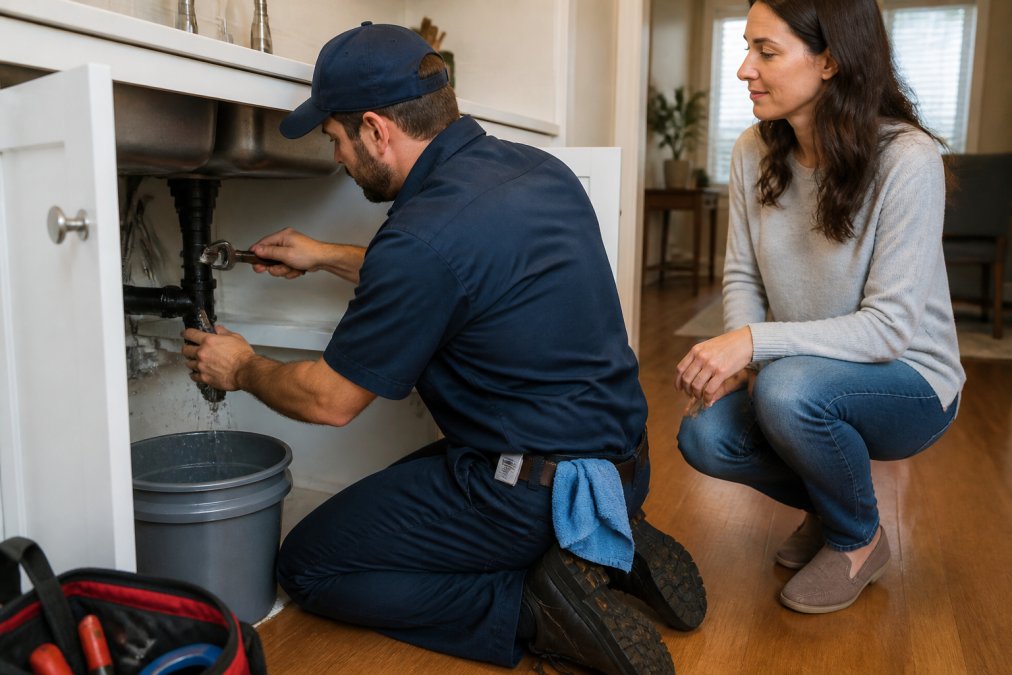
The first thing to do when a pipe bursts is shut off the main water valve, then call a licensed plumber. Everything else, including mopping and moving furniture, comes second. A licensed plumber should confirm arrival time when you call, not after you’ve waited an hour.
Response Times, After-Hours Fees, and What to Ask
Ask three questions before you hang up: What is your guaranteed arrival window? Is there an after-hours or weekend surcharge? Is the service call fee credited toward the repair? Providers that advertise “no hourly or overtime charges” and “upfront pricing with no hidden fees” are telling you the price you’re quoted is the price you pay, regardless of when the call comes in.
A common mistake is assuming a national chain guarantees a faster response than a local provider. In practice, response time depends on how many trucks are actually in your area at that hour, not on brand size.
Never pay a deposit before a plumber arrives on site. A legitimate provider diagnoses the problem first, then quotes the repair. Deposits requested over the phone are a red flag for unlicensed operators.
How to Find a Reliable Plumber Without Getting Burned
Verifying a plumber’s license and insurance takes about five minutes and prevents the most expensive mistakes. Every state maintains a public licensing board database where you can look up a contractor by name or license number. Ask for the license number in writing before work begins, then verify it yourself.
License Verification and Insurance Checks
A licensed plumber carries both a state contractor license and liability insurance. Ask for a certificate of insurance showing general liability coverage and, if they employ staff, workers’ compensation. If a technician is injured on your property and the company has no workers’ comp, your homeowner’s policy may be on the hook.
The U.S. EPA’s guidance on water efficiency and plumbing standards is a useful reference for understanding which fixtures and installations meet current federal standards, and the U.S. Department of Labor’s contractor licensing resources explains why licensing requirements vary by state.
Look up the license number while the plumber is still standing in your driveway. If the name on the license doesn’t match the company on the truck, stop the job before any work starts.
Plumbing Repair Cost Estimates: What Drives the Final Number
A plumbing repair estimate is built from four variables: the diagnosis, the parts required, the labor hours, and access difficulty. Two identical-sounding problems can land at very different prices depending on whether the pipe is exposed in a basement or buried behind finished tile.
The biggest cost driver homeowners underestimate is access.
The number on a plumbing quote is not arbitrary. It reflects diagnosis, parts, labor, and access. Any provider who can’t explain which of those four is driving your price is guessing, and you’ll pay for the guess.
DIY vs. Professional Assessment: When to Call It In
Call a plumber for these every time:
Preventative Maintenance Checklist for Older Homes
Spring
Summer
Fall
Winter
What You Can Do Yourself vs. When to Call a Pro
Call a plumber for these every time:
Photograph your main shutoff valve and tag it with a zip tie. In an emergency, the person who knows where it is saves thousands in water damage, and that person may not be you.
Frequently Asked Questions
What is a residential service plumber?
A residential service plumber handles repairs, installations, and maintenance for single-family homes and multi-unit buildings. That includes clogged drains, water heater repair, leak detection, fixture installation, and sewer line work. Unlike commercial plumbers who focus on business or industrial systems, residential plumbers work with standard home plumbing setups. When searching for residential plumbing services, confirm the provider handles your specific issue, whether that is a slow drain or a full repipe.
How do I know if a plumbing company is licensed and insured?
Ask for the license number and verify it through your state’s licensing board. In many states, you can look up the number online in minutes. Request a certificate of insurance showing both general liability and workers’ compensation coverage. A legitimate company will provide these without hesitation. If a plumber cannot produce a license number or insurance documents, walk away. Unlicensed work can leave you liable for damage and may void your homeowner’s insurance.
What should I ask before hiring a plumber?
Ask four questions: Are you licensed and insured? Do you charge a service call fee or offer free on-site estimates? What is your response time for emergencies? Is your pricing flat-rate or hourly? Also ask whether the quote includes parts, labor, and cleanup. Get the estimate in writing before work begins. A company that provides upfront pricing with no hidden fees will answer all four questions directly, which is a good sign you are dealing with a reputable provider.
How can I avoid getting ripped off by a plumber?
Get at least two written estimates for non-emergency work. Avoid anyone who demands full payment upfront or only accepts cash. Be wary of unsolicited door-to-door offers. Confirm the plumber’s license number matches the company on the invoice. For emergency plumbing services, ask about after-hours rates before they arrive. A trustworthy company will explain what is included in the price and will not add charges after the job is done.
What is the average cost for emergency plumbing services?
Emergency plumbing costs vary widely depending on the problem, time of day, and local labor rates. A burst pipe, sewer backup, or failed water heater each carries different labor and parts requirements. Some companies charge overtime rates on nights and weekends; Alpha Rooter & Plumbing offers no hourly or overtime charges. Request an upfront estimate before work starts so you know the full scope and price.
Comments are closed