
Table of Contents
- Why Galvanized Pipes Fail in Old Houses
- Signs of Galvanized Pipe Corrosion You Should Not Ignore
- Solution 1: Whole-House Repiping With PEX Tubing
- Solution 2: Copper Repiping With Press Connections
- Solution 3: Trenchless Epoxy Pipe Lining for Historic Homes
- Solution 4: Hybrid Repiping for Budget-Conscious Owners
- Solution 5: Targeted Repairs With Push-to-Connect Fittings
- PEX vs Copper for Repiping: Which Material Wins?
- Frequently Asked Questions
Last Updated: September 16, 2026
Why Galvanized Pipes Fail in Old Houses
Galvanized pipes fail because the protective zinc coating inside the steel erodes over decades, exposing bare metal to water and oxygen until the pipe corrodes from the inside out. Most galvanized steel plumbing installed between the 1930s and 1960s has already outlived its expected 40- to 50-year service life, which is why so many older homes now deal with restricted flow, discolored water, and sudden leaks.
How Internal Rust and Scale Accumulation Choke Water Flow
Two processes kill galvanized pipes: internal rust and scale accumulation. As corrosion eats into the steel, mineral deposits bind to the rough interior surface and narrow the passage water travels through. A pipe that once carried a full volume of water may end up with a channel the width of a pencil. That flow restriction shows up as weak shower pressure, taps that take forever to fill a sink, and fixtures that lose pressure whenever a second outlet turns on.
Signs of Galvanized Pipe Corrosion You Should Not Ignore
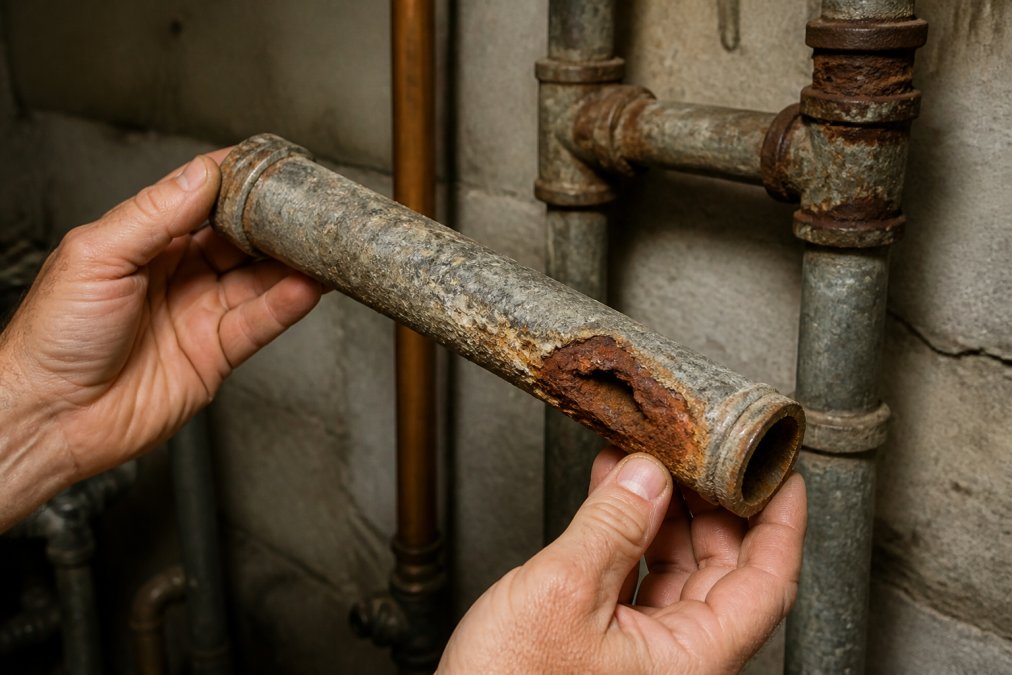
Watch for water discoloration, a metallic taste, pinhole leaks, and dropping water pressure. Any one of these points to corrosion inside the line; two or more together usually mean the system is near the end of its useful life. Because the damage happens inside the pipe, homeowners often miss the early warning signs until a pipe bursts behind a wall.
Water Discoloration, Metallic Taste, and Pinhole Leaks
Brown or yellow water when you first turn on a tap is rust breaking loose inside the line. A metallic taste means the same corrosion is reaching your drinking water. Pinhole leaks, small weeping spots along the pipe, signal that the steel wall has thinned to the point of failure. A common mistake is treating these as isolated problems and patching one leak at a time.
Solution 1: Whole-House Repiping With PEX Tubing
Whole-house repiping with PEX tubing is the most cost-effective permanent fix for a home full of failing galvanized steel. PEX is a flexible cross-linked polyethylene that resists scale buildup and corrosion, so it won’t develop the internal rust that destroyed the original pipes. Because the tubing bends around corners, installers need fewer fittings and can often fish it through existing wall cavities with minimal demolition.
Solution 2: Copper Repiping With Press Connections
Copper repiping remains the traditional choice for homeowners who want maximum lifespan and resale value. Copper is rigid, durable, and naturally resistant to bacterial growth, and a well-installed copper system can last 50 years or more. The modern approach uses press connections rather than soldering: tools like the Viega ProPress system crimp a fitting onto the pipe with a mechanical press, creating a permanent, watertight seal without an open flame.
Solution 3: Trenchless Epoxy Pipe Lining for Historic Homes
Epoxy pipe lining restores failing galvanized pipes from the inside, without tearing open walls or floors. An installer cleans the existing pipe, then applies an epoxy liner that cures into a smooth “pipe-within-a-pipe” barrier. Providers such as Nu Flow pipe lining use this trenchless method specifically for historic homes where demolition isn’t feasible or would destroy original finishes. It stops corrosion, restores flow capacity, and is safe for potable water.
Solution 4: Hybrid Repiping for Budget-Conscious Owners
Hybrid repiping replaces only the worst sections of galvanized pipe while leaving healthier runs in place, cutting the upfront cost of a full repipe and spreading the project across multiple budget cycles. This is the strategy most guides skip, and it’s often the smartest move for a homeowner who can’t fund a whole-house job right now.
How to Phase a Hybrid Repipe
A common pattern is a three-phase plan:
- Phase 1, Stop the bleeding. Replace the runs with active leaks, visible pitting, or the heaviest scale. These are usually the horizontal runs in the basement or crawlspace and the vertical stack feeding the bathrooms.
- Phase 2, Protect the high-use fixtures. Replace the branches feeding the kitchen, primary bath, and laundry, where water demand and health exposure are highest.
- Phase 3, Finish the system. Replace the remaining low-use branches (guest bath, hose bibs, rarely used fixtures) before they fail on their own schedule.
Each phase can be completed as a standalone job, so you’re not paying for a full repipe in one invoice. Expect the per-phase cost to be higher than the equivalent portion of a single whole-house job, because the plumber mobilizes multiple times, but the total is spread over months or years instead of one lump sum.
Which Runs to Replace First
Prioritize by these signals, in order:
- Active or recurring leaks, any run that has already failed once is the most likely to fail again.
- Discolored water at a specific fixture, the branch feeding that fixture is shedding rust and should go first.
- Lowest measured pressure, a pressure gauge reading at each fixture reveals which runs are most choked by scale.
- Accessibility, runs behind finished walls or under slab are worth replacing while you have the wall open for another reason, even if they aren’t the worst offenders yet.
Maintaining the Galvanized Sections You Keep
If you keep any galvanized pipe under a hybrid plan, treat it as a monitored asset, not a solved problem:
- Flush the system at least twice a year by running every fixture, including hose bibs and rarely used taps, for several minutes to move sediment through and out.
- Watch for new discoloration at the fixtures still fed by galvanized pipe; a return of brown or yellow water means the remaining runs are degrading faster.
- Check water pressure quarterly at a consistent fixture. A slow decline is the earliest signal that scale is closing off another run.
- Keep a written map of which runs are new and which are original, so any future plumber can see the system at a glance.
Hybrid repiping buys time, not permanence. The galvanized sections you leave behind will eventually fail, the goal is to control when and where that happens, not to avoid it. Budget for the remaining phases before the pipe forces your hand.
Solution 5: Targeted Repairs With Push-to-Connect Fittings
Targeted repairs with push-to-connect fittings are the fastest way to stop an active leak or bridge a failing galvanized section to new pipe. Fittings like SharkBite push-to-connect join copper, PEX, CPVC, and PE-RT without soldering or glue, so a repair can happen in minutes with no specialized tools. They’re rated for behind-the-wall and underground use, which makes them a genuine fix rather than a temporary patch.
PEX vs Copper for Repiping: Which Material Wins?
PEX wins on cost and installation speed; copper wins on lifespan and resale appeal. For most old houses, PEX is the better value because it’s significantly cheaper, flexible enough to retrofit through existing cavities, and immune to the corrosion that ruined the original galvanized steel. Copper is the stronger pick when you want a permanent, traditional system and plan to stay in the home long term.
| Factor | PEX Tubing | Copper Piping |
|---|---|---|
| Corrosion resistance | High (no rust) | High (can pit in some water) |
| Installation speed | Fast, fewer fittings | Slower, rigid runs |
| Relative cost | Lower | Higher |
| Typical lifespan | Long service life | 50+ years |
| Best for | Budget retrofits | Long-term permanence |
The Two Angles Most Guides Skip
Insurance implications. Some insurers view aging galvanized plumbing as a water-damage risk and may adjust coverage or premiums until it’s addressed. Before you start a repipe, or after a leak, call your carrier and ask three questions: (1) Does my current policy exclude or limit damage from a known aging-pipe condition? (2) Will documenting a partial or full repipe lower my premium or restore full coverage? (3) If a leak already happened, what documentation do you need to process the claim?
- Home improvement loans from a bank or credit union, often unsecured and sized to the project.
- Cash-out refinance if you have equity and want to fold the repipe into a larger renovation.
- HELOC (home equity line of credit), a revolving line you can draw against in phases, which pairs well with a hybrid repipe plan.
- Contractor financing, some plumbing companies offer in-house payment plans; ask before you sign.
Match the material to your timeline and your wallet: PEX for the fastest, cheapest path off galvanized; copper for a permanent system you’ll never think about again. Then line up insurance and financing before the first pipe is cut, not after.
Frequently Asked Questions
Are galvanized pipes a problem in older homes?
Yes. Galvanized steel pipes were common before the 1960s and typically last 40 to 50 years. Once the zinc coating wears away, internal rust and scale accumulation restrict water flow, cause pinhole leaks, and affect water quality. If your home still has original galvanized pipes, they are likely past their useful lifespan and should be evaluated by a licensed plumber.
What should you replace galvanized pipes with?
PEX tubing and copper piping are the two most common replacements. PEX costs less, installs faster, and resists scale buildup, making it a strong choice for whole-house repiping. Copper lasts 50 or more years and adds resale value but costs more in materials and labor. A hybrid approach that combines both materials is also an option for budget-conscious homeowners.
How do I know if my galvanized pipes are failing?
Watch for water discoloration, a metallic taste, dropping water pressure, pinhole leaks, and visible rust on exposed pipes. These are classic signs of galvanized pipe corrosion. A home inspection or camera scope can confirm the internal condition. If you notice multiple signs at once, schedule a professional evaluation before a pipe bursts and causes water damage.
Is it better to repipe or patch galvanized plumbing?
Patching works for isolated pinhole leaks, but if corrosion is widespread, patching becomes a cycle of repeated repairs. Whole-house repiping solves the root problem and restores water pressure and quality. A hybrid repiping strategy, where the worst sections are replaced first, can balance cost and long-term reliability for homeowners not ready for a full repipe.
Can you sell a house with galvanized pipes?
You can sell a house with galvanized pipes, but buyers and inspectors will flag them. Many buyers request a repipe credit or walk away. Replacing galvanized pipes before listing often increases resale value and removes a major negotiation point. If a full repipe is not feasible, documenting recent repairs and a maintenance plan can help ease buyer concerns.
Comments are closed