
Table of Contents
- How Long Residential Sewer Lines Actually Last
- Sewer Line Lifespan by Pipe Material
- How to Identify Your Pipe Material and Estimate Its Age
- What Shortens a Sewer Line’s Service Life
- Signs of a Failing Sewer Line You Should Not Ignore
- Sewer Line Inspection: What a Camera Finds and What It Means
- Sewer Pipe Lining Lifespan vs. Full Replacement
- Frequently Asked Questions
Last Updated: October 13, 2026
How Long Residential Sewer Lines Actually Last
The average lifespan of residential sewer lines ranges from about 50 to 100 years, depending on pipe material, soil conditions, and maintenance. That range is a planning benchmark, not a promise, a clay lateral from 1952 and a PVC line from 2015 can both fail early if tree roots or ground movement get involved.
At Alpha Rooter & Plumbing, we run sewer camera inspections across older neighborhoods every week, and the pattern is consistent: material sets the ceiling, site conditions set the clock.
Lifespan estimates describe how long a pipe can last under good conditions. Your actual service life depends far more on soil chemistry, root intrusion, and installation quality than on the material label alone.
Sewer Line Lifespan by Pipe Material
Sewer line lifespan by pipe material is the biggest factor in how long your lateral serves the property, but not the only one.
| Pipe Material | Typical Service Life | Common Failure Mode | Best For |
|---|---|---|---|
| PVC / ABS plastic | 50-75 years | Joint separation, crushing | New installs, replacements |
| Cast iron | 50-75 years | Internal corrosion, scaling | Pre-1980 homes |
| Clay (vitrified) | 50-100 years | Root intrusion, cracking | Very old neighborhoods |
| Orangeburg | 10-30 years | Collapse, deformation | Historical only |
| Concrete | 50+ years | Cracking, joint failure | Large-diameter mains |
| Steel | 30-50 years | Rust-through | Rare in residential laterals |
The ranges above are widely cited industry estimates, not guarantees. American Society of Civil Engineers infrastructure report card has repeatedly flagged aging underground pipe networks as a growing concern, and residential laterals are part of that same story.
Do not assume a “100-year” clay pipe is safe just because it is under 100 years old. A 60-year-old clay line with heavy root intrusion can fail long before a well-installed PVC line half its age.
PVC and ABS: 50 to 75 Years
PVC and ABS are the modern standard for residential laterals, typically delivering 50 to 75 years when installed correctly. Both are smooth-walled, resistant to most soil chemicals, and joined with solvent cement or mechanical couplings that handle normal ground movement. PVC rarely corrodes but can crack under point loads or settle into a belly if bedding was inadequate; ABS is more susceptible to UV degradation before installation.
Cast Iron and Clay: 50 to 100 Years With Caveats
Cast iron and clay are the materials most likely found under pre-1980 homes, and both can last 50 to 100 years, with significant caveats. Cast iron corrodes from the inside out, narrowing the effective diameter and catching debris, so a line that looks fine outside may be nearly blocked internally.
Steel, Concrete, and Orangeburg: Shorter Timelines
Steel, concrete, and Orangeburg are the short-timeline materials. Steel rusts through in roughly 30 to 50 years. Concrete can last 50 years or more but cracks at joints. Orangeburg, a bituminized fiber pipe used from the late 1940s through the 1970s, deforms and collapses within 10 to 30 years and cannot be reliably rehabilitated, if an inspection confirms it, replacement is the only sensible option.
How to Identify Your Pipe Material and Estimate Its Age
Identifying your sewer pipe material starts with the cleanout. Most homes have at least one exterior cleanout, and the exposed pipe there often reveals the material in seconds.
- PVC or ABS: White, gray, or black plastic with a smooth surface and solvent-welded joints.
- Cast iron: Heavy, dark, magnetic metal, often with visible hub-and-spigot joints.
- Clay: Terracotta-colored, dull, and brittle; joints are usually packed with mortar or gasket material.
For age, check the home’s construction date on public records. Pre-1975 homes likely have cast iron or clay; 1945-1972 homes may have Orangeburg; post-1980 homes are almost always PVC or ABS.
If the cleanout material does not match the home’s construction era, a previous owner likely replaced part of the line. A camera inspection will show where the old pipe ends and the new pipe begins, which tells you exactly what has and has not been upgraded.
What Shortens a Sewer Line’s Service Life
Soil conditions and root intrusion most often cut a sewer line’s life short. The material sets the ceiling; the site decides how close you get to it.
Soil Chemistry, Ground Movement, and Freeze-Thaw Cycles
Acidic or sulfate-rich soils attack concrete and, to a lesser degree, cast iron. Expansive clay soils swell and shrink, stressing joints until they separate, and freeze-thaw cycles shift shallow laterals out of alignment. Groundwater matters too: a line in permanently saturated soil corrodes faster, while one in well-drained soil can last decades longer.
Root Intrusion, Blockages, and Past Installation Quality
Tree roots are the most common cause of premature sewer line failure. Roots enter through the smallest joint gap or crack, then expand until they catch debris and cause a backup; once established, recurring blockages are the norm until the line is repaired or replaced.
Signs of a Failing Sewer Line You Should Not Ignore
Signs of a failing sewer line usually appear in a predictable order, and catching them early is the difference between a targeted repair and full excavation.
- Multiple drains backing up at once, especially in the lowest fixtures
- Slow drainage that returns after every snaking
- Sewage odor in the yard or around the cleanout
A single backup in one fixture is often a local clog. Backups in multiple fixtures, or ones recurring within weeks of being cleared, point to a problem in the lateral itself.
U.S. Environmental Protection Agency guidance on sanitary sewer overflows notes that blockages and root intrusion are among the leading causes of residential sewer backups, which is why recurring clogs deserve a camera inspection rather than another round of snaking.
Sewer Line Inspection: What a Camera Finds and What It Means
A sewer line inspection uses a camera on a flexible reel to record the inside of the pipe from the cleanout to the municipal connection, pinpointing defects by distance from the access point.
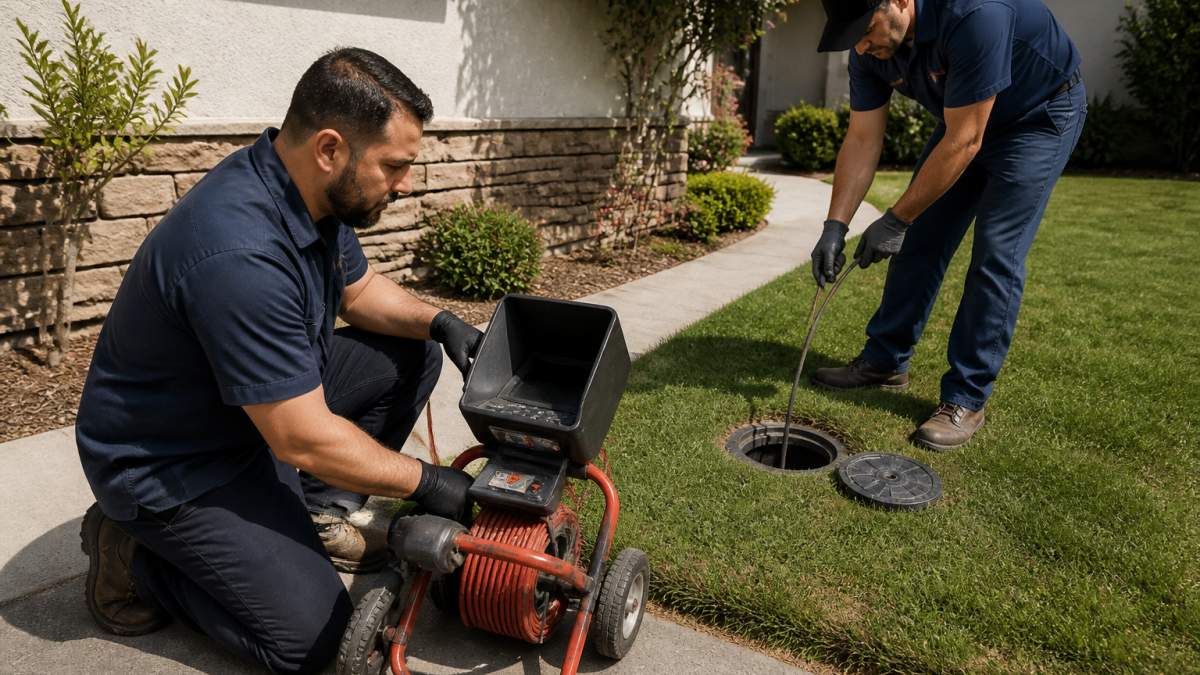
What separates a useful inspection from a useless one is not the footage, it is the interpretation.
Cracks and Fractures
A hairline crack that does not penetrate the wall is a watch item. A crack through the wall, or one with soil or root material entering it, is a structural defect. Once soil migrates in, the void left outside causes bedding to settle, shifting the pipe and widening the crack, which is why a small crack in poorly bedded soil is more urgent than one in stable gravel.
Offset Joints
An offset is when two pipe sections no longer line up, creating a lip inside the pipe. A small offset, roughly a quarter inch or less, usually just catches debris and can be managed with periodic jetting. A larger or actively widening offset points to ongoing ground movement and is a strong candidate for lining or spot repair.
Root Intrusion
Roots enter through the smallest gap, often a joint that looks intact on camera, then branch into a mass that catches paper, grease, and debris. Roots at the pipe wall are manageable with cutting and follow-up; roots that have filled enough cross-section to slow flow require a repair-or-line decision.
Bellies and Low Spots
A belly is a section where the pipe has settled and no longer holds its slope, so water and waste pool instead of draining. Bellies are diagnosed by watching where standing water sits on camera and confirming with a slope reading. A shallow belly may only cause occasional slow drains; a deep belly holding several inches of water is a chronic clog generator requiring excavation or a liner that restores a smooth interior.
Corrosion and Scaling (Cast Iron)
Cast iron corrodes from the inside, showing on camera as a rough, tuberculated interior that narrows the effective diameter, a line that is 4 inches at the cleanout may be effectively 2.5 inches in the worst section. Scaling is progressive, so the practical question is how much cross-section remains and how fast it is closing.
Collapse and Deformation
A collapsed pipe shows a total loss of cross-section, often with soil visible; Orangeburg deformation looks similar, flattening into an oval or slit. Both are end-of-life findings, no lining or repair restores a collapsed or fully deformed pipe, so the section must be replaced.
How to Read the Inspection Report
A competent inspection report should include:
- Footage distance markers for every defect, tying findings to a physical location in the yard
- Pipe material observed and any transitions between materials
- Each defect’s size relative to the pipe diameter
If a report only says “roots found” or “cracks present” without distances and severity, ask for a re-inspection or second opinion. Distance markers let you compare findings to your property layout and confirm where excavation or lining access would be needed.
Ask the technician to pause the camera at each defect and call out the footage distance. A finding you can locate on a plat map is a finding you can get competitive bids on. A finding described only as “somewhere in the line” is not.
Urgency Levels at a Glance
| Finding | Mechanism | Typical Urgency |
|---|---|---|
| Hairline crack, no soil entry | Surface defect | Monitor at next inspection |
| Small offset (under 1/4 inch) | Debris catch point | Jet as needed, re-inspect in 1-2 years |
| Roots at joints, flow clear | Entry point established | Cut roots, schedule repair |
| Roots causing backup | Cross-section restricted | Repair or line now |
| Crack with soil entry | Bedding loss, widening | Repair or line soon |
| Deep belly holding water | Lost slope | Section repair or line |
| Heavy scaling (cast iron) | Internal corrosion | Assess remaining cross-section |
| Collapse or Orangeburg deformation | Structural failure | Replace immediately |
U.S. Environmental Protection Agency guidance on sanitary sewer overflows notes that blockages and root intrusion are among the leading causes of residential sewer backups, which is why recurring clogs deserve a camera inspection rather than another round of snaking.
Sewer Pipe Lining Lifespan vs. Full Replacement
Sewer pipe lining lifespan runs roughly 50 years for a properly installed cured-in-place pipe (CIPP) liner, while full replacement with new PVC delivers 50 to 75 years. But lifespan alone is the wrong way to choose, the right decision depends on damage type, the remaining pipe’s condition, accessibility, disruption tolerance, and your long-term plans.
How CIPP Lining Works
A CIPP liner is a resin-saturated felt tube inverted into the existing pipe and cured in place, creating a smooth new interior wall bonded to the old pipe.
Lining works best when the existing pipe is structurally sound but cracked, root-damaged, or joint-compromised. It is not a fix for a pipe that has lost its shape or its slope.
How Full Replacement Works
Full replacement means excavating the old line and installing new pipe, almost always PVC or ABS. It resets the clock, allows a larger diameter if needed, and permits modern bedding and slope correction. The trade-off is disruption: trenching through yards, driveways, or landscaping, plus restoration.
A Decision Framework
Work through these questions in order. The first one that applies usually settles the choice.
**1.
2. Is the slope correct?
A liner follows the existing pipe, so a deep belly or flat section is preserved.
**3.
**4.
5. What is the remaining service life of the host pipe?
Lining extends a pipe that still has structural integrity.
**6.
Side-by-Side Comparison
| Factor | CIPP Lining | Full Replacement |
|---|---|---|
| Expected service life | ~50 years | 50-75 years (PVC) |
| Excavation required | Cleanout access only | Trench or access pits |
| Typical disruption | Low, landscaping preserved | High, yard, driveway, hardscape |
| Handles collapsed pipe | No | Yes |
| Corrects slope / bellies | Limited | Yes |
| Allows upsizing diameter | No | Yes |
| Handles Orangeburg | No | Yes |
| Same-day return to service | Usually | Usually, after backfill |
| Best for | Sound pipe with cracks, roots, joint damage | Collapse, deformation, severe bellies, end-of-life material |
Cost Considerations
Lining is often less expensive than full excavation because it avoids digging and restoration, but the gap narrows when the line is shallow and easily accessed. Replacement costs rise sharply with depth, hardscape, and restoration. Get itemized bids separating pipe work from restoration so you can compare both options on the same basis.
Lining suits homeowners with structurally intact but damaged pipes who want to avoid digging up landscaping or driveways. Replacement suits properties with collapsed pipes, Orangeburg, severe bellies, or end-of-life material where lining would only mask the underlying failure.
A liner installed over a pipe with an uncorrected belly or a collapsed section will fail, often within a few years. If a contractor proposes lining without first confirming slope and structural integrity on camera, get a second opinion.
Frequently Asked Questions
What is the average lifespan of a residential sewer line?
Most residential sewer lines last between 50 and 75 years, though the exact figure depends on pipe material. PVC and ABS typically reach 50 to 75 years, cast iron often lasts 50 to 100 years with proper maintenance, and clay can serve 50 to 100 years if roots and ground movement are controlled. Older materials like Orangeburg or steel may fail in 25 to 50 years. Soil conditions, installation quality, and how often the line is inspected all shift these numbers up or down.
What are the signs of a failing sewer line I should watch for?
Common warning signs include slow drains throughout the house, gurgling toilets, sewage odors in the yard or basement, multiple backed-up fixtures, and unusually green or soggy patches of grass above the line. Recurring clogs after professional cleaning, visible cracks or bellies on a camera inspection, and foundation cracks near the lateral can also point to failure. If two or more of these appear together, schedule a sewer line inspection before a full backup happens.
Can a sewer line be repaired instead of replaced?
Yes. Cured-in-place pipe (CIPP) lining and other trenchless methods can restore a damaged line without digging up the yard. A fiberglass or epoxy liner is inserted and cured inside the existing pipe, sealing cracks and joint failures. Sewer pipe lining lifespan runs 50 years or more when installed correctly, which makes it a strong option for lines that are structurally sound but worn. Full replacement is usually recommended when the pipe has collapsed, has severe bellies, or is Orangeburg.
How often should a residential sewer line be inspected?
A camera inspection every 18 to 24 months is a practical schedule for most homes, and every 12 months for properties with mature trees, older cast iron or clay pipe, or a history of blockages. Preventive maintenance, including hydro-jetting when buildup is found, extends service life and catches small cracks or root intrusion before they become sewage backups. Property managers with multi-unit buildings should inspect each lateral on the same cycle to avoid emergency calls.