
Last Updated: November 20, 2026
Quick Summary
The right choice between indoor vs outdoor tankless depends on your venting route, your winter temperatures, and how much interior space you can spare. Indoor units are protected from weather but need a longer vent route, while outdoor units free up space and simplify venting but must be rated and sited to resist freezing.
- Indoor units are protected from rain, wind, and freezing, and are easier to service.
- Outdoor units free up interior space and often need less internal venting work.
- Check the outdoor model’s minimum operating temperature and built-in freeze protection before choosing it.
- Indoor gas units must meet manufacturer vent length and bend limits through a wall or roof.
- Get an itemized quote covering venting, gas line, electrical, permit, and labor, not just the unit price.
Table of Contents
- Indoor vs Outdoor Tankless Water Heater: Key Differences
- Pros and Cons of an Indoor Tankless Water Heater
- Pros and Cons of an Outdoor Tankless Water Heater
- Venting, Space and Climate: Side-by-Side Comparison
- Sizing Your Tankless Water Heater for Indoor or Outdoor Use
- Tankless Water Heater Cost: Installed Price and Hidden Expenses
- Choosing the Right Location and Scheduling Your Installation
- Frequently Asked Questions
Indoor vs Outdoor Tankless Water Heater: Key Differences
Choosing between an indoor vs outdoor tankless water heater comes down to where your home can safely vent it, how cold your winters get, and how much usable space you’re willing to give up.
Tankless water heaters, also called on-demand units, heat water only when a tap opens, which saves floor space compared with a storage tank. Where the unit sits changes the installation work, the venting, and how it handles weather.
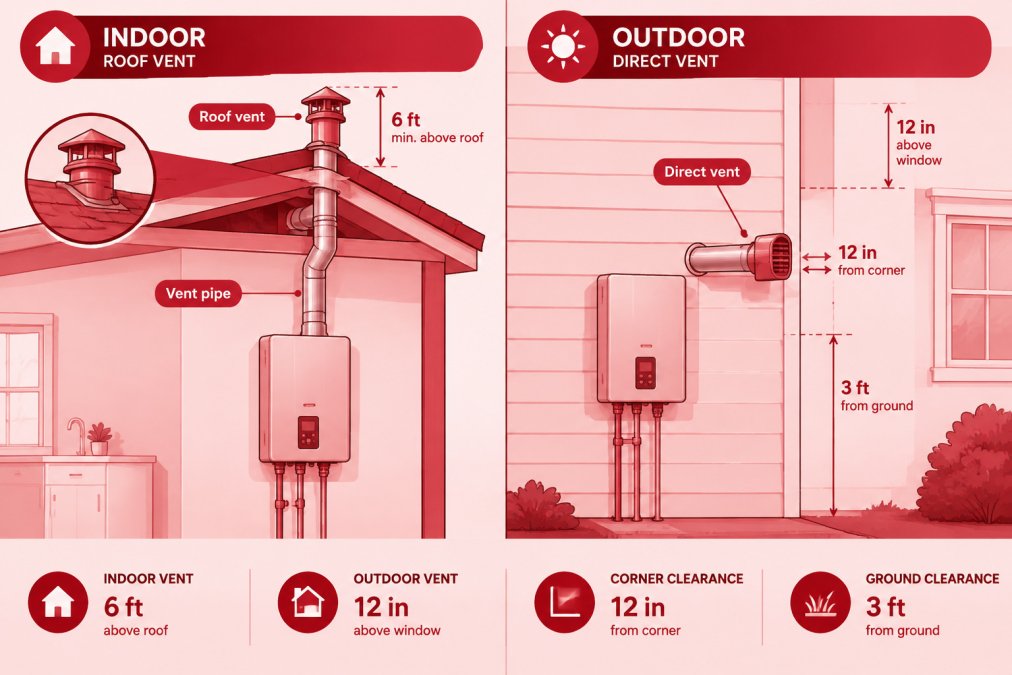
Indoor installs need a dedicated vent route through the roof or an exterior wall, plus combustion air.
Pros and Cons of an Indoor Tankless Water Heater
Indoor installation keeps the unit protected from rain, wind, and freezing temperatures. That makes it the common choice in cold climates and anywhere a homeowner wants the equipment shielded from the elements.
The main drawback is venting.
Best for: homes in cold climates, or owners who want the unit protected and easy to service.
Skip if: your utility closet is small and the vent route would be long or awkward.
Pros and Cons of an Outdoor Tankless Water Heater
An outdoor unit frees up interior space and often simplifies venting, since the unit vents directly through the exterior wall without a long internal run.
The trade-off is exposure. Outdoor units must be rated for the environment and placed where freezing risk is manageable, and they need protection from sun, rain, and debris.
Best for: mild climates with limited interior space.
Skip if: you live where winter temperatures regularly drop below freezing and the unit would sit in direct exposure.
Venting, Space and Climate: Side-by-Side Comparison
Venting, space, and climate are the three factors that most often decide the question. Indoor units need a vent route through the building envelope, which adds labor and can limit placement. Outdoor units typically need less internal venting but must withstand weather. The table below summarizes the practical differences, and the climate discussion that follows explains when an outdoor unit is genuinely suitable.
| Factor | Indoor | Outdoor |
|---|---|---|
| Venting | Longer vent route through wall or roof; must meet manufacturer length and bend limits | Short, direct exterior vent; fewer fittings and less interior demolition |
| Interior space | Uses closet, garage, or wall space | Frees interior space entirely |
| Freeze protection | Sheltered from cold; still needs freeze protection if in an unheated space | Depends on model-rated freeze protection and siting |
| Weather exposure | Minimal | Sun, rain, wind, debris, and snow |
| Service access | Easy and protected | Exposed to weather; service may be delayed in storms |
| Noise and condensate | Indoors; needs drainage planning and noise isolation | Kept outside; condensate must drain away from the foundation |
| Combustion air | Must be supplied to the closet or room | Drawn from outdoors |
Climate and Freeze Risk: When an Outdoor Unit Works
Outdoor tankless units are not all built for the same conditions. Manufacturers publish a minimum operating temperature and describe the freeze-protection method for each model.
A common pattern in cold climates is that an outdoor unit mounted on a sunny south wall with wind protection performs well, while the same unit on a shaded north wall with prevailing wind can freeze during a short cold snap.
For homes in climates where winter temperatures regularly fall below freezing, an indoor unit in a conditioned or semi-conditioned space is usually the lower-risk choice.
Venting and Clearance Specifics
Indoor gas units typically vent through PVC, CPVC, or polypropylene, depending on the model and flue temperature. The vent route must stay within the manufacturer’s maximum equivalent length and bend count, and the termination must meet clearance rules from windows, doors, air intakes, and property lines. Our guide to saving space with tankless water heaters shows how tight homes fit these clearances.
Space and Service Access
Indoor placement consumes interior square footage, but it keeps the unit out of the weather and makes routine service easier to schedule. Outdoor placement frees the closet or wall space for storage or other equipment, but service technicians work in the elements, and repairs during storms or extreme heat can be delayed. Condensate is another practical difference: indoor units need a drain line or neutralizer that routes to a suitable drain, while outdoor units must drain condensate away from the foundation and walkways so it does not create a slip hazard or stain.
Sizing Your Tankless Water Heater for Indoor or Outdoor Use
Sizing depends on flow rate and temperature rise, not on where the unit is mounted. Installers look at how many fixtures run at once, the flow rate each one needs, and the temperature rise required to heat incoming water to your set point.
Location affects the sizing conversation only indirectly. Our guide to whether a tankless water heater is worth it for small apartments explains how sizing works at smaller household scales. Incoming water temperature is colder in winter, so a home in a colder climate may need a larger unit to deliver the same output.
Tankless Water Heater Cost: Installed Price and Hidden Expenses
Installed cost depends on the unit, the fuel type, and the work required, but comparing only the equipment price can be misleading. Our tankless water heater installation cost guide lists typical installed price ranges to compare against the line items below. A realistic comparison separates the project into line items so indoor and outdoor options can be judged on the same basis. The categories below are the ones that most often change the final number.
Equipment
The unit itself is the starting point. Indoor and outdoor versions of the same model line are often priced close to each other, but outdoor units sometimes carry a premium for the weather-rated cabinet and factory freeze protection. Capacity, fuel type (natural gas versus propane), and features such as recirculation or Wi-Fi controls move the price more than the indoor/outdoor designation does. Compare models at the same flow rate and temperature rise, not across different capacities.
Venting
Venting is where indoor and outdoor projects diverge most. An indoor gas unit needs a vent route through a wall or roof, and the cost depends on the length of the run, the number of elbows, the wall or roof penetration, and whether the route passes through finished space that must be opened and repaired. Outdoor units vent directly from the cabinet, which usually eliminates most of that work, though the unit still needs a proper termination and clearance from the wall. Stainless steel venting for condensing units costs more than PVC, and long runs or roof penetrations add labor.
Gas Line and Electrical Upgrades
Tankless units often need a larger gas line than the storage tank they replace, and the cost depends on the distance from the meter and whether the existing line can be reused. Electrical work is usually limited to a dedicated circuit for the ignition and controls, but outdoor units with electric freeze protection may need a dedicated circuit as well. If the electrical panel is full, a panel upgrade can become a significant line item.
Permits and Inspection
Most jurisdictions require a permit for a tankless water heater replacement, and the fee varies by city and by the scope of work. The permit process also adds inspection time to the schedule. Skipping the permit can complicate a future home sale and may void the manufacturer’s warranty, so it belongs in the estimate.
Labor
Labor covers removal of the old unit, mounting, connections, venting, and testing. Our plumbing service call fees guide explains what visit charges cover and how to avoid surprise add-ons. A straightforward swap in the same location is the least expensive scenario. A relocation to a different wall, a switch from indoor to outdoor, or a retrofit into a closet without an existing vent route adds labor. Access matters too: a unit in a tight attic or crawlspace takes longer to install and service than one on an exterior wall.
Ongoing Maintenance
Both types need annual descaling in most water conditions, and the cost is similar. Outdoor units may need more frequent inspection of the cabinet, vent terminal, and freeze-protection components because of weather exposure. Indoor units may need filter cleaning and condensate neutralizer replacement. Budget for these as recurring costs rather than one-time expenses.
Comparing Indoor and Outdoor on the Same Terms
Ask for an itemized estimate that lists equipment, venting, gas line work, electrical work, permit fees, labor, and any required accessories such as a condensate neutralizer or freeze-protection kit. That format makes it possible to see whether an outdoor unit’s lower venting cost offsets a higher equipment price or additional electrical work.
DOE guidance on sizing and selecting a tankless water heater
Watch out: a quote that lists only the unit and a single labor figure usually omits venting, permit, and gas line work, and those omissions are where budgets overrun.
Choosing the Right Location and Scheduling Your Installation
Start with the location checklist before you choose a model:
- Confirm the vent route and check manufacturer length and bend limits
- Check clearance from windows, doors, and vents
- Assess freeze risk and whether the unit needs protection
- Confirm gas line capacity and electrical requirements
- Plan condensate drainage for indoor installs
- Confirm local permit requirements
Once a location is chosen, schedule the installation with a licensed plumber who can confirm the sizing, the venting route, and the permit requirements. Our guide on how long tankless water heaters last and when to replace them helps you time placement and replacement. Alpha Rooter & Plumbing is licensed (License #874454) and offers 24/7 emergency plumbing service. Plan installation around your hot-water needs, and avoid scheduling during a period when you can’t be without hot water.
Ready to decide between indoor and outdoor? Call Alpha Rooter & Plumbing today for pricing and a quote.
Frequently Asked Questions
Should I get an indoor or outdoor tankless water heater?
Choose indoor if your climate gets freezing temperatures and you have a utility room or garage with room for the unit and venting. Choose outdoor if you have limited interior space, want to save indoor square footage, or live in a mild climate where the unit will not face sustained freezing. Indoor units need a properly routed exhaust vent and combustion air, while outdoor units need freeze protection and a weather-rated enclosure. A licensed plumber can check your gas line, venting path and local code clearances before you decide.
Can you use an outdoor tankless water heater indoors?
Outdoor-rated tankless units are generally designed for exterior installation, with weather-resistant housings and freeze protection built in. Installing one indoors is not automatically wrong, but the manufacturer’s installation manual and your local code determine whether that location is allowed. Indoor installation usually requires a different venting arrangement and clearances. Confirm the specific model’s listing before making any change, because venting and clearance requirements differ by manufacturer.
Do indoor tankless water heaters need special venting?
Yes. Gas-fired indoor tankless units need a dedicated exhaust vent, often PVC or stainless steel, routed to the outdoors, along with a source of combustion air. Vent length, number of elbows and wall or roof terminations all affect performance and must follow the manufacturer’s specifications and local code. Electric tankless units avoid gas venting but may require a larger electrical service. Venting is one of the main reasons installation cost varies between homes.
How much does it cost to install a tankless water heater?
Installed cost depends on the unit, fuel type, whether a gas line or electrical service upgrade is needed, venting work, and whether the installation is indoor or outdoor. Pricing depends on the home’s specific conditions and the work required, so Alpha Rooter & Plumbing recommends requesting a written estimate for your property. Ask whether the quote includes permits, venting materials and any plumbing changes so you can compare accurately.
