

Last Updated: November 8, 2026
Quick Summary
To resolve an upfront pricing dispute, call the merchant’s billing department first and request an itemized written explanation of every difference from your quote, setting a deadline such as five business days. If the merchant will not correct the charge, dispute it with your card issuer, which under the Fair Credit Billing Act gives you 60 days from the statement date.
- Pull the original quote, final invoice, and payment record and compare them line by line before calling anyone.
- The most common mistake is paying first and disputing later, which weakens your leverage and can complicate a card dispute.
- Credit card disputes must be filed within 60 days of the statement date under the Fair Credit Billing Act.
- A one-page dated timeline does more for your case than ten angry paragraphs.
- If a dispute is denied, request the investigation file and rebut errors in the documents the merchant submitted.
Table of Contents
- What Counts as an Incorrect Upfront Pricing Charge
- How to Review Your Bill and Spot a Price Discrepancy
- What to Do When a Business Charges More Than Quoted
- Evidence Needed for a Billing Dispute
- How to Write a Credit Card Charge Dispute Letter Template
- How Long to Dispute a Credit Card Charge
- What to Do If Your Dispute Is Denied or Sent to Collections
- Choosing a Plumber With Upfront Pricing You Can Trust
- Frequently Asked Questions
What Counts as an Incorrect Upfront Pricing Charge
An upfront pricing dispute happens when the final bill is higher than the price you were quoted before work began, and the increase was not caused by a change you approved.
An incorrect charge looks different. Common examples include:
- A quoted total that grows with “shop supplies” or “trip fees” nobody mentioned
- Hourly or overtime charges added after you were promised a flat price
- Work billed that was never performed or never authorized
The Federal Trade Commission’s guidance on unfair or deceptive practices treats bait-and-switch pricing as a deceptive practice. A low quote used to win the job, followed by a much higher bill, can fall into that category.
How to Review Your Bill and Spot a Price Discrepancy
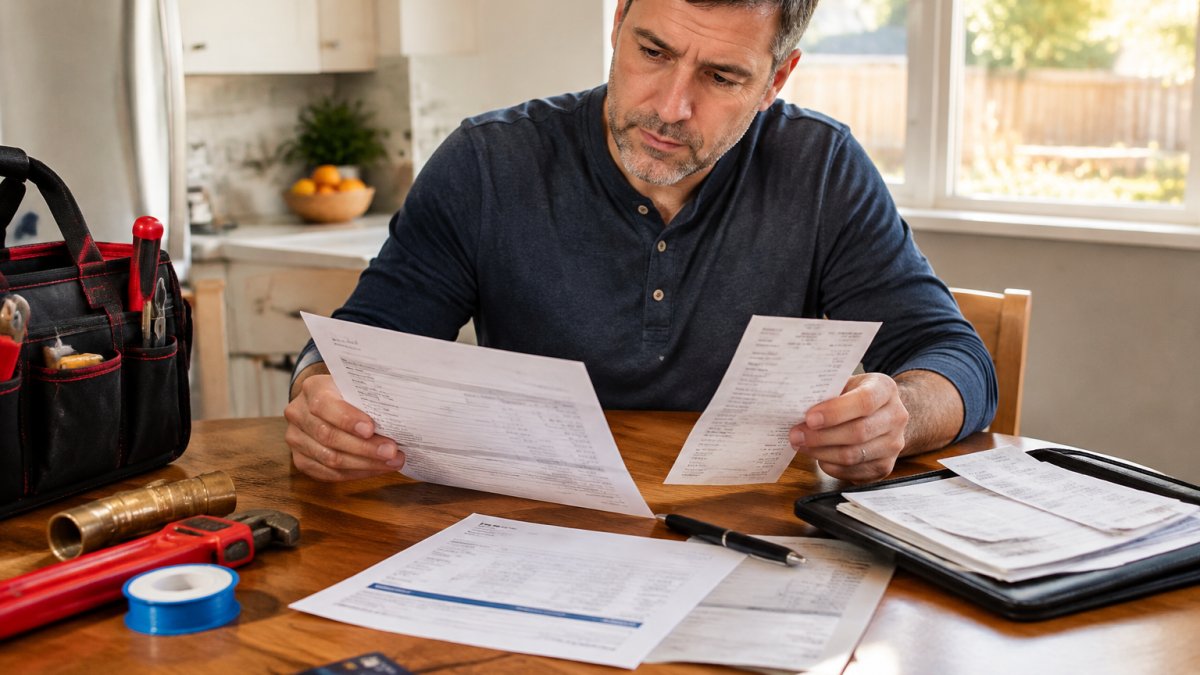
Pull three documents side by side: the original quote, the final invoice, and your payment record. Compare them line by line before you call anyone. The goal is to answer one question: was the difference disclosed and approved, or added after the fact?
Check scope first: does the invoice list the same work the quote described? If you want to know common hidden-fee patterns so you can compare your quote against the final bill, see how to avoid hidden fees in plumbing quotes. Second, check for new line items you did not approve. Third, check the math yourself, including tax and any card surcharge, because many disputes turn out to be arithmetic errors rather than bad faith.
Separate a Changed Estimate From an Incorrect Charge
An incorrect charge looks different. Run the difference through these four tests:
- Was it disclosed before work began? A fee named in the quote, signed terms, or a written change order is disclosed. A fee appearing first on the invoice is not.
- Was it approved? Look for initials, a signed change order, a reply email, or a text saying yes. Silence is not approval.
- Was it performed? Billed work that never happened is the clearest kind of incorrect charge.
If the first two tests fail, you are likely looking at an upfront pricing dispute over an undisclosed fee or post-service adjustment rather than a legitimate price change. Write that conclusion in one sentence; it becomes the spine of your complaint.
Red Flags Specific to Upfront Pricing
- Round-number “miscellaneous” or “shop supplies” charges with no description and no rate
- Trip fees, dispatch fees, or after-hours fees that were not in the quoted total
- Labor billed at a higher rate than the quote stated, or billed hourly when you were promised a flat price
One pattern deserves special attention: the verbal-only quote. If the price was given on the phone and never put in writing, the merchant can argue the number you remember was an estimate.
Watch out: the most common mistake is paying first and disputing later.
If you want to understand which fees are legitimate and which are not, our guide on what is included in upfront pricing breaks down how fares are calculated and which fees to question.
What to Do When a Business Charges More Than Quoted
Call the business before you escalate anywhere else. Most billing disputes get resolved at this stage, and it costs you nothing but a phone call. But the order of escalation matters, and it depends on how you paid and who you hired.
Step 1: The Merchant Call
- Call the billing department, not the technician who did the work
- State the quoted price and the final charge in one sentence
- Ask for an itemized explanation of every difference
- Request the correction in writing, by email
- Set a deadline, such as five business days, for a response
Keep the tone flat and factual. You are building a record, not winning an argument. A workable opening line: “I was quoted $[amount] in writing on 2026, and my card was charged $[amount]. I did not approve any change in scope. Can you send me an itemized explanation of the difference?” If the person on the phone cannot help, ask for a manager and note the name and time of every conversation.
Step 2: The Platform or App Channel
If you booked through an app or marketplace, the platform’s dispute flow usually runs in parallel with the merchant. Use it, but do not rely on it alone. In-app support often resolves fare and fee mismatches quickly because the platform sees the original quote and final charge in one record. File there first when the booking was made in the app, then keep the merchant call as a backup.
Step 3: The Card Issuer
If the merchant will not correct the charge, move to your card issuer. This is where payment method changes the path:
- Credit card: You have the strongest dispute rights. The federal Fair Credit Billing Act gives you 60 days from the statement date to dispute a billing error, and the issuer must investigate and respond within set windows.
- Debit card: The process is similar but the protections and timing differ, and the money may already be out of your checking account. Contact your bank’s dispute department promptly and ask which rule set applies.
- Cash, check, or peer-to-peer transfer: There is no chargeback. Your remedy is the merchant, then small claims court or a consumer complaint, so the written record you built in Step 1 becomes your main evidence.
When you contact the issuer, say plainly that you were charged more than the quoted price without approval, and attach the quote, invoice, and your written complaint to the merchant. Do not describe it as buyer’s remorse. Describe it as an unauthorized or incorrect charge relative to a written quote.
Step 4: Escalation If the Merchant Stalls
If the merchant goes silent or refuses, file a complaint with the Consumer Financial Protection Bureau if a financial product is involved, and with your state attorney general’s consumer protection division for the merchant conduct.
If you need to prove the business was properly licensed as part of your case, our article on how to verify a plumber’s license and insurance covers the lookup steps.
Evidence Needed for a Billing Dispute
The core documents are:
- The original written quote or estimate
- The final invoice or itemized bill
- Your receipt or card statement showing the transaction
Building Your Upfront Pricing Evidence Checklist
Use this checklist before you contact your card issuer:
- Written quote saved, with the date it was given
- Signed contract or terms and conditions reviewed
- Final invoice showing the disputed line items
The timeline is the piece most people skip, and the piece a claims investigator reads first. One page, dated, in plain order, does more than ten angry paragraphs.
How to Write a Credit Card Charge Dispute Letter Template
A credit card charge dispute letter template is a short, factual letter that states what you were quoted, what you were charged, and what you want the card issuer to do. Keep it to one page.
Here is a template you can adapt:
[Your name]
[Your address]
[Date][Card issuer name]
Dispute DepartmentRe: Disputed charge of $[amount] on account ending [last four digits]
To whom it may concern:
On 2026, I hired [business name] for [service]. Before work began, I received a written quote of $[quoted amount]. The final charge on my statement was $[final amount], which is $[difference] more than quoted.
I was not told about additional charges, and I did not approve any change in scope. I contacted the business on 2026 and requested a correction. Their response was [describe or state “no response”].
Attached are the original quote, the final invoice, my card statement, and my written complaint to the business.
I am requesting a refund of $[amount]. Please contact me at [phone] or [email] with any questions.
Sincerely,
[Your name]
Attach copies, never originals. Send it through the issuer’s official dispute channel, whether online form, fax, or certified mail. Keep a copy of everything you send.
How Long to Dispute a Credit Card Charge
The federal deadline to dispute a credit card charge is 60 days from the date the statement containing the error was sent. That window comes from the Fair Credit Billing Act, and it is strict.
Here is how the timing plays out:
| Stage | Typical Timing | What Happens |
|---|---|---|
| You file the dispute | Within 60 days of statement | Issuer must acknowledge in writing |
| Issuer investigates | Up to 2 billing cycles | Merchant is contacted for response |
| Provisional credit | Often within days of filing | Temporary refund while review runs |
| Final decision | Within the legal window | Charge stands or is reversed |
Missing the 60-day window does not always end your options. Some issuers accept later disputes, and debit card disputes follow a different rule set. But do not count on goodwill. File early.
The Consumer Financial Protection Bureau’s guide to disputing charges walks through the process step by step if you want the official version.
What to Do If Your Dispute Is Denied or Sent to Collections
A denial is not the end. You have three moves left, and the order matters.
First, request the investigation file. Ask the issuer in writing for the documents the merchant submitted.
Second, escalate. File a complaint with the Consumer Financial Protection Bureau and your state attorney general’s consumer protection division.
Third, if the charge lands in collections, respond in writing within 30 days of the collector’s first contact and request validation of the debt.
Choosing a Plumber With Upfront Pricing You Can Trust
The best way to avoid a pricing dispute is to hire a provider whose quote holds up.
Ask every plumber these five questions:
- Is the quote a flat price or an estimate, and what could change it?
- What exactly is included: parts, labor, disposal, after-hours fees?
- Will you put the price in writing before work starts?
A provider with real upfront pricing will answer all five without hesitation. One that gets vague about “it depends” is telling you something.
A provider with upfront pricing should put the price in writing before work begins.
Our guide on how to find honest plumbers walks through seven vetting steps, from license checks to contract review.
A pricing dispute is a paperwork problem, not a shouting match.
Frequently Asked Questions
Can I dispute a credit card charge if I willingly paid for the service?
Yes. Paying does not waive your right to dispute a charge that was higher than the upfront price you agreed to. A credit card charge dispute can be filed when the final charge differs from the quoted price or when services were not as described. Contact the merchant first in writing, keep your receipt and quote, then file with your card issuer within the dispute deadline, which is typically 60 days from the statement date under the Fair Credit Billing Act.
What should I do if a business charges more than its upfront quote?
Ask for an itemized bill and compare each line to your written quote. Request a written explanation of any added charges before paying. If the difference is not justified, send a written complaint to the merchant’s billing department and keep a copy. If they refuse to correct it, file a credit card charge dispute with your card issuer. Document every call, email, and text so you have a clear record for the investigation.
How long do I have to dispute a credit card charge?
Under federal billing-error rules, you generally have a limited window from the date the first statement containing the error was sent to file a dispute with your card issuer. Some issuers allow longer windows, so check your cardholder agreement. For debit cards, the window can be shorter. Act quickly: gather your receipt, quote, and written communications, and send your dispute in writing so you have a dated record.
What evidence do I need for a billing dispute over upfront pricing?
Collect the written or emailed upfront quote, the final itemized bill or receipt, and the credit card statement showing the charge. Add any texts, emails, or notes from phone calls where the price was confirmed. A signed contract or terms and conditions helps too. If the merchant changed the estimate, keep the message where they explained why. This documentation gives your card issuer a clear paper trail and speeds up the investigation.
