
Table of Contents
- What You’ll Need Before You Start
- Signs of a Cracked Cast Iron Pipe You Should Never Ignore
- Step-by-Step: How to Inspect Cast Iron Pipes for Cracks
- Cast Iron Pipe Leak Detection: Finding Hidden Moisture and Drainage Problems
- Cast Iron Pipe Camera Inspection: What a Sewer Scope Can and Cannot Reveal
- Cast Iron Sewer Line Repair Options After You Find a Crack
- How to Interpret Severity and Decide What to Do Next
- Frequently Asked Questions
Last Updated: October 15, 2026
What You’ll Need Before You Start
Learning how to inspect cast iron pipes for cracks starts with a few basic tools and one hard rule: never open a pipe. At Alpha Rooter & Plumbing, we have walked thousands of older homes with failing drain lines, and the calls we dread most follow a homeowner’s own repair attempt gone wrong.
Gather these items before you begin:
- A bright LED flashlight
- Work gloves and safety glasses
- Paper towels or a rag
You will not need a wrench, a snake wire, or anything that cuts or opens pipe. A visual inspection is a look-only job.
Never cut, torque, or hammer a cast iron drain line to test it. Cast iron gets brittle with age, and a small crack can shatter into a full break, turning a repair into an emergency.
Signs of a Cracked Cast Iron Pipe You Should Never Ignore
The clearest signs of a cracked cast iron pipe are rust-colored stains, musty odors, slow drains, and water spots on ceilings or walls. Any one deserves a closer look.
Watch for these warning signs:
- Orange or brown rust streaks along a pipe or joint
- Dark water stains on a basement ceiling or wall
- A musty, damp smell that never goes away
Many older homes still run on cast iron drain lines installed decades ago. Cracks often form at joints and low spots where water sits.
Crack vs. Corrosion vs. Joint Leak vs. Condensation: Telling Them Apart
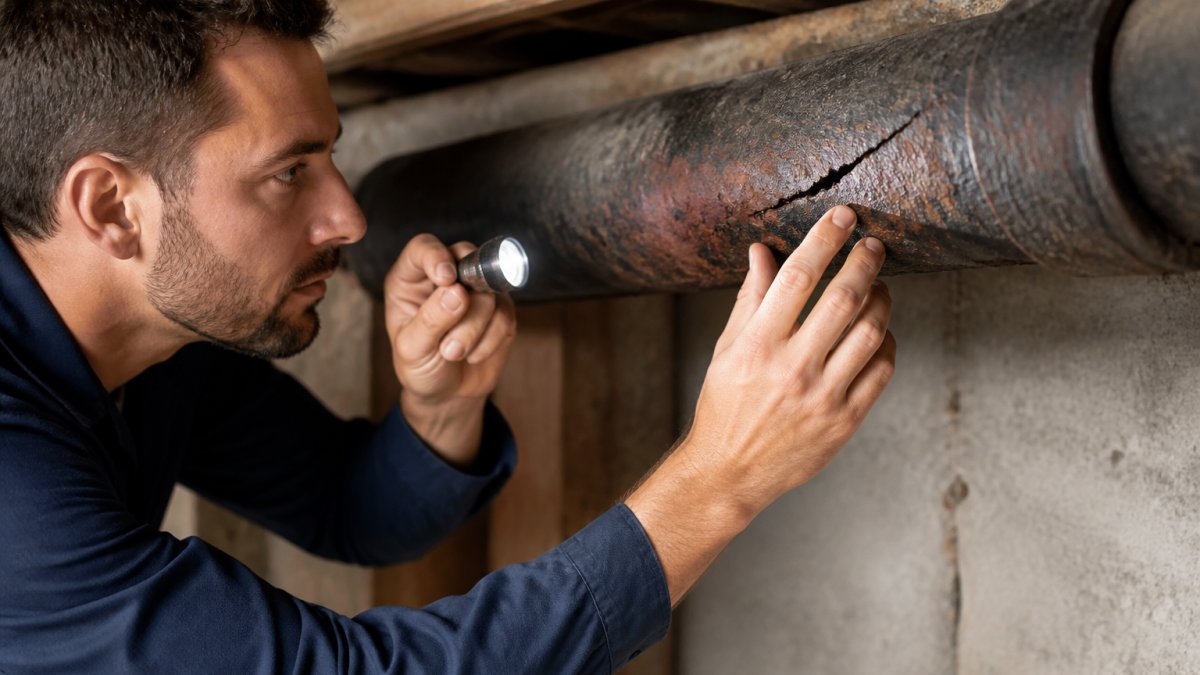
A crack is a physical split in the metal. Corrosion is surface rust that eats the pipe wall over time. A joint leak comes from a failing connection, not the pipe body. Condensation is moisture that forms on a cold pipe in warm air.
Here is how to tell them apart:
| What You See | Likely Cause | Quick Clue |
|---|---|---|
| Sharp split in the metal | Crack | Visible line, often at a joint |
| Flaky orange rust | Corrosion | Rough, pitted surface |
| Drip at a connection | Joint leak | Wet ring right at the joint |
| Beads of water on a dry pipe | Condensation | Dries when the air warms |
Each problem has a different fix: a crack may need a plumber, while condensation may just need better airflow.
Step-by-Step: How to Inspect Cast Iron Pipes for Cracks
A safe visual inspection takes about 15 to 20 minutes for a typical single-family home with an exposed basement or crawlspace run. Work from the main stack outward and write down what you see as you go.
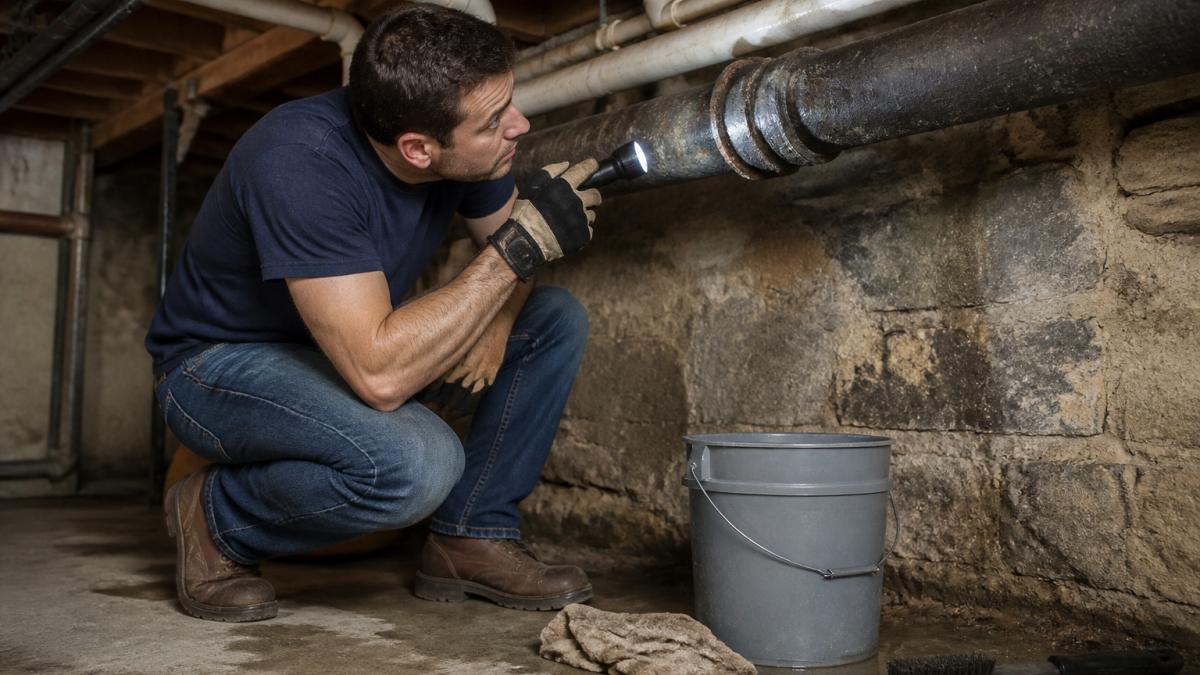
Before You Start: Set Up Safely
- Confirm the area is dry underfoot. Cast iron in a wet basement is a slip hazard.
- Keep a bucket under any suspected drip so you can tell new moisture from old staining.
- Have your phone charged, you will use the flashlight and camera most.
The Inspection Sequence
- Locate the main stack. Look for the largest vertical cast iron pipe, usually 3 to 4 inches in diameter, running from the basement floor up through the roof. It often sits near a bathroom wall or in a utility chase.
- Trace each branch by eye. Follow the horizontal runs from the stack toward each fixture, toilet, sink, tub, laundry. Do not skip short runs behind a vanity or under a kitchen sink.
- Examine every joint first. Joints are where most failures begin. Look for a wet ring, dark mineral crust, or white-green buildup at the hub or coupling.
- Scan the pipe body for rust and pitting. Run the flashlight along the top and bottom. The bottom of a horizontal run holds water and corrodes first.
- Check low spots and sags. A belly in the line traps water and debris. Look for a dip where the pipe loses its slope.
- Look above and below. Check the ceiling and wall below an upstairs bathroom, and the floor above a basement run.
- Photograph everything. Take one wide shot for location and one close-up for detail, with a coin or your hand for scale.
- Log your findings. Note the location, what you saw, and the date. A simple list is enough.
What Each Defect Actually Looks Like
Use these cues at the pipe, not from memory:
| What You See | Likely Cause | Distinguishing Cue |
|---|---|---|
| A sharp, straight line in the metal, often with a dark edge | Crack | The line has clean edges and does not rub off |
| Flaky orange or brown scale that flakes when touched with a gloved finger | Corrosion | Surface is rough and pitted, not split |
| A wet ring or drip right at a hub or coupling | Joint leak | Moisture is localized to the connection |
| Beads of water on an otherwise dry pipe, more on cold mornings | Condensation | Dries as the space warms; no stain trail |
| A dark stain with a defined edge on drywall or wood | Old or slow leak | Stain has a tide line showing it grew over time |
A crack and a joint leak can look similar from a distance. The tell is location: a crack runs along the pipe body or through the metal at a fitting, while a joint leak shows moisture only at the seam.
Documentation That Helps a Plumber
A plumber can work faster, and quote more accurately, when you hand over a short, organized record. Include:
- The date and time of the inspection
- The location of each finding (for example, “basement ceiling, 6 feet from the stack, above the laundry drain”)
- A photo of the wide view and a close-up
Where a Homeowner’s Inspection Ends
A visual check is safe. Anything that involves opening, cutting, torquing, or snaking the pipe is not. Stop and call a licensed plumber if you see:
- An active drip or stream of water
- Sewage odor or backup
- A pipe that is visibly bowed, sagging, or separated at a joint
A phone camera on a selfie stick can peek into tight spots you cannot reach. Snap a photo and zoom in later instead of squeezing into a crawlspace.
Never cut, torque, or hammer a cast iron drain line to test it. Cast iron gets brittle with age, and a small crack can shatter into a full break, turning a repair into an emergency.
Cast Iron Pipe Leak Detection: Finding Hidden Moisture and Drainage Problems
Hidden leaks often show up far from the pipe itself. A first-floor ceiling stain may trace back to a cracked cast iron drain line on the second.
Use these clues to track a hidden leak:
- Water stains that grow over time
- A musty smell in one room
- A floor that feels soft or spongy
A moisture meter helps confirm what your eyes suspect. Press it against a wall or ceiling near a suspected leak. A high reading points to trapped moisture.
Slow drainage is another clue. A cracked pipe catches debris, and that buildup narrows the line.
Cast Iron Pipe Camera Inspection: What a Sewer Scope Can and Cannot Reveal
A cast iron pipe camera inspection sends a small waterproof camera down the drain line to show the inside of the pipe on a screen, the best way to see cracks you cannot reach from outside.
A sewer scope can reveal:
- Cracks and splits inside the pipe wall
- Heavy corrosion and scale
- Blockages and debris
But a camera scope has limits: it cannot show the outside of the pipe, measure remaining wall thickness, or catch small cracks hidden under scale or debris.
guidance from the CDC on household water safety is worth reviewing if you suspect a leak is affecting your water quality.
A camera inspection shows the inside of the pipe, not its strength. Use it to find problems, then let a plumber judge how serious they are.
Cast Iron Sewer Line Repair Options After You Find a Crack
Once a crack is confirmed, the right repair depends on the pipe’s condition, its location, and how much of the line is affected.
Common repair options include:
- Spot repair: Cutting out the damaged section and replacing it with new pipe.
- Pipe lining: Coating the inside of the pipe to seal cracks without digging.
- Trenchless repair: Fixing the line through small access points instead of a full trench.
information from the EPA on sewer systems and pipe materials can help you understand how older drain lines fit into a home’s plumbing.
Many homeowners find a short section repair solves the problem; others with long stretches of failing pipe do better with lining or replacement.
How to Interpret Severity and Decide What to Do Next
Not every crack is an emergency, but none should be ignored. Severity comes down to four questions: Is it leaking now? Where is the crack? How much pipe is affected? Are drains still working?
The Four Questions
- Is it actively leaking? A drip or stream means water is escaping today, the strongest signal to act now.
- Where is the crack? A crack in a vertical stack above a living space is more urgent than one in an exposed basement run, because water travels into ceilings and walls.
- How much pipe is affected? One localized crack is a spot repair. Widespread corrosion, multiple cracks, or a sagging line points to replacement.
- Are drains still moving? Slow or backing-up drains mean the line is compromised. Full stoppage or sewage backup is an emergency.
Severity Guide
| Severity | Signs | Typical Next Step |
|---|---|---|
| Low | Light surface rust, no moisture, drains flow normally | Monitor and recheck in 2 to 3 months; photograph for a baseline |
| Medium | Slow drain, small stain, damp joint, no active drip | Schedule a plumber visit within a week or two; ask for a camera inspection |
| High | Active drip, growing stain, multiple rusted sections, recurring clogs | Book a camera inspection now; plan for spot repair or lining |
| Emergency | Water pouring, sewage backup, crack in a stack above living space | Call for emergency service today; shut off water use on that line if possible |
How Location Changes the Call
- Exposed basement or crawlspace run: Easier to see and reach. A small crack here can often wait for a scheduled visit if it is not leaking.
- Stack above a finished ceiling: Water has a short path into drywall, insulation, and framing. Treat even a slow leak as high priority.
- Under a slab or behind a wall: You cannot see it directly. Any stain, musty odor, or unexplained water bill increase warrants a camera inspection.
When to Call a Licensed Plumber
Call now if you see:
- Active leaking or water you cannot stop
- Sewage odor or backup
- A crack in a pipe above a living space
Severity is not about how big the crack looks. It is about whether water is escaping, where it is going, and whether the drain still works. When in doubt, treat it as urgent.
If you are dealing with a cracked or leaking cast iron line and want a clear answer, Alpha Rooter & Plumbing offers 24/7 emergency service, upfront pricing with no hidden fees, and a response time of under 90 minutes.
homeowner plumbing guidance from the U.S. Department of Housing and Urban Development is a useful resource for understanding older home systems.
Frequently Asked Questions
How do I know if my sewer line is cracked?
Watch for recurring clogs in the same drain, slow drainage across multiple fixtures, sewage odors, and damp patches on floors or ceilings. A cast iron sewer pipe that has cracked often leaks slowly at first, so water stains or a constantly damp spot near the pipe route are strong clues. If you notice any of these, have the line scoped with a camera to confirm the location and extent of the damage before it worsens.
Can you inspect cast iron pipes without removing them?
Yes. Most cast iron pipe inspections are non-invasive. A visual inspection checks exposed sections in basements, crawl spaces, and utility areas, while a cast iron pipe camera inspection sends a sewer scope through an existing cleanout or drain opening. Neither approach requires digging up floors or cutting the pipe. Removal only becomes necessary when a repair or replacement is actually performed, not for the inspection itself.
What should I do if I find a crack in a cast iron pipe?
Stop using the affected drain, document the location with photos, and place a bucket or towel under any active drip. Do not apply tape or sealant as a permanent fix. Call a licensed plumber to assess the severity. Depending on the crack size and pipe condition, cast iron sewer line repair options range from a targeted section replacement to pipe lining or full replacement, and a camera scope will show which applies to your situation.
Can a cracked cast iron pipe be repaired, or does it need replacement?
Both are possible. A short, isolated crack on an otherwise sound pipe can sometimes be repaired by cutting out the damaged section and replacing it with a new segment and proper adapters. If the pipe shows widespread corrosion, rust, or multiple cracks, pipe lining or full replacement is usually more cost-effective. A plumber should assess pipe age and overall condition before recommending repair over replacement.