
Table of Contents
- Why Commercial Grease Trap Maintenance for Restaurants Is Non-Negotiable
- How a Grease Trap Works (And Where It Fails)
- Signs of a Clogged Grease Trap You Can’t Ignore
- Grease Trap Cleaning Frequency Requirements by Municipality
- FOG Management for Restaurants: A Daily Playbook
- The Grease Trap Maintenance Log Template You Should Use
- DIY vs. Professional Pumping and Hydro-Jetting
- Conclusion: Build a Maintenance Routine That Passes Inspection
- Frequently Asked Questions
Last Updated: September 5, 2026
Why Commercial Grease Trap Maintenance for Restaurants Is Non-Negotiable
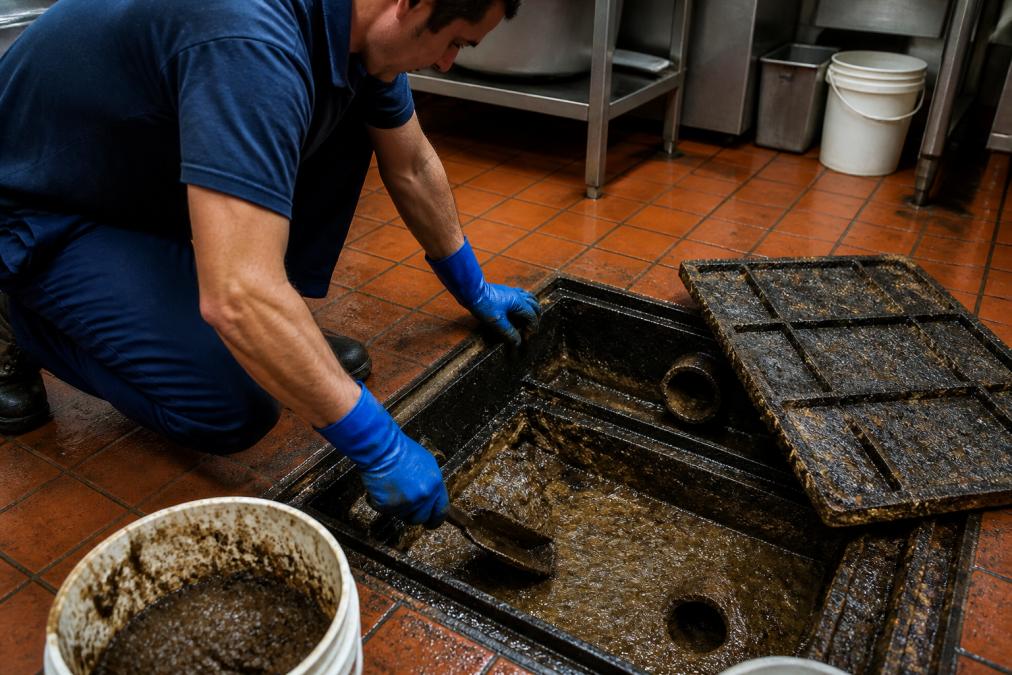
Commercial grease trap maintenance for restaurants is the single most important plumbing task a food service operation can perform, yet it is also the most commonly deferred. Skipping a scheduled cleaning risks a full sewage backup into your kitchen during the dinner rush, meaning lost product, a health code violation, and potentially a multi-day shutdown. At Alpha Rooter & Plumbing, nearly every urgent grease-related issue we respond to traces back to a missed service interval rather than a sudden equipment failure.
The cost of reactive maintenance always exceeds the cost of prevention. When a grease trap overflows, the FOG that escapes into your sanitary sewer line can congeal and block the main drain line, turning a routine pump-out into an emergency hydro-jetting job. Municipalities hold the business owner responsible for blockages in the lateral line, and fines for a preventable discharge can far exceed the price of a scheduled service.
Do not wait for a visible backup to schedule service. By the time wastewater is backing up into your floor drains, the grease has already traveled past the trap and is accumulating in your drain line, where it is significantly more expensive to remove.
How a Grease Trap Works (And Where It Fails)
A grease trap is a passive separation device installed between your kitchen sinks, dishwashers, and floor drains and the public sanitary sewer. Wastewater enters the unit and slows down, allowing lighter FOG to float to the top as a scum layer while heavier solids sink to the bottom as sludge. The relatively clear water in the middle, known as effluent, flows out through a baffle system and continues to the sewer.
The system fails when the accumulated scum layer and bottom sludge grow thick enough to push effluent through the outlet baffle. Once FOG escapes, it cools and solidifies further down the drain line, creating a blockage no trap maintenance can clear. A common mistake is assuming the trap works because water still drains slowly; slow drainage is often the first sign the outlet baffle is already compromised.
Signs of a Clogged Grease Trap You Can’t Ignore
The most obvious indicator of a failing grease trap is water backing up in sinks or floor drains, but earlier warning signs appear first. Foul odors from drains, even when the kitchen is clean, indicate decomposing organic matter is trapped. Gurgling sounds signal air being pushed through a partially blocked line, and standing water that drains progressively slower each week points to growing FOG accumulation.
Check the grease layer thickness yourself between professional cleanings. If the scum layer is within about 25% of the outlet pipe’s bottom edge, you are due for a pump-out. This simple visual inspection can prevent the majority of emergency failures.
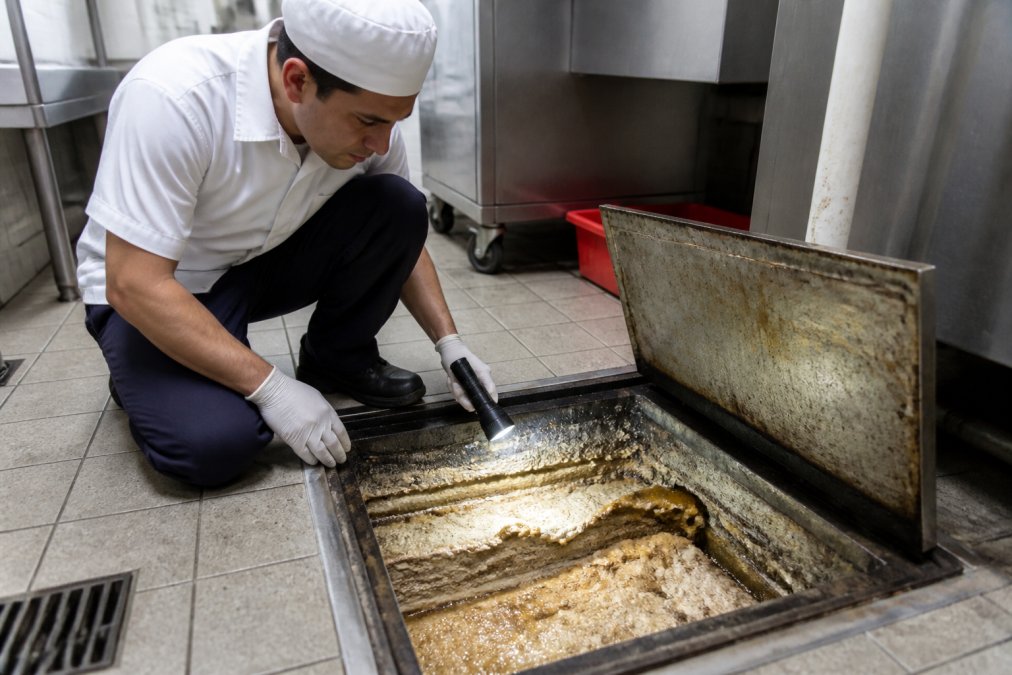
A grease trap at capacity also produces a distinctive, rancid odor standard kitchen cleaning cannot eliminate. This smell signals FOG breaking down anaerobically, producing hydrogen sulfide gas that can corrode plumbing and create a health hazard for staff (the CDC). If your kitchen exhibits any of these signs, schedule a cleaning immediately.
Grease Trap Cleaning Frequency Requirements by Municipality
Local jurisdictions set the legal baseline for how often you must pump your grease trap, but the code is rarely a simple ‘every 90 days’ rule. Most municipalities adopt one of two regulatory models: a fixed-interval ordinance or a performance-based ordinance. Understanding which applies to your address is the first step to a defensible compliance file.
Fixed-Interval vs. Performance-Based Codes
Under a fixed-interval code, the ordinance states a maximum allowable time between pump-outs, often 30, 45, or 90 days, regardless of actual grease production. Many cities in the Southeast require a minimum 30-day interval for establishments that fry foods, while lighter operations may be allowed 90 days (the EPA). The inspector verifies that your service records show a pump-out within that window.
A performance-based code, increasingly common in the mid-Atlantic and parts of the West, does not set a calendar deadline (peer-reviewed research). Instead, it requires the grease trap never exceed a specific fill level, typically 25% of liquid depth for the FOG layer and 25% for the sludge layer. You choose your service interval but must prove you are measuring the layers and scheduling service before they hit the limit, shifting the burden of proof from a simple invoice to a documented measurement log.
The Inspection and Audit Trail
Regulatory inspections are often triggered by a complaint, a plumbing permit application, or a routine health department visit. Inspectors will ask for two things: your service invoices and your waste manifests. The invoice proves the pump-out happened; the manifest proves the FOG was taken to an approved treatment plant rather than dumped illegally. A missing manifest is treated as evidence of improper disposal in many jurisdictions, with fines starting at several hundred dollars per occurrence.
Do not rely on your service provider to keep your records. Inspectors require the restaurant to produce documentation on demand. Keep a physical binder or a cloud folder with every invoice and manifest, organized by date, and train your manager on where it lives.
How to Determine Your Exact Requirement
Your service provider should know the local code, but you are legally responsible for compliance. Before setting a schedule, call your local department of public works or environmental services and ask three specific questions:
- What is the maximum allowable interval or fill level for my classification?
- Do I need a waste manifest from a licensed transporter, or is a pump-out invoice sufficient?
- Are there additional reporting requirements for my facility’s size or location (e.g., near a water body or in a combined sewer area)?
A common pattern is that the municipal code is silent on specific intervals and instead references a state or county plumbing code, making the local inspector’s interpretation the de facto standard. Ask for the inspector’s contact information and confirm your schedule directly with them. This proactive call clarifies your obligation and demonstrates good faith if a dispute arises.
The Cost of Non-Compliance
Fines for a single missed service are often less than the cost of the service itself, which is why some operators gamble. The real financial risk is a sanitary sewer overflow (SSO). If FOG escapes your trap and blocks the public sewer main, your municipality can bill you for cleanup, repair crew, and environmental remediation, bills that routinely reach five figures. Your business liability insurance may not cover this, as many policies exclude pollution-related damages from inadequate maintenance.
Treating the code as a minimum standard and building a documented audit trail with measurements and manifests converts a regulatory burden into a competitive advantage during inspections.
FOG Management for Restaurants: A Daily Playbook
Daily FOG management is not just about protecting your drain line, it is about protecting the municipal wastewater system your restaurant depends on. When poured down the drain, FOG cools, congeals, and combines with other debris to form ‘fatbergs’, massive blockages in public sewer mains that can cause raw sewage to back up into basements, streets, and waterways. Every pound of FOG you keep out of the drain reduces the burden on that system and lowers the risk of a municipal fee or surcharge being passed on to commercial users.
The Daily Disposal Hierarchy
The most effective daily playbook follows a simple hierarchy: Recycle > Scrape > Absorb > Never Pour.
-
Recycle used cooking oil. Used fryer oil is a valuable commodity. A licensed grease recycler will collect it in a dedicated bin, often for free or at a low cost, because they sell it to biodiesel refiners. Never mix used cooking oil with your grease trap waste; it must be collected separately. Keep the recycler’s pickup manifest as part of your environmental compliance record.
-
Scrape all solid food waste into the trash. Before any plate, pot, or pan touches water, remove all solid scraps. This includes breadcrumbs, batter bits, and vegetable peels. A rubber spatula and a perforated drain basket in the pre-rinse sink are your first line of defense.
-
Absorb liquid fats with a dry wipe. For small amounts of oil or butter left in a pan, use a paper towel to soak it up and toss it in the trash. This is more effective than pouring it down the drain with hot water, which only moves the problem downstream.
-
Never pour FOG down any drain. This includes floor drains, mop sinks, and dishwashers. A single quart of oil poured down a drain can coat the inside of your pipe and the public sewer lateral, creating a sticky surface that captures other debris.
The Role of the Dish Machine
Your commercial dishwasher is a major FOG contributor, even with high-temperature water and detergents. The wash water contains emulsified fats from plates and racks; detergent breaks the fat into tiny droplets that still pass through your grease trap and into the sewer. Ensure the dishwasher has a properly sized and maintained grease trap of its own, or that its discharge is routed through the main trap. Many operators overlook this, assuming the internal filter catches everything, it does not.
Staff Training and the ‘Green’ Angle
A daily playbook is only as good as the staff executing it. Post a simple sign above the pre-rinse sink stating the three rules: Scrape, Wipe, Recycle. Include this in new hire orientation and revisit it during quarterly training. When staff understand why, that FOG causes sewer overflows that harm local waterways, they are more likely to comply than if it is just a ‘boss’s rule.’
Frame your FOG management as an environmental commitment. Displaying a ‘Certified Grease Responsible’ poster in your back-of-house, or mentioning your recycling program in your marketing, resonates with eco-conscious customers and can be a differentiator in a competitive market.
Measuring Your Daily Impact
To move beyond guesswork, track the volume of used cooking oil you recycle each month. If you are a high-volume fryer operation, a sudden drop in recycled volume often means oil is being poured down the drain. Similarly, track the amount of solid waste you scrape into the trash. These simple metrics, recorded on your maintenance log, provide a quantitative picture of your FOG management and data to discuss with your service provider when adjusting pump-out frequency.
The Grease Trap Maintenance Log Template You Should Use
A grease trap maintenance log is your primary documentation tool for proving compliance during a regulatory inspection. It should record every professional pumping or hydro-jetting service, including the date, provider’s name, amount of waste removed, and disposal method. Many municipalities also require a waste manifest from the disposal facility to confirm the FOG was handled legally.
Beyond professional service records, your log should capture daily kitchen activities that affect grease accumulation. Track the volume of food cooked, any grease spills or overflows, and the results of weekly scum layer measurements. This data helps you adjust service frequency to match actual production rather than guessing based on a generic schedule.
A complete log includes both the professional service record with waste manifest and the daily kitchen observations. Inspectors look for this combination to confirm that you are not just paying for service, but actively managing FOG production.
A simple template should include columns for date, service type, provider name, waste volume removed, disposal facility, and the name of the staff member who verified the service. Keep three years of records on file, as some jurisdictions review historical documentation during permit renewal or after a change of ownership.
DIY vs. Professional Pumping and Hydro-Jetting
Attempting to clean a grease trap yourself is rarely effective and often creates a larger problem. Removing accumulated FOG requires specialized equipment, including a vacuum truck capable of safely extracting and transporting waste to an approved disposal facility. Pouring hot water or chemical degreasers into the trap does not remove buildup; it simply pushes liquefied grease further into the drain line, where it re-solidifies and causes a blockage downstream.
Professional service provides two distinct operations DIY methods cannot replicate. Pumping removes accumulated FOG and sludge from the trap itself, while hydro-jetting uses high-pressure water to scour the drain line between the trap and the sanitary sewer, removing any residue that has escaped. A reputable provider will also inspect the trap for cracks, damaged baffles, and other issues that could compromise its function.
Alpha Rooter & Plumbing performs both pumping and hydro-jetting as part of a comprehensive commercial grease trap maintenance program. Our licensed technicians arrive with state-of-the-art equipment, provide upfront pricing with no hidden fees, and document every service so you have the records needed for compliance. For restaurant owners who cannot afford downtime, our 24/7 availability and under 90-minute response time ensure that an unexpected failure does not force a closure.
Conclusion: Build a Maintenance Routine That Passes Inspection
The difference between a restaurant that passes regulatory inspection with ease and one that faces fines comes down to a consistent, documented maintenance routine. Commercial grease trap maintenance is not an expense to minimize; it is an investment in operational continuity that protects your kitchen from sewage backups, foul odors, and costly emergency repairs. Pair a realistic service frequency with daily FOG management habits, keep meticulous records, and work with a provider who understands local municipal code requirements.
A proactive schedule costs less than a single emergency callout, and the peace of mind from knowing your drainage system is sound is worth the modest investment. When you need a partner for both scheduled maintenance and urgent failures, Alpha Rooter & Plumbing delivers licensed expertise, transparent pricing, and a response time that keeps your doors open. Call now to schedule your grease trap service and build a compliance record that will stand up to any inspection.
Frequently Asked Questions
How often should a restaurant grease trap be serviced?
Most municipalities require service every 30 to 90 days, but the exact grease trap cleaning frequency depends on your cooking volume, the size of your unit, and your local code. High-volume fryer use may demand monthly pumping. Check your municipal code for the minimum standard. A licensed plumber can assess your FOG output and recommend a schedule that keeps you compliant and prevents backups.
What are the legal requirements for restaurant grease trap maintenance?
Legal requirements are set by your local municipality, often enforced through the plumbing code and the sanitary sewer authority. They typically mandate a minimum cleaning frequency, require records of service, and prohibit FOG from entering the sewer system. Failure to comply can result in fines, penalties, or even temporary closure. You must keep waste manifests and service logs on site for inspection.
What happens if a restaurant fails to maintain its grease trap?
Neglecting maintenance leads to a clogged drain line, sewage backups into your kitchen, and foul odors throughout the property. Beyond the immediate health hazard and operational shutdown, you face regulatory fines, potential loss of your permit, and liability for damage to the sanitary sewer system. The cost of emergency hydro-jetting and cleanup far exceeds the price of routine pumping.
How much does professional grease trap cleaning cost?
Professional cleaning costs vary based on the trap’s size, the volume of sludge, and your location. Standard pumping of a smaller unit is less expensive than a large grease interceptor that requires a vacuum truck. Many providers offer no hidden fees with upfront quotes. Contact Alpha Rooter & Plumbing for current pricing and a service plan tailored to your restaurant’s needs.
Can I use additives instead of pumping my grease trap?
No. Bio-enzymatic additives can help break down some organic matter between cleanings, but they do not eliminate the need for physical pumping. Fats, oils, and grease solidify, and the accumulated sludge and scum layer must be physically removed by a licensed pumper. Additives are a supplement to your maintenance routine, not a replacement for it.
What is the difference between a grease trap and a grease interceptor?
A grease trap is typically a smaller, under-sink unit that serves one or two fixtures, while a grease interceptor is a larger, in-ground tank that handles wastewater from the entire kitchen. Both operate on the same principle of slowing effluent to let FOG separate, but interceptors have a much larger capacity and require service by a vacuum truck. Your plumbing code dictates which type your restaurant needs.
This article was written using GrandRanker
Comments are closed