
Last Updated: October 25, 2026
Quick Summary
Commercial kitchen drain cleaning should follow a frequency-based schedule: daily hot-water flushing and screen emptying, weekly enzyme treatment of sink drains and brushing of floor drains, monthly grease interceptor inspection and pumping if grease exceeds 25% of depth, and quarterly professional hydro-jetting of main drain lines. Adjust these intervals based on daily meal volume, menu type, operating hours, plumbing layout, and local health department requirements.
- Empty drain screens daily after each meal period and flush all drains with hot water at end of shift
- Clean sink drains weekly with enzyme-based commercial drain cleaner and brush floor drains weekly to bi-weekly
- Pump out grease interceptors monthly in busy restaurants or every 6-8 weeks in slower establishments when grease reaches 25% of trap depth
- Schedule professional hydro-jetting of main drain lines every quarter to remove grease buildup
- High-volume kitchens over 300 covers daily should shorten grease interceptor service to every 2-3 weeks and increase floor drain cleaning to weekly
Table of Contents
- Why Commercial Kitchen Drain Maintenance Matters
- Daily Drain-Cleaning Practices for Commercial Kitchens
- How Often to Clean Commercial Kitchen Drains: A Frequency-Based Schedule
- Commercial Kitchen Grease Trap Maintenance and Inspection
- Preventing Clogged Commercial Kitchen Drains: FOG Control and Food Waste Management
- Commercial Kitchen Drain Cleaning Checklist for Staff
- Warning Signs and When to Call for Professional Drain Service
- Schedule Your Professional Drain Inspection Today
- Frequently Asked Questions
Why Commercial Kitchen Drain Maintenance Matters
A clogged drain in a commercial kitchen shuts down operations, creates health code violations, and can cost thousands in emergency repairs. Prevention through a solid commercial kitchen drain maintenance schedule is far cheaper.
Commercial kitchens generate massive volumes of grease, food scraps, and debris daily. Unlike residential drains, these systems face constant heavy use, so grease accumulates and food particles get trapped, producing clogs that worsen fast.
Health inspectors check drain systems, and backed-up drains fail those inspections, bringing fines or operational shutdowns. A documented commercial kitchen drain cleaning schedule protects your business and keeps your kitchen compliant.
Daily Drain-Cleaning Practices for Commercial Kitchens
Your kitchen drains need attention every single day, the foundation of your entire maintenance schedule.
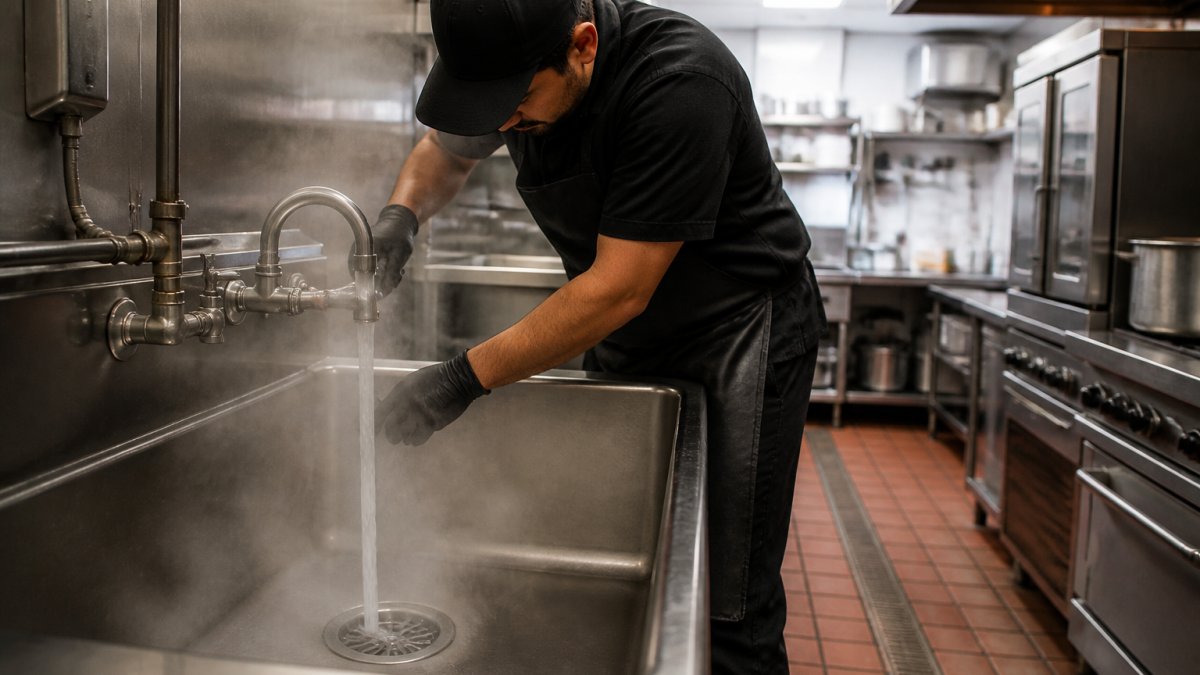
Hot water flushing is your first defense.
Remove visible debris before it enters the drain system. Place screens or strainers in all sink drains. Empty these screens into the trash, never let food scraps wash down. Train every staff member on this routine.
Daily checklist for kitchen staff:
- Empty drain screens after each meal period
- Flush all sinks and floor drains with hot water
- Wipe grease from prep surfaces into trash, not down drains
- Check for slow drainage or odors
- Report any backup immediately
Assign one person ownership of this task and make it part of closing procedures, accountability makes it routine.
How Often to Clean Commercial Kitchen Drains: A Frequency-Based Schedule
Different drain components need different schedules.
Component-by-component maintenance calendar
| Component | Daily | Weekly | Monthly | Quarterly | Annually |
|---|---|---|---|---|---|
| Sink drains and strainers | Empty screens after each meal period; hot-water flush at close | Enzyme treatment and trap check | , | , | Professional line inspection |
| Floor drains | Remove visible debris; hot-water flush at close | Brush and flush high-volume drains | Brush and flush low-volume drains | , | Professional hydro-jet |
| Grease interceptor | , | Visual fill-level check | Pump-out if grease exceeds 25% of depth | Full pump-out and inspection | Professional assessment and documentation review |
| Main drain lines | , | , | , | Professional hydro-jetting | Video inspection |
| Dishwasher discharge line | Final hot-water rinse | , | Descale if hard water | , | , |
Sink drains: Weekly
Clean sink drains weekly with hot water and a food-service-safe commercial drain cleaner.
Floor drains: Weekly to bi-weekly
Floor drains collect debris constantly.
Grease interceptors: Monthly minimum
Grease interceptors trap fats and oils before they reach municipal sewer lines. They fill up fast.
Main drain lines: Quarterly
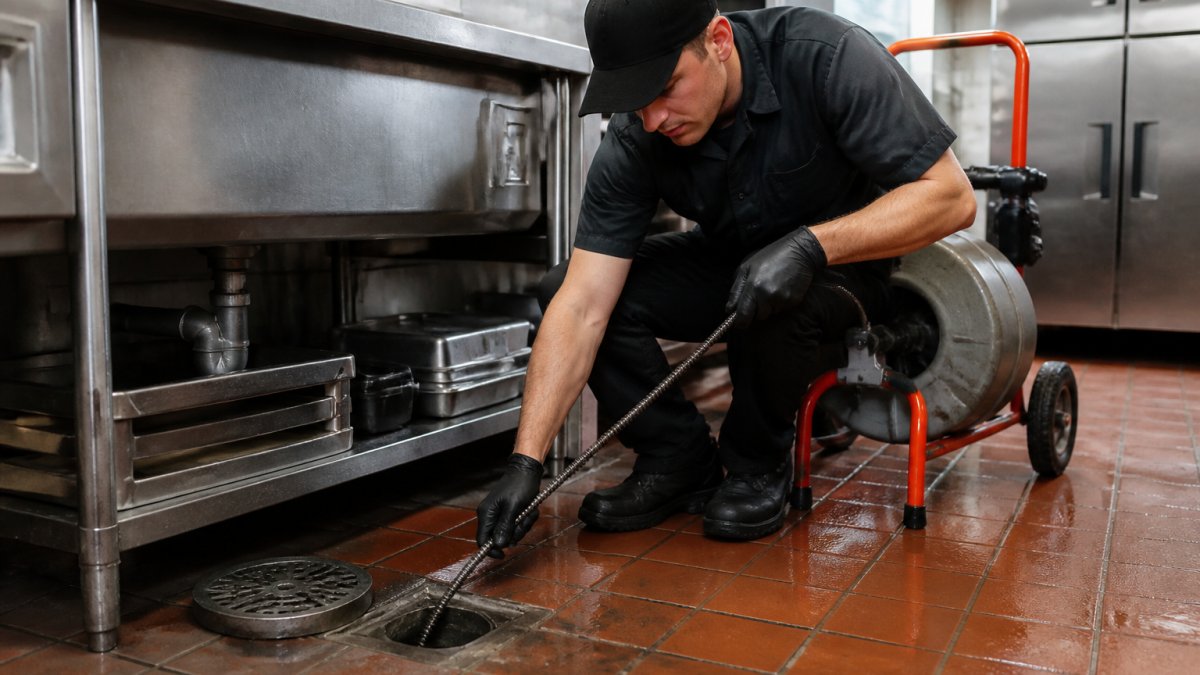
Schedule professional hydro-jetting of main drain lines every quarter.
Decision framework for setting your frequency
Start with the baseline above, then adjust using these five factors, combining them rather than relying on any single one.
- Daily meal volume. Count covers per day. Under 100 covers, the baseline holds. 100-300 covers, shorten grease interceptor and floor-drain intervals by roughly one step. Over 300 covers, move grease interceptor service to every 2-3 weeks and floor drains to weekly.
- Menu type. Fried and grill-heavy menus load drains with FOG faster than salad or sandwich menus. A steakhouse or fry-heavy kitchen should treat the baseline as a maximum, not a target.
- Operating hours. A kitchen open 16 hours a day generates roughly twice the wastewater of one open 8 hours. Longer hours mean more frequent hot-water flushing and earlier professional service.
- Plumbing layout. Long horizontal runs, few cleanouts, and undersized lines slow flow and trap grease. Kitchens with these features need shorter intervals and more frequent hydro-jetting.
- Local requirements. Many municipal pretreatment programs set minimum grease interceptor pumping intervals and require manifests. Verify your jurisdiction’s rules before finalizing your calendar; where a local rule is stricter than this baseline, the local rule governs.
How to know your schedule is working
Review drain performance monthly. If you see slow drainage, recurring odors, or a grease layer reaching 25% of interceptor depth before the scheduled pump-out, shorten the interval.
Set calendar reminders for each interval rather than relying on memory. A shared digital calendar with assigned owners turns this table into a working schedule.
Commercial Kitchen Grease Trap Maintenance and Inspection
Your grease trap (or grease interceptor) is the most critical component of your drainage system, and the most neglected.
Monthly inspection routine:
Check your grease trap monthly. Lift the access covers and check the grease layer thickness.
Professional cleaning frequency:
Most commercial kitchens need grease trap cleaning every 4-6 weeks. High-volume operations need it every 2-3 weeks. Your local health department may mandate specific intervals, check your permits.
Learn more about grease trap maintenance best practices to understand the full scope of this critical system.
Professional cleaning involves pumping out accumulated grease and solids, then inspecting the trap for damage. This isn’t a DIY job.
Documentation requirement:
Keep records of every grease trap cleaning, date, what was removed, and who performed the service.
Get detailed step-by-step guidance on grease trap cleaning to understand what professional service includes.
Preventing Clogged Commercial Kitchen Drains: FOG Control and Food Waste Management
FOG stands for fats, oils, and grease, the enemy of commercial kitchen drainage systems. FOG control is where prevention actually happens.
Never pour grease down the drain. This is the single most important rule.
Strain all food waste. Every sink should have a strainer basket emptied into the trash.
Wipe, don’t rinse. Train staff to wipe grease from pans and dishes into the trash before washing.
Hot water protocol:
Use hot water for final rinses in dishwashing.
Understand proper cooking oil disposal methods to ensure your entire team follows compliant practices.
Commercial Kitchen Drain Cleaning Checklist for Staff
Staff behavior drives drain health. A written checklist makes expectations clear and creates accountability.
Printable drain maintenance log
Copy this table into your closing binder or a shared spreadsheet. Each row is a task; each column is a field staff fill in.
| Task | Frequency | Responsible role | Completion (initials/date) | Issue noted | Escalated to |
|---|---|---|---|---|---|
| Empty all drain screens | Daily, end of shift | Closing line cook | |||
| Flush sinks and floor drains with hot water | Daily, end of shift | Closing dishwasher | |||
| Wipe grease from prep surfaces into trash | Daily, end of shift | Prep cook | |||
| Check for slow drainage or odors | Daily, end of shift | Closing manager | |||
| Clean sink drains with enzyme cleaner | Weekly | Designated maintenance lead | |||
| Brush and flush floor drains | Weekly | Designated maintenance lead | |||
| Inspect grease interceptor fill level | Weekly | Designated maintenance lead | |||
| Review daily log compliance | Monthly | Kitchen manager | |||
| Schedule professional grease interceptor service | Monthly or as needed | General manager | |||
| Inspect drain covers for damage | Monthly | Maintenance lead | |||
| Schedule hydro-jetting of main lines | Quarterly | General manager | |||
| Review maintenance records for compliance | Quarterly | General manager |
Assigning ownership
Name one person per task, not a department, when a task belongs to “the kitchen,” it belongs to no one.
Escalation thresholds
Give staff clear triggers for moving from routine cleaning to a professional call. Escalate immediately if any of the following occur:
- Water backs up into a sink or floor drain and does not clear within a few minutes of hot-water flushing.
- A foul odor persists after cleaning and flushing.
- Drainage is slow across multiple fixtures, not just one.
- Gurgling occurs when fixtures drain.
- Grease is visible in a floor drain area or the interceptor reaches 25% of its depth before the scheduled pump-out.
- Pests are seen around drain areas.
Record the trigger in the issue field, note who was notified, and date the escalation.
Making the log stick
Post the daily checklist in the kitchen and laminate it. Make it part of new-hire training. Review completed logs weekly as a manager and monthly as an owner.
A checklist without an owner and an escalation path is just a list. Add the responsible role, completion field, and issue field, and it becomes an operational procedure you can show an inspector.
Warning Signs and When to Call for Professional Drain Service
Some drain issues you can prevent. Others require professional intervention. Know the difference.
Call a professional immediately if you notice:
- Water backing up into sinks or floor drains
- Foul odors coming from drains
- Slow drainage that doesn’t improve with hot water flushing
- Gurgling sounds from drains
- Grease visible in floor drain areas
- Pest activity around drain areas
These aren’t minor issues. They indicate serious blockages or system damage. Waiting makes them worse and more expensive. Learn about commercial drain cleaning services available when issues arise.
Professional service includes:
Video inspection of drain lines to identify blockages and damage. Hydro-jetting to clear grease and debris. Grease trap pumping and cleaning. System assessment to prevent future problems.
Alpha Rooter & Plumbing provides commercial drain cleaning with state-of-the-art equipment and licensed technicians. We handle everything from routine maintenance to emergency backups.
Don’t wait for a backup to call. Schedule preventive maintenance. It costs far less than emergency service and keeps your kitchen operating smoothly.
Schedule Your Professional Drain Inspection Today
Your commercial kitchen drainage system is complex. Daily practices and a solid maintenance schedule prevent most problems. But professional inspection catches issues before they become emergencies.
A professional drain inspection typically includes:
- Video camera inspection of main lines and traps
- Assessment of grease trap condition
- Identification of potential problem areas
- Recommendations for maintenance adjustments
- Documentation for health department compliance
The cost of a routine inspection is minimal compared to the cost of a backup that shuts down your kitchen during service. Review professional drain cleaning services cost to understand pricing upfront.
When drain issues hit a commercial kitchen, they hit hard. Prevention through consistent maintenance and a documented schedule keeps your business compliant and operational. Start with daily staff practices. Follow a frequency-based maintenance schedule. Call professionals for the work that requires specialized equipment and expertise.
Frequently Asked Questions
How often should a restaurant schedule professional drain cleaning?
Most restaurants need professional commercial kitchen drain cleaning every 1-3 months, depending on volume and FOG (fats, oils, and grease) production. High-volume kitchens producing heavy grease loads may need monthly service, while lower-volume establishments can extend to quarterly service. Grease traps typically require cleaning every 1-2 months. A professional plumber can assess your specific drainage system and usage patterns to recommend the right frequency for your operation.
What should be included in a commercial kitchen drain maintenance checklist?
A commercial kitchen drain cleaning checklist should cover: removing visible food scraps and debris from drains daily, flushing with hot water after each service period, inspecting trap arms and P-traps for buildup, checking grease trap levels, wiping down sink strainers, documenting maintenance dates and staff assignments, and scheduling monthly deep flushes. Assign staff ownership so cleaning happens consistently. Include notes on drain performance and any slow drainage or odors so you can escalate to professional service when needed.
How can kitchen staff prevent grease from clogging drains?
Prevent grease clogs by scraping all food waste into trash bins before washing dishes, never pouring fats, oils, or grease down drains, using drain strainers on all sink drains to catch debris, flushing drains with hot water after heavy cooking, and wiping cookware with towels before washing. Train all staff on FOG disposal procedures and assign one person to empty grease collection containers daily. These daily practices reduce strain on your drainage system and extend the time between professional cleanings.
What are the signs that a commercial kitchen drain needs professional service?
Warning signs include slow drainage, gurgling sounds from pipes, standing water in sinks, drain odors, or backups during peak service hours. If hot-water flushing and daily cleaning don’t resolve slow drainage within 24 hours, or if you notice grease backing up into sinks, call for professional drain cleaning immediately. Don’t wait for a complete blockage, early intervention prevents operational downtime and costly emergency repairs. High-volume kitchens should schedule routine professional service before problems occur.
