
Table of Contents
- What Is a Grease Trap and Why It Matters for Restaurants
- Signs of a Clogged Grease Trap You Cannot Ignore
- Tools and Equipment You’ll Need Before Starting
- Step-by-Step Grease Trap Cleaning Process
- Recommended Grease Trap Cleaning Frequency
- Commercial Grease Trap Maintenance Checklist
- Health Code Compliance and Regulatory Requirements
- DIY Cleaning vs. Professional Services: What You Should Know
Last Updated: August 26, 2026
What Is a Grease Trap and Why It Matters for Restaurants
A grease trap is a plumbing device designed to intercept fats, oils, and grease (FOG) before they enter your sewer line. It works by slowing wastewater flow so that grease solidifies and separates from the liquid effluent, preventing costly clogs and environmental contamination. For restaurants, grease trap cleaning for restaurants isn’t optional, it’s a regulatory requirement and a critical component of kitchen operations.
Without proper maintenance, FOG accumulates in your sewer line and creates blockages that shut down your operation. The consequences include backups into your kitchen, health code violations, fines, and emergency plumbing bills running into thousands of dollars. Your grease trap catches what your drain strainer misses. As wastewater enters, it slows down. Grease cools and hardens, floating to the top as a scum layer. Solids sink to the bottom as sludge. The cleaner water exits through an outlet pipe toward the municipal sewer system. The trap itself is a buried or under-counter tank with inlet and outlet pipes. Inside, a baffle system directs flow and maximizes separation time. The size depends on your kitchen’s volume: a small café needs different capacity than a high-volume steakhouse.
Signs of a Clogged Grease Trap You Cannot Ignore
Slow drainage is the first red flag. If water drains sluggishly from your sinks, dishwashers, or floor drains, your trap is approaching capacity. Continued use pushes grease further into your sewer line.
Foul odors around your kitchen or outside near the trap indicate decomposing FOG and bacterial growth. This smell intensifies and signals that the scum layer has built up and is beginning to break down.
Backflow is serious. If water backs up into your sinks or if grease appears on your kitchen floor near drains, your trap has failed. This is a health code violation. Your kitchen cannot serve food until this is resolved.
Pooling water around the trap or visible grease residue on the ground outside indicates a leak or overflow. The trap is either full or damaged, with FOG escaping into the soil and violating environmental regulations.
Pest activity, rats, cockroaches, or flies, often congregates around failed grease traps. The decomposing FOG is a food source and signals active leaking.
Tools and Equipment You’ll Need Before Starting
A wet/dry vacuum rated for liquid removal is essential. You need industrial-grade suction to pull sludge from the bottom, with a tank capacity of at least 5 gallons and a motor rated for continuous use.
Heavy-duty gloves, nitrile or rubber rated for chemical and grease contact, protect your hands. A respirator or N95 mask is non-negotiable. Decomposing FOG releases hydrogen sulfide, a toxic gas that causes headaches, nausea, and respiratory damage (the CDC).
A long-handled brush helps dislodge sludge stuck to trap walls and baffles. A shovel or scoop moves sludge into a disposal container. You cannot pour grease down the drain.
5-gallon buckets or a grease disposal container collect removed FOG and sludge. A flashlight illuminates the trap’s interior. Safety glasses protect your eyes from splashing. A disposal manifest documents what you removed and where it went for compliance.
Step-by-Step Grease Trap Cleaning Process
Grease trap cleaning follows a methodical sequence. Rushing or skipping steps leaves FOG behind.
Step 1: Prepare the Area and Gather Safety Gear
Close your kitchen to customers if possible. Turn off any equipment that uses drain water: dishwashers, ice machines, floor cleaning systems.
Put on your respirator or N95 mask before opening the trap. Gloves go on next, followed by safety glasses. Position your wet/dry vacuum nearby with the hose ready. Place disposal buckets within arm’s reach. Lay out your shovel, brush, and flashlight.
Step 2: Remove the Trap Cover and Inspect Contents
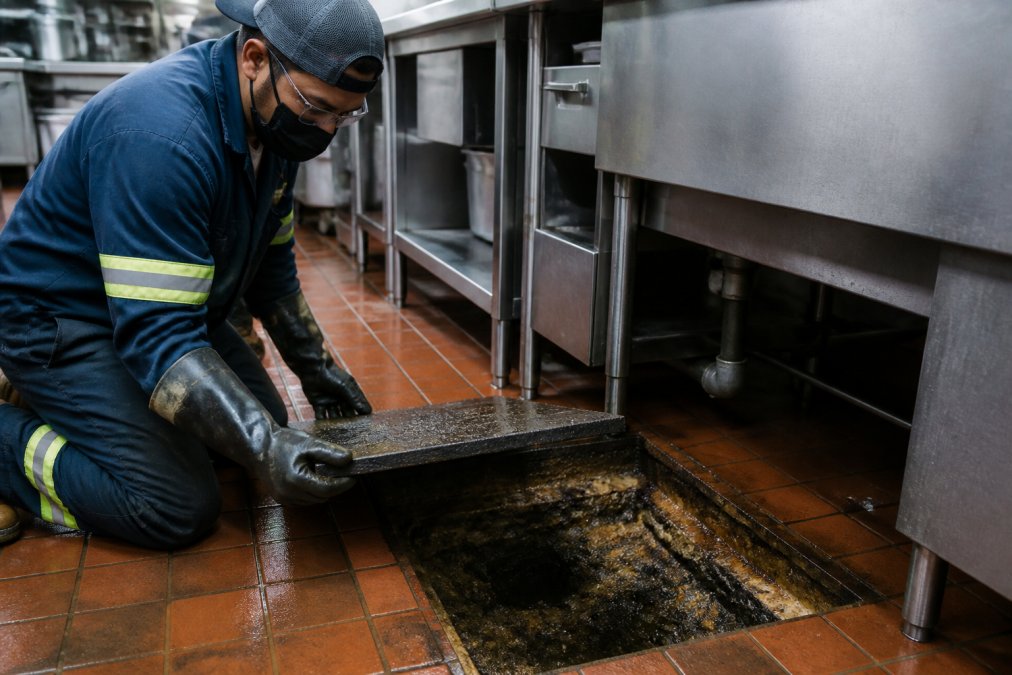
Open the trap cover slowly. Do not remove it suddenly, gases may rush out. Loosen it partially, wait 10 seconds for pressure to equalize, then remove it fully.
Use your flashlight to inspect the interior. You should see three distinct layers: a scum layer on top, liquid effluent in the middle, and sludge on the bottom. If either the sludge or scum exceeds 25% of the trap’s total depth, the trap is overdue for cleaning (nsf.org). If completely full, call a professional.
Step 3: Pump Out Accumulated Sludge and Scum Layer
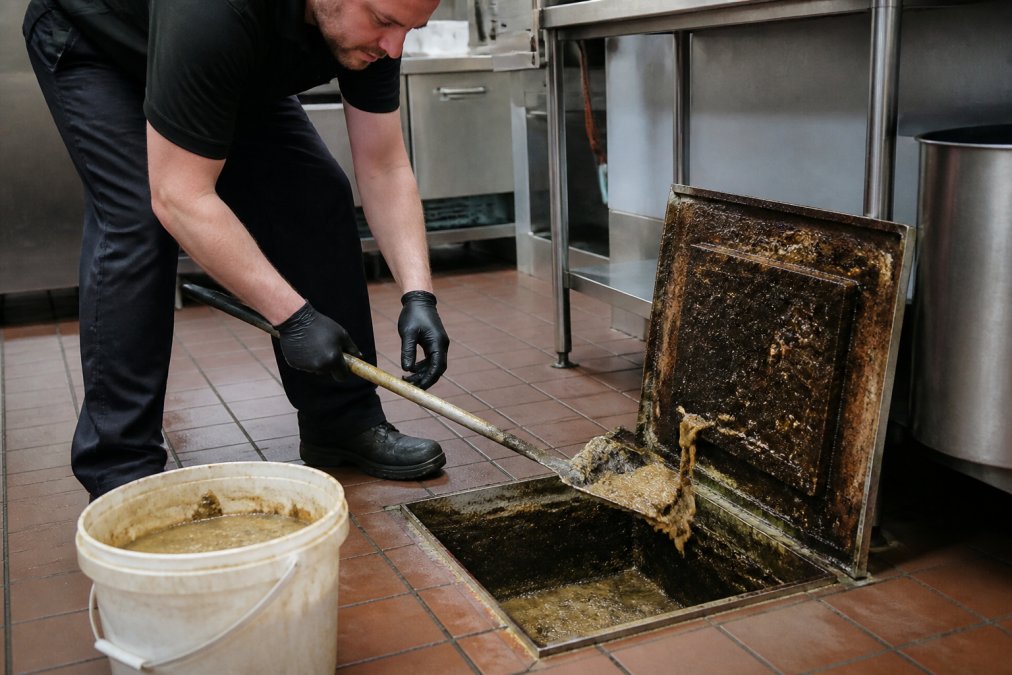
Start with the sludge at the bottom. Use your shovel or scoop to break it up and load it into your wet/dry vacuum. Work systematically from one end of the trap to the other.
Once sludge is removed, tackle the scum layer on the surface. Use your brush to break up the hardened grease and push it toward the center where your vacuum hose can reach it. Do not leave any grease behind. As you work, empty your vacuum tank before it reaches capacity.
Step 4: Clean Interior Walls and Baffle System
Once bulk sludge and scum are removed, clean the trap’s interior walls. Use your long-handled brush to scrub the sides, paying special attention to baffle plates. Brush the inlet and outlet pipes gently. Vacuum any loose debris and grease residue.
Step 5: Flush and Restore the System
Flush the trap with hot water. Use a hose to run water through the inlet pipe and observe it exiting the outlet pipe. Water should flow freely without backing up. If it doesn’t, blockage remains in the outlet line and requires professional intervention.
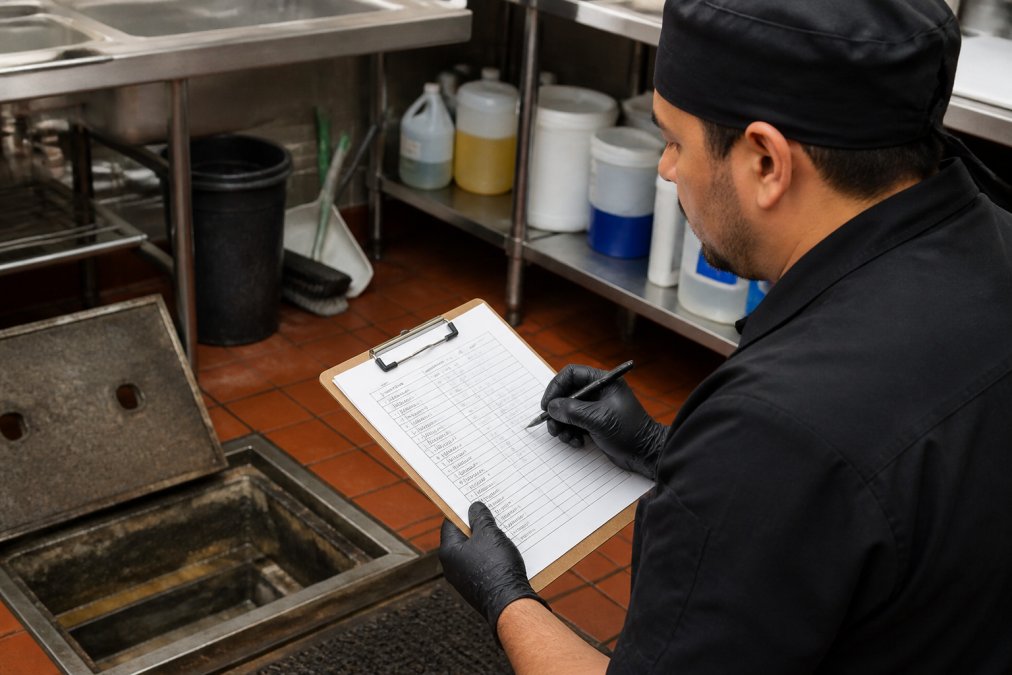
After flushing, replace the trap cover securely. Run water through your kitchen drains to verify normal flow. Document the cleaning: date, amount of FOG removed, condition of the trap, and any issues observed.
Recommended Grease Trap Cleaning Frequency
How often you clean depends on your kitchen’s volume and the trap’s size. A small café might clean quarterly. A high-volume steakhouse might need cleaning every 2-3 weeks. A casual restaurant might clean monthly.
Clean when the combined sludge and scum layer reaches 25% of the trap’s total depth. Track your cleaning dates and the amount of FOG removed each time. If you’re removing 10 gallons every two weeks, your next cleaning should happen in two weeks.
Most jurisdictions require documentation of grease trap maintenance. You should have a log showing cleaning dates, who performed the cleaning, and disposal records. Professional cleaning services often recommend: monthly for high-volume kitchens, quarterly for moderate operations, and twice yearly for low-volume establishments. Adjust based on your actual accumulation rate.
Commercial Grease Trap Maintenance Checklist
Effective grease trap management extends beyond cleaning.
Daily Tasks:
- Scrape food waste into trash, not drains
- Wipe grease from cookware into a waste container before washing
- Check for unusual odors or slow drainage
Weekly Tasks:
- Inspect the trap area for pooling water or leaks
- Verify that drain strainers are in place and functioning
- Monitor kitchen drainage for sluggish flow
Monthly Tasks:
- Inspect the trap visually for sludge depth
- Review your cleaning log and estimate next cleaning date
- Check that the trap cover is secure and not leaking
Quarterly Tasks:
- Perform a professional inspection if you haven’t cleaned recently
- Test the outlet pipe for blockages
- Document any issues or changes in drainage patterns
Annual Tasks:
- Have a licensed plumber inspect the entire grease trap system
- Check for cracks, leaks, or structural damage
- Review your disposal records for compliance
Regular monitoring catches problems early, when they’re inexpensive to fix.
Health Code Compliance and Regulatory Requirements
Grease trap maintenance is a legal requirement. Health departments enforce grease trap standards to protect municipal sewer systems and the environment.
The National Plumbing Code requires that all food service establishments install and maintain grease traps or interceptors (icc.org). Your local health department specifies the trap size based on your kitchen’s fixture count and estimated grease production.
Maintenance records are mandatory. You must document when the trap was cleaned, how much FOG was removed, and who performed the work. These records are reviewed during health inspections.
Disposal of FOG is regulated. Removed grease must be disposed of through a licensed waste hauler. Many jurisdictions require a disposal manifest. Keep these records for at least three years.
Some municipalities require professional cleaning at specified intervals. Check with your local health department about whether you can self-certify or if a licensed contractor must perform the work.
Violations carry penalties. A single citation for an unmaintained grease trap can result in fines of $500 to $5,000 depending on your jurisdiction. Repeated violations lead to higher fines or operational restrictions.
DIY Cleaning vs. Professional Services: What You Should Know
The decision to clean your grease trap yourself or hire a professional depends on trap size, accumulation rate, your comfort with the work, and regulatory requirements.
DIY cleaning works for small traps in low-volume kitchens. If your trap is under-counter and holds less than 50 gallons, you can likely manage it yourself. The cost savings are real, you pay only for supplies, not labor.
However, large buried traps require excavation and specialized equipment. If your trap is more than 4 feet deep or holds over 100 gallons, professional equipment is necessary. Health code compliance may also require professional documentation. If your jurisdiction mandates that a licensed plumber certify the cleaning, DIY work doesn’t satisfy the requirement.
Professional cleaning services bring industrial-grade equipment: vacuum trucks with 500+ gallon capacity, hydro-jetting systems to clear blockages, and disposal trucks that haul FOG to proper facilities. A professional job takes 1-2 hours instead of 3-4 hours of labor. Professionals also diagnose problems you might miss and identify issues requiring repair.
Professional cleaning typically costs between $300 and $800 per visit. DIY cleaning costs $50-$150 in supplies. If you clean quarterly, professional service runs $1,200 to $3,200 annually. DIY runs $200-$600. For restaurants, if you have expertise and your trap is small, DIY works. If your trap is large, your code requires professional certification, or you’re uncomfortable with the work, hire a professional. The cost of emergency cleaning after a failure far exceeds routine maintenance.
Alpha Rooter & Plumbing provides professional grease trap cleaning for restaurants throughout the Los Angeles area, with rapid response and thorough documentation for compliance. Their team handles everything from routine maintenance to emergency cleanouts, ensuring your kitchen stays operational and your facility meets all regulatory requirements.
=== FAQ ANSWERS (audit these too, same rules) ===
[1] Q: How often should a commercial grease trap be cleaned?
A: Cleaning frequency depends on kitchen volume and FOG output. High-volume restaurants typically need cleaning every 1-3 months, while smaller operations may go 3-6 months. Health codes require that grease traps maintain at least 25% of their capacity as free space. Waiting until the trap is full risks sewer backups, cross-contamination, and regulatory violations. Monthly inspections help you stay compliant and prevent costly emergency repairs.
[2] Q: What are the health code requirements for grease trap maintenance?
A: Health departments require restaurants to maintain grease traps so they function properly and don’t discharge FOG into the municipal sewer system. Most jurisdictions mandate regular cleaning, disposal of waste through licensed haulers, and documentation of maintenance records. Improper maintenance can result in fines, operational shutdowns, and liability for sewer line damage. Your local health department can provide specific requirements; professional services ensure full compliance and generate the documentation inspectors require.
[3] Q: Can I clean a grease trap myself, or should I hire a professional?
A: DIY cleaning is possible for small traps in low-volume kitchens, but professional service is safer and more thorough. Professionals have vacuum pumping equipment, hydro-jetting capability, and proper disposal manifests for solid waste and FOG. They also handle baffle inspection and cross-contamination risks that DIY methods miss. For restaurants operating under health code scrutiny, professional service provides liability protection and compliance documentation that DIY cleaning cannot guarantee.
[4] Q: What should I do if my grease trap backs up and I can’t open for service?
A: Call a licensed plumber immediately for emergency vacuum pumping and hydro-jetting. A backed-up trap indicates the inlet pipe or sludge layer is blocking drainage. Do not attempt DIY clearing, as this can damage the baffle or push FOG into the sewer line. Professional emergency service can usually respond quickly and restore function. Keep your plumber’s contact information readily available; delays in addressing backups create health code violations and lost revenue.
Frequently Asked Questions
How often should a commercial grease trap be cleaned?
Cleaning frequency depends on kitchen volume and FOG output. High-volume restaurants typically need cleaning every 1-3 months, while smaller operations may go 3-6 months. Health codes require that grease traps maintain at least 25% of their capacity as free space. Waiting until the trap is full risks sewer backups, cross-contamination, and regulatory violations. Monthly inspections help you stay compliant and prevent costly emergency repairs.
What are the health code requirements for grease trap maintenance?
Health departments require restaurants to maintain grease traps so they function properly and don't discharge FOG into the municipal sewer system. Most jurisdictions mandate regular cleaning, disposal of waste through licensed haulers, and documentation of maintenance records. Improper maintenance can result in fines, operational shutdowns, and liability for sewer line damage. Your local health department can provide specific requirements; professional services ensure full compliance and generate the documentation inspectors require.
Can I clean a grease trap myself, or should I hire a professional?
DIY cleaning is possible for small traps in low-volume kitchens, but professional service is safer and more thorough. Professionals have vacuum pumping equipment, hydro-jetting capability, and proper disposal manifests for solid waste and FOG. They also handle baffle inspection and cross-contamination risks that DIY methods miss. For restaurants operating under health code scrutiny, professional service provides liability protection and compliance documentation that DIY cleaning cannot guarantee.
What should I do if my grease trap backs up and I can't open for service?
Call a licensed plumber immediately for emergency vacuum pumping and hydro-jetting. A backed-up trap indicates the inlet pipe or sludge layer is blocking drainage. Do not attempt DIY clearing, as this can damage the baffle or push FOG into the sewer line. Professional emergency service can usually respond quickly and restore function. Keep your plumber's contact information readily available; delays in addressing backups create health code violations and lost revenue.
Grease trap failures don’t announce themselves until they’ve already shut down your kitchen. The restaurants that avoid emergency calls are the ones that clean on schedule and document their maintenance. If you’re managing a busy kitchen and grease trap cleaning feels like one more thing on an already full plate, Alpha Rooter & Plumbing’s licensed team can handle it with upfront pricing and no hidden fees. Call now for a consultation, they respond within 90 minutes.
This article was written using GrandRanker
Comments are closed