
Table of Contents
- How Cast Iron Pipes Corrode and Narrow Over Time
- Signs of Cast Iron Pipe Failure You Shouldn’t Ignore
- Why Cast Iron Pipes Keep Backing Up Repeatedly
- Sewer Camera Inspection Cost and What It Reveals
- Repair vs. Replace: When Trenchless Sewer Repair Works for Cast Iron
- Preventative Maintenance for Aging Cast Iron Systems
- Professional Methods for Clearing Stubborn Cast Iron Clogs
- Frequently Asked Questions
Last Updated: September 21, 2026
How Cast Iron Pipes Corrode and Narrow Over Time
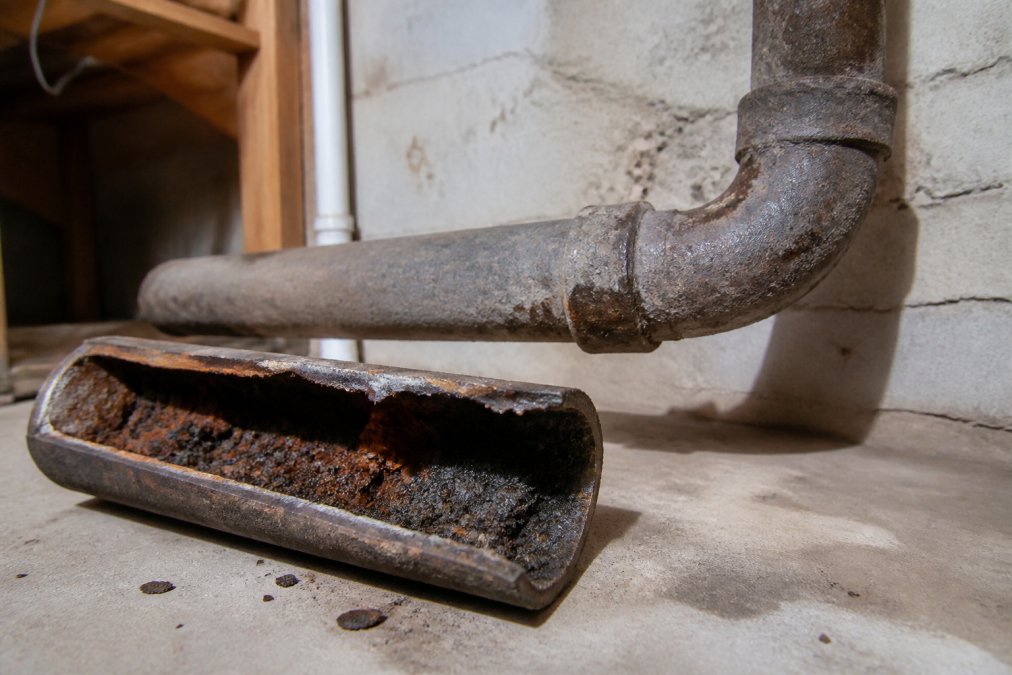
Cast iron pipes corrode from the inside out. The metal oxidizes when exposed to water and oxygen, creating rust that builds up on the interior walls. Over decades, this corrosion layer thickens and narrows the pipe’s diameter, restricting water flow.
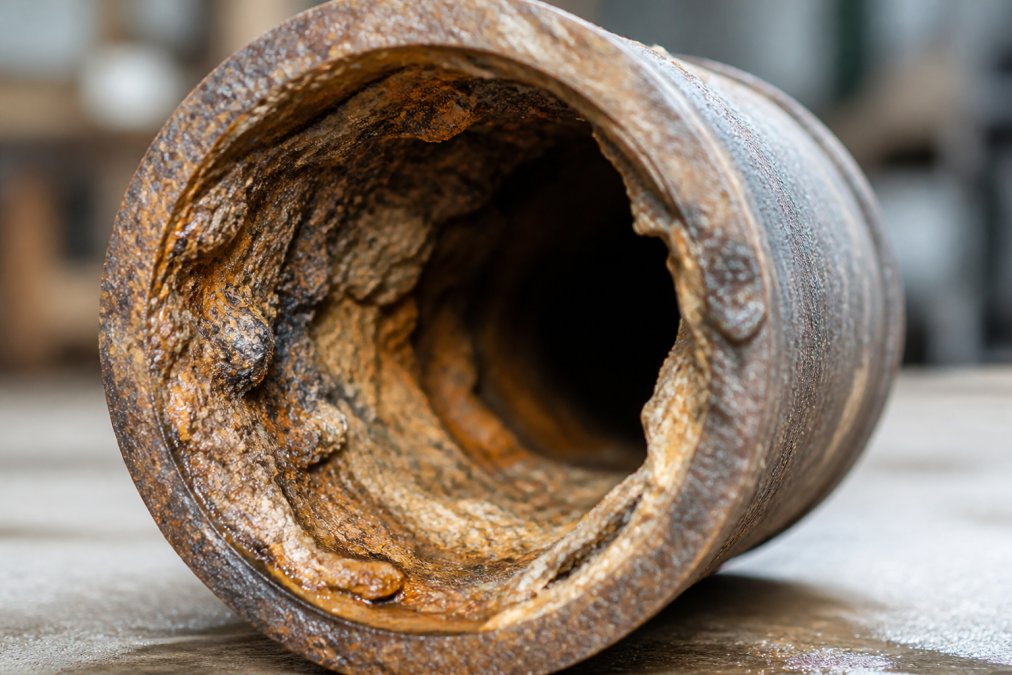
The process accelerates in acidic water or areas with high mineral content. Minerals deposit on the corroded surface, creating a rough interior that traps debris and slows drainage.
Pipes originally 4 inches wide often narrow to 2 inches or less after 60+ years of corrosion and mineral accumulation.
Why this happens:
- Oxygen in water triggers oxidation of iron
- Acidic water speeds corrosion significantly
- Mineral deposits stick to rough corroded surfaces
- The buildup creates a narrower, restrictive passage
Signs of Cast Iron Pipe Failure You Shouldn’t Ignore
Visual and Auditory Warning Signs
Slow drains in multiple fixtures signal a main line problem, not individual traps.
Gurgling sounds indicate air pockets from partial blockages.
Performance Red Flags
Recurring backups are the clearest sign of cast iron pipe failure. If your toilet backs up, clears, and backs up again within days or weeks, the problem is the main sewer line, not the trap.
Why Cast Iron Pipes Keep Backing Up Repeatedly
Why cast iron pipes keep backing up repeatedly comes down to three factors: narrowed diameter, rough interior surfaces, and structural failure. A 4-inch pipe reduced to 2 inches handles less volume. The corroded interior’s bumpy surface grabs debris, hair, soap, grease, instead of letting it flow through. Partial structural failure allows dirt and roots to enter, blocking flow further. Clearing the line doesn’t fix the underlying damage, so backups return within days.
Sewer Camera Inspection Cost and What It Reveals
A sewer camera inspection shows exactly what’s happening inside your pipes. A waterproof camera travels through the line on a flexible cable, transmitting real-time video to a monitor above ground.
The inspection reveals:
- Corrosion severity and location
- Scale buildup thickness
- Cracks or holes in the pipe
- Root intrusion points
- Debris accumulation
- Pipe diameter reduction
Most residential inspections take under an hour.
Repair vs. Replace: When Trenchless Sewer Repair Works for Cast Iron
Understanding Your Repair Options and True Costs
When a sewer camera inspection confirms cast iron pipe deterioration, homeowners face two paths: trenchless repair (pipe lining) or full replacement, depending on pipe condition, budget, and long-term plans.
Trenchless Pipe Lining (CIPP)
Advantages:
- No excavation required (yard stays intact)
- Completed in 1-3 days
- Significantly cheaper than full replacement
- New interior surface resists corrosion for 50+ years
- Minimal disruption to daily life
Limitations:
- Reduces interior diameter by 1/4 to 1/2 inch (problematic if flow is already restricted)
- Cannot repair collapsed sections or large holes
- Requires clean-out access points; some properties lack adequate access
- Not suitable if multiple severe breaks exist along the line
- May not be covered by standard homeowner’s insurance policies
Full Pipe Replacement
Advantages:
- Eliminates corrosion permanently
- Restores original pipe diameter (no flow restriction)
- Fixes all structural damage in one project
- Prevents recurring backups for decades
- Often more cost-effective long-term if multiple sections are severely damaged
Disadvantages:
- Requires excavation (yard disruption, potential landscaping restoration costs)
- Takes 5-10 days depending on line length
- Higher upfront cost
- May require permits and inspections
Insurance and Warranty Coverage
Most standard homeowner’s insurance policies do not cover sewer line failure from age, corrosion, or wear and tear, though coverage varies by policy.
What may be covered:
- Sudden, accidental damage (tree root intrusion causing a sudden break)
- Damage from external events (foundation shift, vehicle impact)
- Backup of sewage into the home (water damage portion, not the pipe repair itself)
What is typically excluded:
- Corrosion and rust (normal wear)
- Scale buildup and mineral deposits
- Gradual structural failure
- Preventative maintenance or upgrades
Decision Framework: Lining vs. Replacement
Choose lining if:
- Pipe has corrosion and minor cracks but no collapse
- Only one or two sections are severely damaged
- Budget is tight and you need a quick fix
- You plan to sell within 5-10 years
- Excavation is impractical (mature trees, hardscape, tight spaces)
Choose replacement if:
- Multiple sections show severe corrosion or structural failure
- Pipe has collapsed areas or large holes
- Interior diameter is already severely restricted
- You plan to stay in the home 20+ years
- Recurring backups are happening multiple times per year
- You want to eliminate the problem permanently and avoid future emergency calls
The Hidden Cost of Repeated Temporary Fixes
Repeated snaking or hydro-jetting can incur significant costs over time, often exceeding permanent repair costs. A sewer camera inspection provides data to choose the most cost-effective path.
Preventative Maintenance for Aging Cast Iron Systems
Regular hydro-jetting removes scale buildup and debris before they cause backups. Annual or biennial cleaning is reasonable for cast iron systems over 50 years old.
Watch for warning signs:
- Slow drains
- Sewage odors
- Wet spots in yard
- Gurgling sounds
- Recurring backups
Professional Methods for Clearing Stubborn Cast Iron Clogs
Why Store-Bought Tools Fail on Cast Iron
Consumer-grade drain snakes and plungers are designed for modern smooth plastic pipe and typical household clogs (hair, soap, grease). They fail against cast iron for two mechanical reasons:
1. Insufficient Force Against Mineral Scale
2. Inadequate Reach and Maneuverability
Professional Hydro-Jetting: The Gold Standard for Cast Iron
Hydro-jetting uses pressurized water to scour pipe interiors clean. Professional hydro-jetting equipment operates at 3,000-4,000 PSI, 15 to 20 times the pressure of a consumer pressure washer.
How it works:
- A specialized nozzle is attached to a flexible hose and fed into the pipe via a clean-out
- Water jets spray in multiple directions (forward, backward, and sideways) to scour all interior surfaces
- The high-pressure stream breaks apart mineral scale, grease buildup, and debris
- Loosened material is flushed downstream toward the municipal sewer
- The process cleans the pipe walls, not just punching through the blockage
Why it works on cast iron:
- 3,000+ PSI is sufficient to break the chemical bond of mineral scale
- Omnidirectional jets reach the entire interior circumference, not just the center
- The cleaning effect lasts longer because the rough surface is temporarily smoothed
- Debris doesn’t re-accumulate as quickly on a freshly cleaned surface
Limitations of hydro-jetting:
- Cannot repair structural damage (cracks, holes, collapsed sections)
- Not effective if the pipe is more than 50% blocked by solid debris or roots
- Temporary solution if the underlying corrosion and narrowing remain
- Requires professional equipment and trained operators (improper technique can damage old pipes)
Sewer Camera Inspection Guides the Right Method
Before choosing a clearing method, a professional sewer camera inspection identifies the exact nature and location of the blockage:
- Scale buildup only: Hydro-jetting is highly effective
- Scale + grease accumulation: Hydro-jetting followed by preventative maintenance
- Scale + root intrusion: Hydro-jetting to clear, then root barriers or replacement to prevent recurrence
- Partial structural collapse: Hydro-jetting may temporarily clear flow, but replacement or lining is necessary
- Severe collapse or large holes: Hydro-jetting is ineffective; repair or replacement is required
Mechanical Snaking: When It’s Appropriate
Professional mechanical snaking (using a motorized cable with a cutting head) is still useful for:
- Clearing tree roots that have penetrated the pipe
- Breaking through partial blockages in pipes that are not severely narrowed
- Initial clearing before hydro-jetting (to remove large debris)
- Situations where hydro-jetting equipment cannot access the line
However, snaking alone does not clean the pipe. It clears a path but leaves scale and debris on the walls. Hydro-jetting after snaking is often necessary for a lasting result.
The Professional Advantage: Equipment, Expertise, and Diagnostics
Professional plumbers bring three things consumer tools cannot:
- Specialized Equipment: Hydro-jetting units, camera systems, and extended snakes designed for residential sewer lines
- Diagnostic Capability: Sewer cameras reveal the exact problem, preventing wasted time on ineffective methods
- Experience with Failure Modes: Professionals recognize when clearing is temporary versus when structural repair is necessary, saving homeowners money on repeated failed attempts
A professional hydro-jetting service and a sewer camera inspection provide a professional diagnosis and clearing. This is higher than a single consumer attempt, but it prevents the cycle of repeated backups and emergency calls that cost far more over time.
Frequently Asked Questions
What is the average lifespan of a cast iron sewer line?
Cast iron pipes typically last 75 to 100 years, though many fail earlier due to corrosion, scale buildup, and tree root intrusion. Pipes installed in the 1950s or earlier are now approaching or exceeding their design life. If your home has original cast iron from that era and experiences repeated backups, replacement or trenchless sewer repair for cast iron may be necessary sooner than expected.
What are the signs that my cast iron pipes are failing?
Common signs of cast iron pipe failure include slow drains throughout your home, frequent backups in multiple fixtures, sewer odors inside or near your property, wet spots or sinkholes in your yard, and patches of unusually lush grass (indicating a leak). Gurgling sounds from drains and sewage backing into showers or lowest-level fixtures are also red flags. A sewer camera inspection can confirm the extent of deterioration and help determine whether repair or replacement is needed.
Can cast iron pipes be repaired without excavation?
Yes, trenchless sewer repair for cast iron is possible in many cases. Pipe lining (cured-in-place or slip-lining) can seal interior corrosion and reduce flow restrictions without digging up your yard. However, trenchless methods work best for moderate corrosion and structural cracks. If the pipe has collapsed sections, severe root intrusion, or multiple breaks, traditional excavation and replacement may be the only reliable solution. A video inspection will determine which option is suitable for your situation.
How much does a sewer camera inspection cost?
Sewer camera inspection cost varies based on the length of the line inspected and your location, but the investment provides critical diagnostic information. A professional inspection identifies corrosion, scale buildup, root intrusion, and structural damage, all factors that cause repeated backups. The findings guide your repair decision and help you avoid unnecessary replacement costs. Contact Alpha Rooter & Plumbing for a quote on sewer camera inspection; this single diagnostic step often saves thousands by clarifying whether you need repair or full replacement.
Comments are closed