
Table of Contents
- Immediate Steps During an Emergency Plumbing Crisis
- Signs of a Burst Pipe Emergency You Can’t Ignore
- Tenant Communication During Plumbing Emergencies
- Emergency Plumbing Response Time Standards
- Who Is Responsible? Tenant vs. Landlord and Insurance
- Preventative Maintenance for Multi Unit Properties
- Conclusion
- Frequently Asked Questions
Last Updated: September 14, 2026
Immediate Steps During an Emergency Plumbing Crisis
Emergency plumbing for multi unit buildings fails or succeeds in the first ten minutes, before any contractor arrives. A documented emergency protocol is the single biggest factor in limiting damage, and the buildings that recover fastest are the ones whose managers already know where the shut-off valve is.
Start with these steps, in order:
- Confirm the source: ask the tenant which fixture is leaking, or whether water is coming through a ceiling or wall.
- Kill the water at the nearest isolation valve, or the building main if the source is unclear.
- Cut power to any affected area at the breaker panel if water is near outlets or fixtures.
- Call your emergency plumbing line and report the unit, the source, and whether water is still flowing.
- Document everything with photos and timestamps before cleanup begins.
- Notify affected tenants and, if the issue is building-wide, the full resident roster.
Never send a tenant to shut off a main valve themselves. A seized or mislabeled valve turned the wrong way can flood an entire riser, turning a single-unit repair into a building-wide water damage mitigation job.
How to Shut Off the Main Water Supply
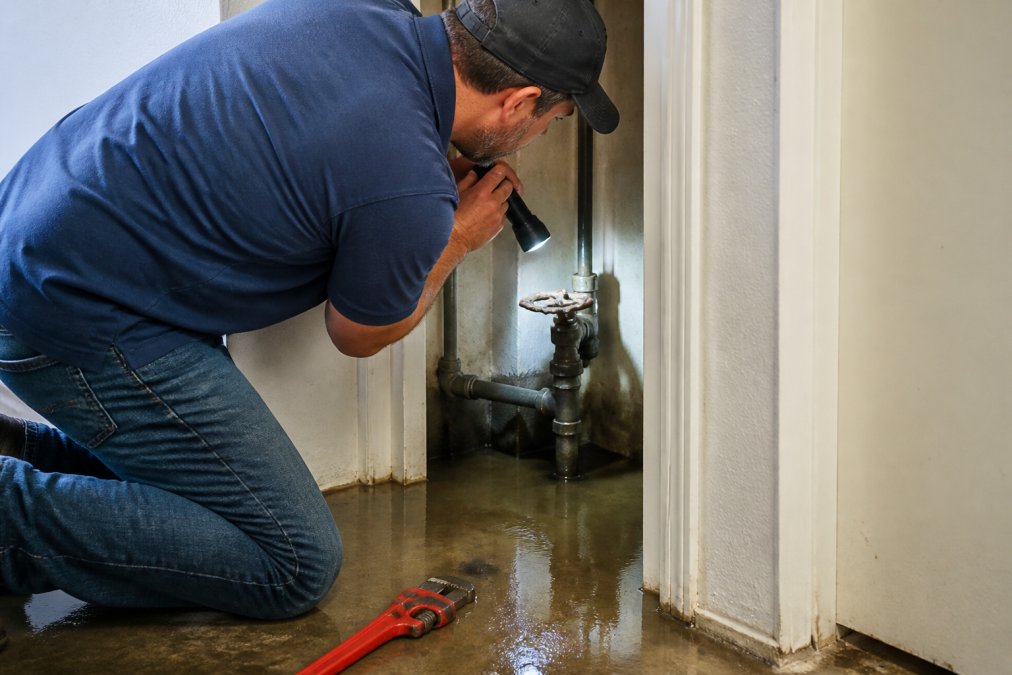
The main water shut-off valve is the most important piece of plumbing infrastructure in any multi-family property, and it should be labeled, tagged, and tested at least twice a year. It usually sits near the water meter, in a basement utility room, or in a ground-floor mechanical closet.
Gate valves fail more often than ball valves because their internal washers degrade. If your building still has an older gate valve on the main, budget for replacement rather than waiting for it to seize mid-emergency. A ball valve with a lever handle gives you a quarter-turn shutoff, which is the difference between a contained mess and a flooded hallway.
Water Damage Mitigation and Documentation
Water damage mitigation begins the moment the water stops, not when the plumber arrives. Extract standing water, run dehumidifiers, and photograph every affected surface before you touch it. Insurance reimbursement depends almost entirely on documentation quality.
Your emergency repair documentation should capture four things: the time the leak was reported, the time water was shut off, photos of the source and the spread, and a written log of every call and action. Write it down immediately; adjusters notice gaps.
Signs of a Burst Pipe Emergency You Can’t Ignore
A burst pipe in a multi-unit building rarely looks like the movies. It usually announces itself as a pressure change, a sound, or a bill anomaly before any water is visible. Treat the signs below as a confirmed emergency, not a wait-and-see item.
Pressure and flow signals
- A sudden drop in pressure across multiple fixtures in one stack, but not the whole building, points to a break in a vertical riser between floors.
- Pressure that drops on upper floors while lower floors stay normal is a classic high-rise symptom: the break is above the affected units and gravity is draining the line.
- A single unit losing pressure while neighbors are fine usually means a contained but urgent branch line or fixture supply issue.
- Water hammer that gets louder over days, followed by a pressure drop, often precedes a failed joint in galvanized or cast iron lines.
Sound signals
- Hissing or rushing inside a wall or ceiling cavity is moving water, the most reliable indicator of an active hidden leak.
- A gurgling drain stack backing up across multiple units suggests a main line break or collapsed section, not a simple clog.
- Banging on startup that escalates to a steady hiss signals a failing valve seat or a pinhole that just opened.
Visual and billing signals
- Ceiling staining that reappears after paint, especially on a lower floor, is a slow leak from the unit above, not a roof issue.
- A water bill spike of 20 percent or more with no change in occupancy is a strong hidden-leak indicator; most utilities will flag this on request (the EPA).
- Warm floor spots or a hot water bill spike with no fixture running points to a slab leak in a hot water line.
High-Rise vs. Garden-Style: Different Buildings, Different Failure Modes
Building type changes what a burst pipe looks like and how fast it spreads.
High-rise (typically five stories and above)
- Vertical stacks carry water under higher static pressure, so a break on an upper floor can drain through multiple units before anyone on the ground floor notices.
- Pressure-reducing valves at the base of the riser fail quietly; when one goes, upper-floor fixtures see full street pressure and joints fail in sequence.
- A single riser break can cut water to an entire column of units, so the shut-off scope is larger and tenant impact immediate.
- Slab leaks are less common in high-rise construction but costlier, since the line often sits under a post-tension slab that cannot be cut without engineering review.
Garden-style (typically one to three stories, exterior entries)
- Horizontal branch lines and slab-on-grade construction make slab leaks the dominant hidden failure; warm floors and unexplained bill spikes are the early tells.
- Because each building has its own main, a break is usually contained to one building, which shortens the shut-off scope.
- Freeze events hit garden-style harder: exterior wall runs and unheated crawl spaces split first, often surfacing as multiple simultaneous leaks after a thaw.
- Shorter, shallower sewer laterals mean root intrusion and offset joints show up as recurring backups in the same unit rather than a building-wide event.
Map your risers and branch lines on a simple floor plan and label which isolation valve controls which column of units. In a high-rise, knowing the valve scope cuts response time more than any other single piece of preparation.
Hidden Leaks: The Slow Version of the Same Emergency
Hidden leaks are the dangerous variant because they run for weeks before surfacing as mold, a sagging ceiling, or a failed inspection. In older buildings with cast iron or galvanized steel lines, pipe corrosion is the usual culprit, and a pinhole leak today is a full rupture next month. Any unexplained moisture, musty odor, or bill spike gets a leak detection sweep within 48 hours.
Tenant Communication During Plumbing Emergencies
Tenant communication during plumbing emergencies is where most property managers lose control. Clear, fast, specific messages reduce panic calls and prevent tenants from making the damage worse.
Send three messages: an acknowledgment within minutes, a status update once the source is confirmed, and a resolution notice when the work is complete. Keep each one short and factual.
Communication Templates for Property Managers
Use these templates as-is or adapt them to your building’s tone.
Acknowledgment (send within 15 minutes):
“Hi [Tenant Name], we’ve received your report of [issue] in [unit/area] and our emergency plumber is being dispatched now. Please do not use any water in [affected area] until we confirm it’s safe. We’ll update you within the hour. For urgent questions, call [emergency number].”
Status update (once source is confirmed):
“Update on [building/unit]: the issue is [brief description]. Water has been shut off to [scope]. Expected repair window is [timeframe]. Affected units: [list]. We’ll notify you the moment service is restored.”
Resolution notice:
“[Issue] has been repaired and water service is restored to [scope]. If you notice any discoloration, low pressure, or new leaks, report them immediately to [contact]. Thank you for your patience.”
Keep a copy of every message. If a tenant later disputes a claim, your communication log is your best defense.
Emergency Plumbing Response Time Standards
Emergency plumbing response time standards vary by contract, but a reasonable benchmark for multi-unit properties is on-site arrival within 60 to 90 minutes for active leaks and sewer backups. Anything slower turns a contained repair into a building-wide water shut-off and remediation project.
Set expectations in writing. Your service level agreement should spell out:
- Response window for after-hours calls versus business-hours calls
- What counts as a true emergency versus a next-day repair
- Whether the after-hours surcharge is waived or capped
- The escalation path if the first technician is delayed
Response time is the metric that matters most to tenants and to your insurance carrier. A documented 90-minute standard, consistently met, is worth more than a lower hourly rate that comes with a three-hour arrival window.
Who Is Responsible? Tenant vs. Landlord and Insurance
Property owner responsibility generally covers the building’s plumbing infrastructure: supply lines inside walls, the main line, water heaters, and shared drain stacks. Tenant liability typically applies to damage from misuse, such as flushing wipes or grease, or from failing to report a leak promptly. The dividing line is causation, not location.
Insurance follows the same logic: the building’s policy covers the structure and common areas, a renter’s policy covers personal belongings, and if tenant negligence caused the damage, the owner’s carrier may pursue the tenant or their insurer for recovery.
Legal and Lease Nuances for Emergency Access
Emergency access is the clause most leases get wrong. In most states, a landlord may enter a unit without prior notice during an active emergency that threatens property or safety, but the lease should state this explicitly (hud.gov). For co-ops and condos, board rules often layer on top of the lease and can restrict who may authorize entry or repairs.
Your lease should also address:
- Who pays for emergency repairs when the cause is disputed
- Whether the landlord may relocate a tenant during extended repairs
- The tenant’s duty to report leaks within a set time window
- How the building handles entry when a tenant is unreachable
Check your state’s landlord-tenant statutes and local building codes for the notice and entry rules that apply to your property type. Plumbing code compliance and emergency access rules differ between high-rise and garden-style buildings, so a single template rarely fits both.
Preventative Maintenance for Multi Unit Properties
Preventative maintenance for multi unit properties is the cheapest insurance a property manager can buy, but only if it’s scoped to the building’s actual failure modes. A generic annual checklist wastes money on low-risk items and misses the ones behind the most expensive claims.
A practical annual schedule, adjusted for building type, looks like this:
| Task | Frequency | Typical Trigger Avoided |
|---|---|---|
| Main line inspection and hydro-jetting | Annually | Main line blockage, sewer backup |
| Water heater flush and anode check | Annually | Sudden heater failure, flooding |
| Fixture and shut-off valve test | Twice yearly | Seized valves, water pressure issues |
| Leak detection sweep | Annually | Hidden leaks, pipe corrosion |
| Drain cleaning on kitchen stacks | Quarterly | Grease buildup, recurring backups |
| Pressure-reducing valve test (high-rise) | Annually | Riser joint failures, upper-floor overpressure |
| Slab leak moisture mapping (garden-style) | Annually | Hidden slab leaks, foundation damage |
| Freeze-prep inspection (exterior runs) | Pre-winter | Split pipes after thaw |
Cost-Benefit Analysis of Maintenance Contracts
A maintenance contract trades a predictable annual cost for the elimination of most emergency calls. The math favors it in almost every building with more than four units, because of the avoided cost of a single catastrophic event.
Here is the framework most property managers use to decide:
What a contract typically includes
- Scheduled inspections at a fixed frequency, usually quarterly or semi-annual
- Priority dispatch and a defined response window for emergencies
- A locked-in labor rate for the contract term, which protects against after-hours surcharges
- Documentation of every visit, which doubles as your insurance paper trail
What an ad-hoc approach actually costs
- Market rate plus an after-hours surcharge on every emergency call
- No priority in the dispatch queue, so you get the next available tech, not the fastest
- Remediation, deductible, and lost rent on any event that a scheduled inspection would have caught
- No service history, which weakens your position with an adjuster after a claim
The break-even logic
A single burst-pipe claim in a multi-unit building typically involves water extraction, drywall and flooring replacement, possible mold remediation, and at least one unit of lost rent during repairs. That total usually exceeds the annual cost of a maintenance contract for a small to mid-size property, so the contract pays for itself if it prevents one event, not several.
The comparison is straightforward:
- No contract: you pay market rate for every emergency, plus the after-hours surcharge, plus remediation, plus tenant disruption.
- With a contract: you pay a fixed annual fee for scheduled service, and emergencies drop sharply because small problems get fixed before they escalate.
Do not evaluate a maintenance contract on the hourly rate. Evaluate it on the number of emergency calls it eliminates and the documentation it produces. A contract that costs more per hour but prevents one burst pipe is cheaper than the lowest bid that does not.
What to Put in the Contract
A maintenance contract is only as good as its terms. The clauses that matter most:
- Response window: a written on-site arrival commitment for after-hours emergencies, not a vague ‘priority service’ promise.
- Scope definition: which systems are covered (risers, mains, water heaters, common-area fixtures) and which are excluded (in-unit fixtures, tenant-owned appliances).
- Escalation path: who to call if the first technician is delayed, and what the backup plan is.
- Documentation requirement: a written report after every visit, with photos, that you can hand to an adjuster.
- Termination and renewal terms: avoid auto-renewal clauses that lock you in for a year after a single poor response.
Ask any contractor you vet for their license number, insurance certificate, and two references from comparable buildings. Contractor vetting on the front end prevents the liability mess on the back end.
State landlord-tenant statutes and local building codes governing emergency entry and repair obligations
Conclusion
Every multi-unit property will face a plumbing emergency eventually. The managers who come through it with minimal damage prepared before the call, not after it. Alpha Rooter & Plumbing handles 24/7 emergency dispatch with a guaranteed under-90-minute response time, upfront pricing with no hidden fees, and no hourly or overtime charges, backed by licensed plumbers and state-of-the-art diagnostic tools. When a pipe bursts at 2 a.m., that combination keeps a bad night from becoming a bad year. Call Alpha Rooter & Plumbing now and get a licensed technician on site before the water spreads.
Frequently Asked Questions
How much does emergency plumbing typically cost?
Emergency plumbing costs depend on the job, time of day, and parts needed. Many companies charge an after-hours surcharge, but Alpha Rooter & Plumbing does not charge hourly or overtime fees. For an accurate quote, contact a licensed plumber directly. Pricing depends on the specific issue, and you should always ask for upfront pricing before work begins.
What is the 135 rule in plumbing?
The 135 rule is a common guideline for sizing drain pipes: a drain should be at least 1.35 times the diameter of the pipe it connects to. This helps prevent clogs and ensures proper flow. While not a code requirement everywhere, it’s a useful rule of thumb for multi-unit buildings with shared drain lines. Always check local plumbing codes for exact requirements.
What qualifies as a plumbing emergency in a multi-unit building?
A plumbing emergency in a multi-unit building includes any issue that threatens property, health, or safety, such as a burst pipe, sewer backup, no water, or flooding. Unlike a single-family home, a problem in one unit can affect many others, so it requires immediate action. If you’re unsure, call a 24/7 emergency plumber for guidance.
Who is responsible for emergency plumbing repairs in a rental unit?
In most cases, the landlord or property manager is responsible for emergency plumbing repairs, as they must maintain a habitable living environment. However, if the tenant caused the damage through negligence, they may be liable. Lease agreements and local laws determine the specifics. Always document the issue and communicate promptly with your landlord or property manager.
How can property managers minimize damage during a major plumbing leak?
Property managers can minimize damage by acting fast: shut off the main water supply, use towels or buckets to contain water, and call a 24/7 emergency plumber immediately. Document everything with photos for insurance. After the repair, consider a preventative maintenance plan to avoid future leaks. Quick action reduces repair costs and tenant disruption.
What are the legal requirements for providing emergency plumbing access to tenants?
Legal requirements vary by state and lease, but generally landlords must provide reasonable notice before entering a unit, except in emergencies. In an emergency, immediate access is usually allowed to prevent property damage. Check your local laws and lease agreements. Always document the emergency and the steps taken to resolve it.
How do you coordinate emergency plumbing repairs across multiple units?
Coordination starts with a clear emergency protocol: identify the source, shut off water if safe, and contact a 24/7 plumber. Notify all affected tenants with a template message, and keep a log of communications. For large buildings, a service level agreement with a plumbing company ensures priority response. Designate a point person to manage the repair and updates.
Comments are closed