
Last Updated: October 22, 2026
Quick Summary
Hiring commercial emergency plumbers for residential complexes means choosing licensed contractors with commercial certification, higher liability insurance, and after-hours staffing for multi-unit buildings. Vet them on license, insurance, multifamily references, a written response-time commitment, and a documented fee schedule before you sign a service agreement.
- Commercial policies usually carry higher general liability coverage, which matters when a failed repair damages multiple units.
- Ask for two references from multifamily properties, not single-family homes, and confirm the crew’s conduct on site.
- Define response time in writing as a specific number of minutes from dispatch to arrival, with after-hours parity.
- Get the diagnostic fee, after-hours surcharge, parts markup, and scope-change approval threshold in writing before the first call.
- Rank emergencies in three tiers so dispatch matches your priorities, with active flooding and sewage backup first.
Table of Contents
- What a Commercial Emergency Plumber Brings to a Residential Complex
- How to Vet an Emergency Plumber for Apartment Buildings
- Emergency Plumber Response Time: What to Put in Writing
- Emergency Plumbing Cost, Fees, and Contract Terms
- Your Property Manager Plumbing Emergency Checklist
- Multi-Unit Response Planning and Preventive Maintenance
- Frequently Asked Questions
What a Commercial Emergency Plumber Brings to a Residential Complex
Commercial emergency plumbers are licensed contractors trained to handle plumbing failures in multi-unit buildings, where one burst pipe can flood several units and shut down water for dozens of residents. At Alpha Rooter & Plumbing, we work these calls, and the difference between a commercial crew and a general handyman shows up in the first ten minutes.
A residential plumber is set up for one kitchen, one water heater, one shutoff valve. A multifamily property has stacked risers, shared drain lines, and a main shutoff serving twenty units or more.
That’s why hiring commercial emergency plumbers for residential complexes is a different job than calling whoever fixed your sink. You need someone who understands building plumbing as a system.
Commercial Versus Residential Contractor Qualifications
Residential plumbing licenses typically cover single-family work, while commercial plumbing often requires additional certification, bonding capacity, and insurance limits that match the building’s value.
Three things separate the two:
- Insurance limits. A commercial policy usually carries higher general liability coverage, which matters when a failed repair damages multiple units.
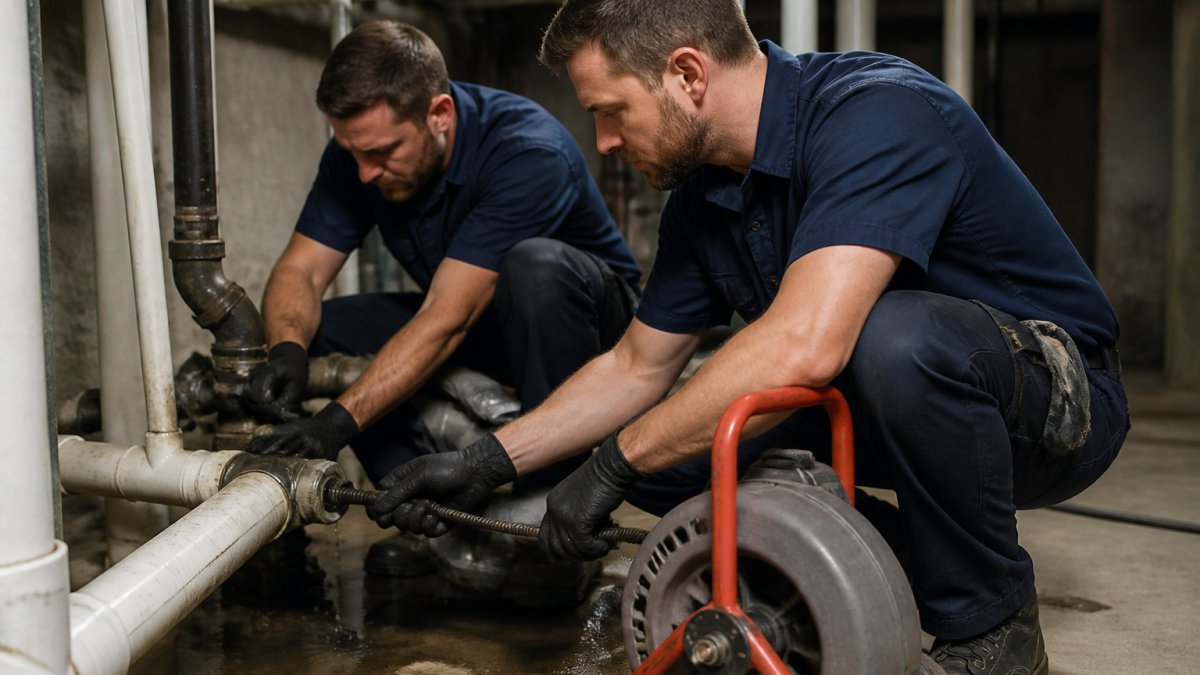
- Equipment. Commercial crews carry sewer cameras, hydro-jetting machines, and larger augers for main lines that residential vans don’t stock.
- After-hours staffing. Commercial contractors typically run scheduled on-call rotations rather than forwarding calls to an answering service.
Ask any candidate which license classification they hold and what liability limit their policy carries. A contractor who hesitates on either question is telling you something.
How to Vet an Emergency Plumber for Apartment Buildings
Vetting an emergency plumber for apartment buildings comes down to five checks you can complete before you sign a service agreement. Do them once, keep the results on file, and you’ll never scramble during a 2 a.m. sewer backup. Each item has a pass condition, a fail condition, and a place to record the answer.

The vetting checklist, with pass conditions:
- License. Look up the state contractor license number on your state’s licensing board website. Pass: the license is active, the classification covers commercial or multifamily work, and the business name matches the certificate of insurance. Fail: the number returns no record, is expired, or belongs to a different entity.
- Insurance. Request a certificate of insurance showing general liability and workers’ compensation. Pass: the general liability limit is high enough to cover a multi-unit water loss, your property or management company can be named as an additional insured, and the workers’ comp policy is current. Fail: the certificate is expired, the limits are residential-grade, or the contractor resists adding you as an additional insured.
- Multifamily references. Ask for two references from multifamily properties, not single-family homes. Pass: the references are property managers or maintenance supervisors who can describe a real emergency call and the crew’s conduct on site. Fail: the references are homeowners or the contractor can only produce commercial office references with no occupied residential units.
- Response commitment. Ask for the written response-time standard and the after-hours dispatch process. Pass: a stated maximum arrival window that applies nights and weekends, a named on-call rotation, and a dispatch confirmation step. Fail: “same day,” “as soon as possible,” or an answering service that cannot name a technician.
- Fee schedule. Get the diagnostic fee, after-hours surcharge, parts markup, and scope-change approval threshold in writing before the first emergency call. Pass: every line item is documented and the contractor will sign a service agreement that locks rates. Fail: pricing is described verbally or the contractor will only quote after arrival.
What most property managers miss: ask whether the crew carries its own water extraction and drying equipment. A plumber who stops the leak but leaves standing water in three units hands you a mold claim you’ll be managing for months. A contractor who subcontracted extraction to a restoration company adds a handoff delay exactly when minutes matter.
How to run the vetting without slowing down an emergency. Do the paperwork before you need it: collect license and insurance documents from two or three candidates, call the references, and file the results in a shared vendor folder. When an emergency hits, you are dispatching a contractor you already cleared. If you inherit a building with no vendor on file, start with license and insurance, those protect you personally if the repair goes wrong.
Licensing, Insurance, and Liability Checks
In most states, plumbing contractors must hold a state-issued license, and many municipalities require a separate local registration or permit before work begins.
Ask for a certificate of insurance naming your property or management company as an additional insured, so the contractor’s policy responds first if a repair floods a unit rather than your building’s carrier absorbing the loss.
Workers’ compensation coverage matters just as much: if an uninsured technician is injured in your building, the liability exposure can land on the property.
Emergency Plumber Response Time: What to Put in Writing
Emergency plumber response time should be defined in your service agreement as a specific number of minutes from dispatch to arrival, with the clock starting when you place the call. Verbal promises mean nothing during a flood.
A written standard should cover four points:
- Arrival window. A stated maximum, not a range. “Under 90 minutes” is a commitment; “same day” is not.
- After-hours parity. Weekend and overnight response should match weekday response. Confirm there’s no separate, slower queue.
- Dispatch confirmation. A callback or text confirming a technician is en route, with a name.
- Escalation contact. A direct line to a supervisor if the window is missed.
The most common mistake is accepting a response-time promise that only applies during business hours. Sewer backups and burst pipes don’t check the clock, and a contractor with a thin overnight rotation will miss the window exactly when the damage is worst.
Track actual arrival times against the commitment. Two or three misses in a quarter is a pattern, not bad luck.
Emergency Plumbing Cost, Fees, and Contract Terms
Emergency plumbing cost should be quoted upfront, in writing, before work begins. A contractor who won’t put a number in front of you is asking you to trust a blank check.
Pricing structures vary, but the terms to nail down are consistent:
| Term | What to Confirm | Why It Matters |
|---|---|---|
| Diagnostic fee | Whether it’s credited toward the repair | Avoids paying twice for one visit |
| After-hours surcharge | Flat fee or hourly multiplier | Determines true overnight cost |
| Parts markup | Percentage or flat | Affects large repair totals |
| Scope changes | Written approval threshold | Prevents surprise invoices |
| Payment terms | Net 30 for property accounts | Keeps cash flow predictable |
For a property manager, the goal is a service agreement that locks in rates and waives hourly overtime charges, turning an unpredictable emergency expense into a budgetable line item.
Ask directly: “If you arrive and the job is bigger than expected, what happens?” A good contractor stops, explains the new scope, and gets written approval before continuing. A bad one finishes the work and invoices you for whatever they decided.
Your Property Manager Plumbing Emergency Checklist
A property manager plumbing emergency checklist is a one-page document telling staff and residents exactly what to do in the first fifteen minutes of a failure. Keep it posted in the maintenance office and saved on every phone.
Before the emergency:
- Post the main water shutoff location for every building
- Keep a current vendor list with after-hours numbers
- Store shutoff tools on site and check them quarterly
- Document the service agreement response-time commitment
During the emergency:
- Shut off water at the nearest isolation valve
- Call the emergency line and log the dispatch time
- Notify affected residents with a specific update time
- Photograph damage before cleanup begins
After the emergency:
- Record actual arrival time against the commitment
- File the invoice with the written estimate attached
- Note the failure point for the maintenance log
- Schedule an inspection of adjacent units
The single most useful habit is logging dispatch-to-arrival times. That data tells you whether your vendor is meeting the written standard or just saying so.
Multi-Unit Response Planning and Preventive Maintenance
Multi-unit response planning starts with prioritization: which failures get the first truck.
Rank emergencies in three tiers:
- Tier 1 (immediate): Active flooding, sewage backup, no water to the building, gas-adjacent water heater failure
- Tier 2 (same day): Single-unit drain clog, leaking fixture contained by a bucket, no hot water in one unit
- Tier 3 (scheduled): Slow drains, running toilets, minor drips
Share that ranking with your contractor so dispatch matches your priorities.
How to triage a live incident. Designate one person, usually the maintenance supervisor or on-call property manager, as the triage authority.
Access coordination. Keep a current access list for every unit, including after-hours contacts and units managed by a separate owner.
Resident communication. Give affected residents a specific update time, not a vague promise.
Preventive maintenance that reduces repeat incidents. Annual camera inspections of main sewer lines catch root intrusion and collapsed sections before they back up into ground-floor units, and water heater flushes extend tank life.
At Alpha Rooter & Plumbing, we handle scheduled maintenance for multifamily properties alongside emergency calls. Regular service visits build that familiarity.
Build a simple vendor scorecard, response time, first-visit fix rate, invoice accuracy, and resident complaints, and review it quarterly.
Frequently Asked Questions
How do I choose an emergency plumber for a residential complex?
Start with licensing and insurance: ask for the license number and a certificate of insurance naming your property, then verify both. Confirm the contractor handles multifamily buildings, not just single-family homes, and ask how many units they can serve on one call. Get the response standard, after-hours terms, and pricing structure in writing before an emergency happens. A short trial run, such as a routine drain cleaning or water heater service, shows you how the crew actually works before you depend on them at 2 a.m.
How quickly should an emergency plumber respond to a multifamily property?
For active water loss, sewer backups, or no-hot-water calls affecting multiple units, a response window under 90 minutes is a reasonable standard to write into your agreement. Ask for the clock to start at call dispatch, not at arrival, and request a callback when the technician is en route. Track actual arrival times across several calls rather than trusting a single promise. If a contractor misses the window repeatedly, that pattern matters more than any single delay.
How much does an emergency plumbing cost for a residential building?
Pricing depends on the problem, the time of day, access to the affected unit, and whether parts are stocked on the truck. Ask for a written schedule covering service call fees, after-hours rates, and how change orders are approved before work starts. Alpha Rooter & Plumbing advertises no hourly or overtime charges and upfront pricing with no hidden fees, so ask any contractor to define exactly what the quoted price includes. Request a written estimate before approving non-emergency repairs.
What information should I give a plumber during an emergency call?
Give the property address, building and unit number, and a one-line description of the problem, such as a burst pipe in a second-floor unit or a sewer backup in the laundry room. State whether water is actively flowing and whether the main shutoff has been closed. Mention access details: gate codes, parking, elevator availability, and who will meet the technician. Confirm a callback number for the on-site contact and ask for the technician’s name and estimated arrival time so you can update residents.